The Myth of Westphalia
How a Seventeenth-Century Peace Became a Twentieth-Century Legend
written by Ankita Banerjee
edited by Pranav md
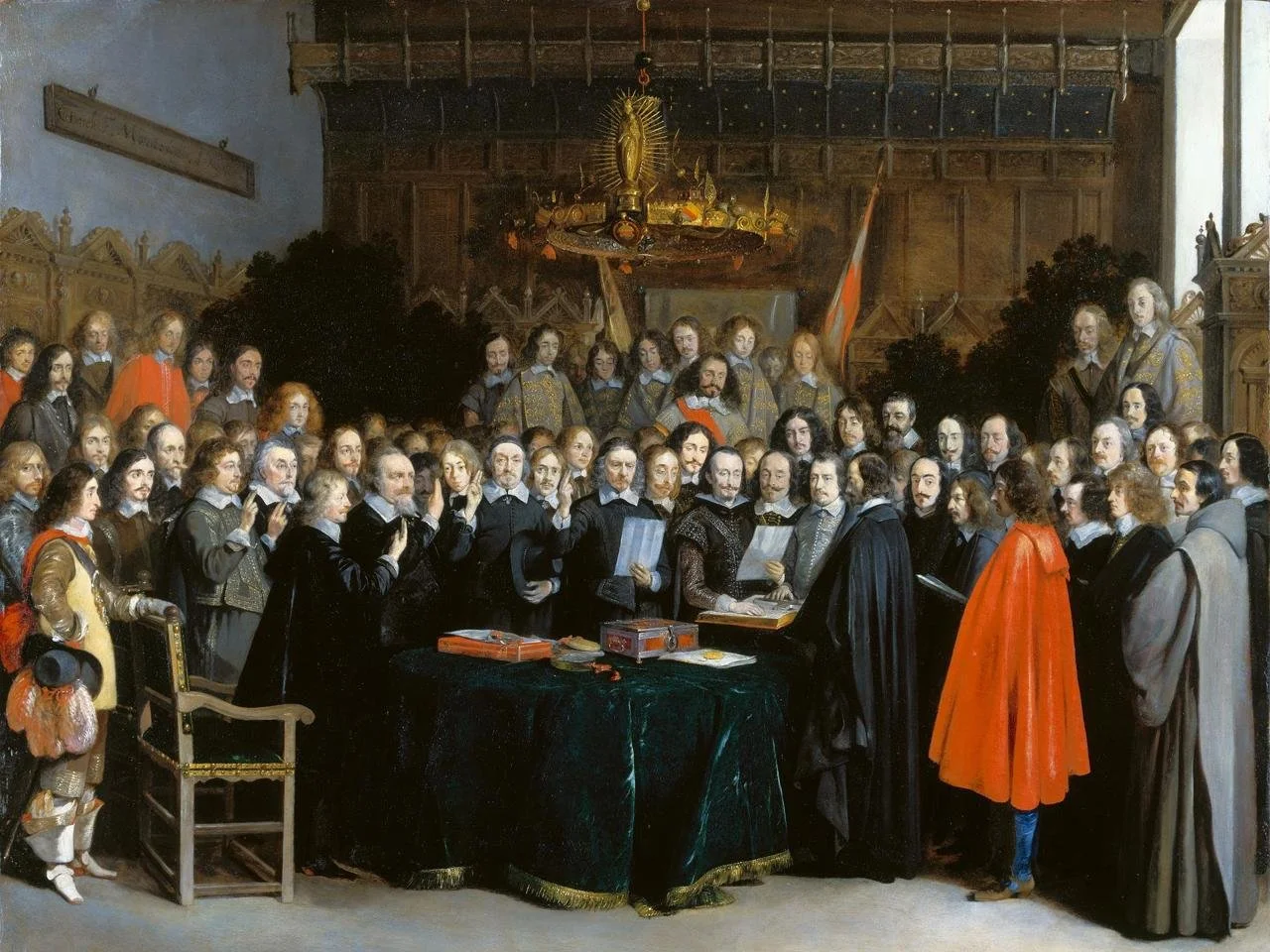
Ask any student of international relations to name the birthday of the modern world, and most will answer without hesitation: 1648. That is the year two treaties, signed in the Westphalian towns of Münster and Osnabrück, supposedly ended the age of empires and popes and inaugurated the age of sovereign states, each equal before the law, each master of its own house, none entitled to meddle in another's affairs. Political science textbooks call this the Westphalian system. Diplomats reach for the word Westphalian whenever they want a policy to sound grounded in centuries rather than decades. Realist theorists treat it as the founding constitution of world politics, the moment anarchy among formally equal states became the permanent condition of international life.
Almost none of it is true, at least not in the way it is usually told. The treaties of 1648 were real, the war they ended was catastrophic, and something did change in Europe afterward. But the claim that Westphalia created a system of sovereign nation-states in one stroke, that it marked a clean break from medieval hierarchy to modern equality, is largely a story international relations theorists told themselves in the twentieth century and then projected backward three hundred years. Historians who have actually read the treaties, and a determined handful have built careers doing exactly that, have spent the past few decades quietly dismantling the legend. What remains is a stranger and more interesting story than the one in the textbooks: not the birth of the modern state, but the story of how a discipline invented its own origin myth and then mistook the myth for history.
A War About Something Else
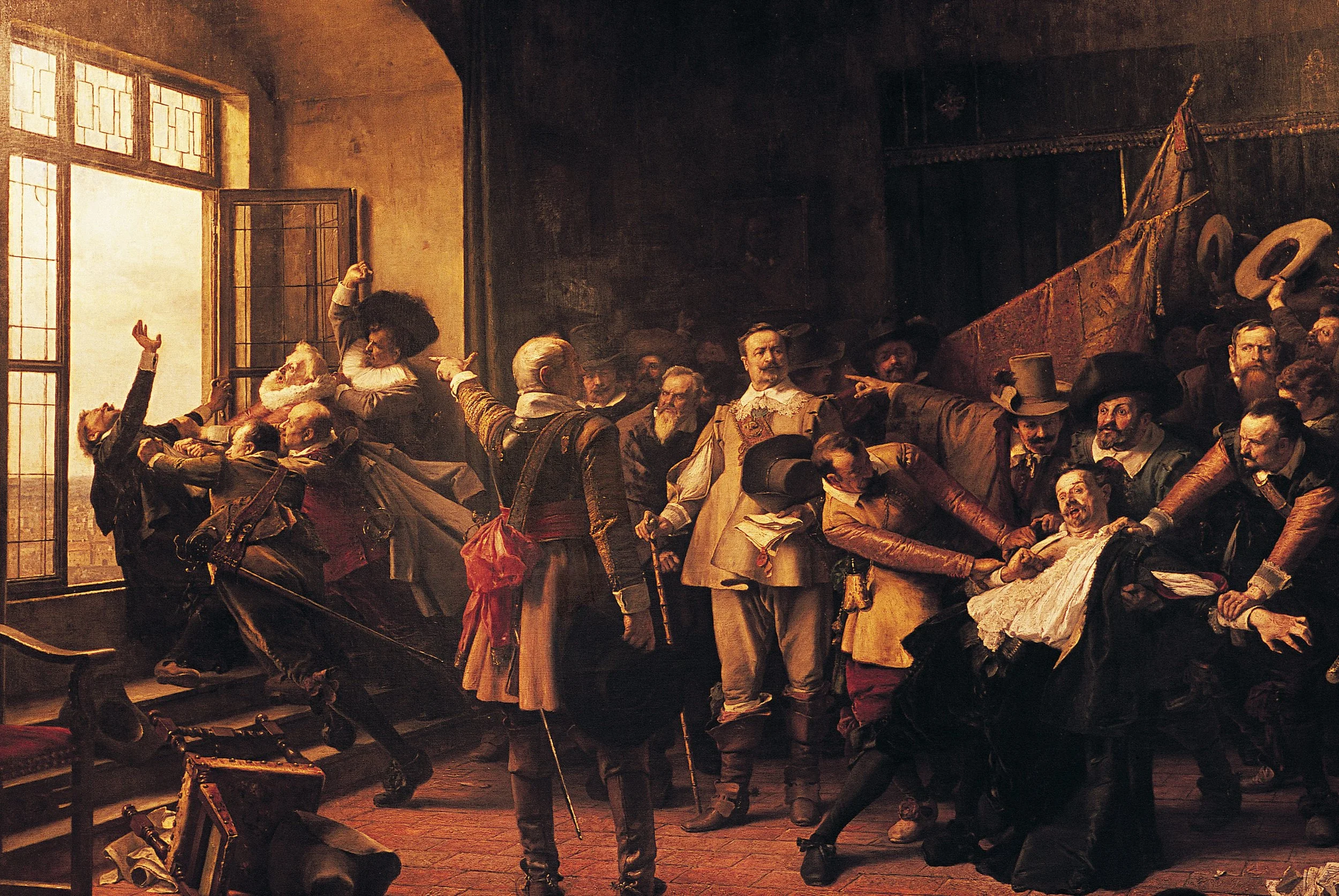
The conflict that Westphalia ended, the Thirty Years War, began in May 1618 with an act that sounds almost comic until the death toll is counted. A group of Protestant nobles in Prague marched into the royal castle, seized two Catholic officials of the crown along with their secretary, and threw all three out of a third-floor window. All three survived the fall, landing in what Catholic accounts later insisted was a providential pile of manure, but the message was unmistakable. Bohemia's Protestant estates were rejecting the authority of their Habsburg king, and within a year the local revolt had grown into a continental war.
Its fuel was the slow collapse of a religious settlement reached decades earlier. In 1555 the Peace of Augsburg had tried to freeze the German lands into two recognized camps, Lutheran and Catholic, under the principle that the religion of a ruler determined the religion of his territory. It said nothing about Calvinists, whose numbers grew regardless, and it rested on a balance of power that the ambitions of the Habsburg emperors kept disturbing. By the time Sweden, Denmark, France, and Spain had all been drawn into the fighting, the war had stopped being a purely religious quarrel and become a contest over whether the Habsburg dynasty, whose Austrian branch held the imperial crown and whose Spanish branch ruled an empire stretching from the Netherlands to the Americas, would be allowed to dominate the continent. Historians describe the coalition that opposed the Habsburgs as a mix of Protestant princes defending their faith and Catholic France defending its own interests against a rival dynasty, an alliance of convenience dressed in the language of religious liberty.
The fighting moved through distinct phases as each new power entered looking for advantage or fearing the alternative. Denmark intervened on the Protestant side in the 1620s and was beaten back. Sweden entered in 1630 under Gustavus Adolphus, whose early victories briefly threatened to remake the Empire's religious balance until his death in battle at Lützen in 1632. France, though officially Catholic, joined openly against the Habsburgs in 1635, less from religious conviction than from Cardinal Richelieu's calculation that a weakened Habsburg dynasty served French interests more than a united Catholic front ever could. By the war's final decade, it had long since stopped resembling a contest between faiths and become a struggle over the balance of power in Europe, conducted in religious vocabulary that increasingly few of the participants still believed.
The human cost was staggering by any standard, let alone that of the seventeenth century. Historical demographers estimate that somewhere between four and eight million soldiers and civilians died from combat, famine, and the disease that trailed every army through the countryside, and parts of the German lands lost more than half their population. Some regions did not recover their prewar numbers for a century.
What the Treaties Actually Say
Talks to end the war stretched back to the early 1640s and dragged on for years, in part because the Catholic and Protestant delegations refused to sit in the same room, splitting the negotiations between two neighboring towns. The result was not one treaty but two, the Treaty of Osnabrück between the Emperor and Sweden and the Treaty of Münster between the Emperor and France, both finalized on the same day, October 24, 1648. A separate agreement signed that January had already recognized the independence of the Dutch Republic from Spain after eighty years of war, and the treaties confirmed the Swiss Confederation's independence from the Empire as well.
What the treaties actually accomplished was narrower and more technical than the legend suggests. They confirmed the religious settlement of 1555 and extended it to cover Calvinists. They restored territory and rank to princes who had lost both during the fighting. And they granted the roughly three hundred territorial rulers inside the Holy Roman Empire, its electors, dukes, bishops, and free cities, a broader and more secure version of the right to govern their own lands, tax their own subjects, and enter alliances with foreign powers, provided those alliances were not aimed against the Emperor or the Empire itself.
Here is the detail that rarely survives the textbook version. Read the Latin text of the treaties themselves and the word sovereignty does not appear, not as suprema potestas, not as majestas, not in any of the terms seventeenth-century jurists used for supreme and unconditional authority. The drafters chose instead a more modest and more precise phrase, ius territoriale, territorial right, language that deliberately preserved the legal subordination of the princes to the imperial structure above them. Specialists in the history of international law have made the point directly: this was not an oversight. The negotiators at Münster and Osnabrück knew exactly what they were doing, and what they were doing was not creating a continent of independent equals. They were reorganizing the internal chain of authority within an empire that continued to exist.
An Empire That Refused to Die
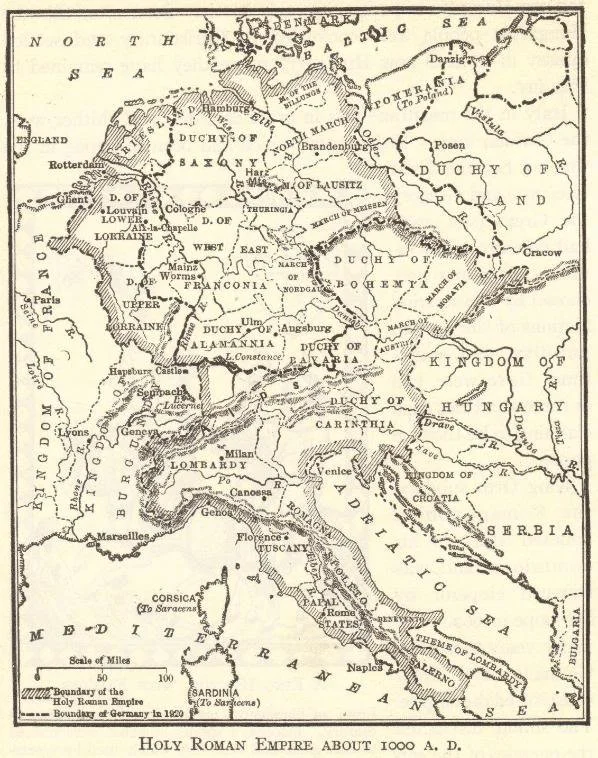
If Westphalia had truly established a Europe of sovereign states, the single largest bloc of territory in the continent's center would have become one, or several. Instead the Holy Roman Empire carried on, an unwieldy structure of prince-bishoprics, free cities, and lay territories bound to an elected emperor, for another hundred and fifty-eight years. It survived the wars of Louis XIV, the rise of Prussia as a great power, and most of the Enlightenment. It only came apart in 1806, when Napoleon's victory at Austerlitz stripped Emperor Francis II of any remaining leverage over the German princes and a group of them formed the French-aligned Confederation of the Rhine. Francis abdicated the imperial title that August, and the empire that Westphalia had supposedly buried a century and a half earlier simply dissolved, without a war, almost without ceremony.
That timeline alone should give the standard story pause. A settlement said to have inaugurated the sovereign state system in 1648 left its largest, least sovereign political structure standing until Napoleon happened to be marching through the neighborhood. Whatever changed at Westphalia, a tidy transition to modern statehood was not it.
Manufacturing a Myth
If the treaties themselves do not support the legend, where did the legend come from? The answer, according to a cluster of historians and international relations scholars who began pressing the question seriously from the 1990s onward, is that it came from the twentieth century, not the seventeenth.
The clearest marker is an essay published in 1948 by the international lawyer Leo Gross, timed to the three hundredth anniversary of the peace, arguing that Westphalia had established the constitutional framework of the modern international order. Gross wrote at a moment when the discipline of international relations badly needed an origin story. The League of Nations had failed, a second world war had just ended, the United Nations was newly built, and decolonization was about to multiply the number of nominally sovereign states many times over. A field trying to explain and stabilize this new world reached back three centuries and found, in Westphalia, a founding moment that felt suitably grand and suitably old. Tellingly, when the 350th anniversary arrived in 1998, historians marked it with conferences and new research, while the discipline of international relations, the very field that treats 1648 as its own point of origin, largely let the date pass unremarked.
The political scientist Andreas Osiander made the fullest case against the Gross reading in a landmark 2001 article in the journal International Organization. Osiander argued that the popular image of Westphalia, a war between a hierarchical, universalist Habsburg empire and freedom-loving sovereign states, descends less from the historical record than from seventeenth-century anti-Habsburg propaganda, dusted off and repackaged by international relations theorists three centuries later. He called the whole apparatus an ideology of sovereignty, a retrospective invention that let the discipline judge the present against a past that was, in his own phrase, largely imaginary. The irony he pointed to is sharp. Scholars had spent decades measuring how far the world had supposedly drifted from a Westphalian order that never existed in the form they imagined it.
The historian Benno Teschke pushed the critique further in a 2003 book that won the Isaac and Tamara Deutscher Memorial Prize the same year it appeared. Teschke's argument, built on a framework borrowed from the historian Robert Brenner, is that 1648 amounts to what he calls a false caesura. The forces actually shaping relations between European polities, in his account, were not treaties but the underlying property relations of dynastic, agrarian societies, and those relations did not change in any fundamental way at Westphalia. The rulers who signed the treaties remained absolutist monarchs governing through inherited right, not modern states governing through impersonal law. For Teschke, the genuine transformation had to wait for the displacement of dynastic rule by capitalist states, a process still unfolding well after 1789 and, in parts of Europe, considerably later than that.
A third strand of the critique comes from Stephen Krasner, whose 1999 book Sovereignty: Organized Hypocrisy approaches the problem from a different angle entirely. Krasner cares less about what happened in 1648 than about what has happened ever since, and his answer is that the norm of sovereignty, in whichever form, has been violated constantly by the very states that claim to uphold it. He separates international legal sovereignty, the mutual recognition of states as juridically independent, from what he specifically labels Westphalian sovereignty, the principle that no outside authority may operate inside a state's own borders. Both, he shows through cases spanning minority rights treaties and great power interventions across two centuries, have been honored selectively and abandoned whenever convenient. If sovereignty has always been organized hypocrisy, locating its clean birth in a single peace conference misreads what sovereignty has ever actually been.
Why a Debunked Story Keeps Working
None of this scholarship has dislodged Westphalia from its place in the textbooks, and it is worth asking why. Part of the answer is pedagogical convenience. Teaching international relations without an origin point is harder than teaching it with one, and 1648 offers a clean date, a resonant place name, and a satisfying before and after. Part of the answer is institutional. Language in the United Nations Charter on the sovereign equality of states, and its limits on outside interference in a state's domestic affairs, draws real rhetorical force from sounding like it carries three centuries of history behind it rather than eight decades.
The myth is also useful to opposing sides of the same argument, which may be the best evidence that it functions as myth rather than fact. Governments resisting outside pressure over their internal affairs invoke Westphalian sovereignty as an old and nearly sacred principle. Advocates of humanitarian intervention and the doctrine known as the Responsibility to Protect argue just as confidently that a Westphalian order is eroding or already obsolete, which assumes an equally solid starting point against which erosion could even be measured. Both camps borrow the same origin story to argue toward opposite conclusions, which suggests the story is doing rhetorical work that the treaties of 1648 were never built to do.
What the Myth Teaches
There is a broader lesson here that outlasts any single peace conference. In 1983 the historians Eric Hobsbawm and Terence Ranger published an influential collection of essays showing how much of what nations and institutions treat as ancient custom, from Scottish tartans to the pageantry surrounding the British monarchy, was invented far more recently than anyone assumed, and invented precisely to give a new arrangement the borrowed authority of old age. Westphalia belongs on that list. It is not a fabrication in the sense that the treaties never happened. It is an invented tradition in the sense that the meaning attached to those treaties, the idea that they founded the sovereign state as it is now understood, was constructed long afterward by people who needed a usable past for a project of their own century.
None of this makes the actual Peace of Westphalia unimportant. It ended one of the most destructive wars in European history, it widened religious toleration, and it did shift real authority toward the princes of the Empire, even though the treaties were careful never to call that authority sovereign. What it did not do is create, in a single stroke, the world of equal, independent nation-states that later generations needed it to have created. That world took another two and a half centuries to arrive, assembled not at a negotiating table in Westphalia but through the slow, uneven, and often violent displacement of dynastic empires by something recognizably modern.
The next time 1648 comes up as the year the modern state was born, it is worth asking which century is actually being described: the seventeenth, where princes secured a more defined place inside an empire that still had another hundred and fifty-eight years left to run, or the twentieth, where a discipline in need of a founding myth reached backward and found one conveniently waiting.
References
Osiander, Andreas. "Sovereignty, International Relations, and the Westphalian Myth." International Organization 55, no. 2 (2001): 251-287.
Teschke, Benno. The Myth of 1648: Class, Geopolitics, and the Making of Modern International Relations. London and New York: Verso, 2003.
Krasner, Stephen D. Sovereignty: Organized Hypocrisy. Princeton: Princeton University Press, 1999.
Gross, Leo. "The Peace of Westphalia, 1648-1948." American Journal of International Law 42, no. 1 (1948): 20-41.
Hobsbawm, Eric, and Terence Ranger, eds. The Invention of Tradition. Cambridge: Cambridge University Press, 1983.
Encyclopaedia Britannica, s.v. "Peace of Westphalia,".
Max Planck Encyclopedia of Public International Law, s.v. "Westphalia, Peace of, 1648," Oxford Public International Law.
About the Author
Ankita Banerjee is a B.S.–M.S. student in Computer Science and Data Analytics at the Indian Institute of Technology (IIT) Patna. Her technical research spans drone guidance systems, artificial intelligence, and digital infrastructure, while her academic interests extend to the study of ancient Indian knowledge systems and their relevance to contemporary political thought and statecraft.
She has presented research at institutions including the Indian Statistical Institute, Central Sanskrit University (Jaipur), and the Central University of Gujarat. She also holds an IKS Educator Certificate from Madras Sanskrit College.
Through her writing, Ankita critically examines the assumptions of Western-centric political theory and seeks to reinterpret classical Indian texts within their own intellectual and civilizational context, highlighting their continuing relevance for modern debates on governance, ethics, and statecraft.