
The Birth of Bangladesh: Genocide, Great Power Politics,and the War That Redrew Indian Sub-Continent
written by Ankita Banerjee
edited by itiha
On the morning of 16 December 1971, a crowd packed the Ramna Race Course in Dhaka to watch two generals sign a single sheet of paper. Lieutenant General A. A. K. Niazi, commanding what remained of Pakistan's Eastern Command, set his signature beside that of Lieutenant General Jagjit Singh Aurora of the Indian Army. Within the hour, roughly 93,000 Pakistani soldiers and officials became prisoners of war, the largest military surrender anywhere since the end of the Second World War. East Pakistan, a province that had existed for less than a quarter century, ceased to exist. In its place stood a new nation, Bangladesh, born out of nine months of massacre, mass flight, and a war that lasted barely two weeks yet pulled in Washington, Moscow, and Beijing almost as directly as it pulled in Delhi and Islamabad. The easy version of 1971 treats it as a regional story: a civil war inside Pakistan that India eventually settled by force. That version is not false, but it leaves out most of what makes the episode worth studying today, more than fifty years later. Read the declassified cables, the memoirs, and the historical record scholars have pieced together since, and a larger, more uncomfortable picture emerges, one in which a humanitarian catastrophe in the Bengal delta became entangled with the secret opening of relations between the United States and China, a treaty binding India to the Soviet Union, and an American foreign policy establishment that knew what was happening on the ground and chose, for reasons entirely its own, to look away. Few episodes of the twentieth century show as clearly how great powers weigh human suffering against strategic advantage, and how often the second consideration wins.

Lt. Gen. A. A. K. Niazi of the Pakistan Army signing the Instrument of Surrender under the direction of Lt. Gen. Jagjit Singh Aurora of the Indian Army and Bangladesh Forces
A Country Split by a Thousand Miles
Pakistan was, from its founding in 1947, a geographic improbability. Its two wings, West Pakistan and East Pakistan (formerly East Bengal), lay on opposite sides of the Indian subcontinent, separated by well over a thousand kilometres of Indian territory. The two halves shared little beyond a common religion. East Pakistan held the majority of the country's population and, through its jute exports, a large share of its foreign earnings, yet it received a distinctly smaller share of state investment, civil service appointments, and senior military posts. Bengali, the language of the east, was treated by the Urdu speaking establishment in the west as distinctly secondary. When the central government tried to impose Urdu as Pakistan's sole national language in 1952, student protests in Dhaka were met with police gunfire, and the anniversary, 21 February, is still observed in Bangladesh as Language Martyrs' Day.
By the mid-1960s, these grievances had found an organised political voice. Sheikh Mujibur Rahman, leader of the Awami League, built a movement around a Six Point Programme that called for East Pakistani autonomy in everything except defence and foreign affairs. To the generals and civil servants who actually ran Pakistan, the six points looked less like a bargaining position than a blueprint for the country's breakup, and they treated it accordingly. That mutual suspicion, more than any single event, shaped everything that followed.
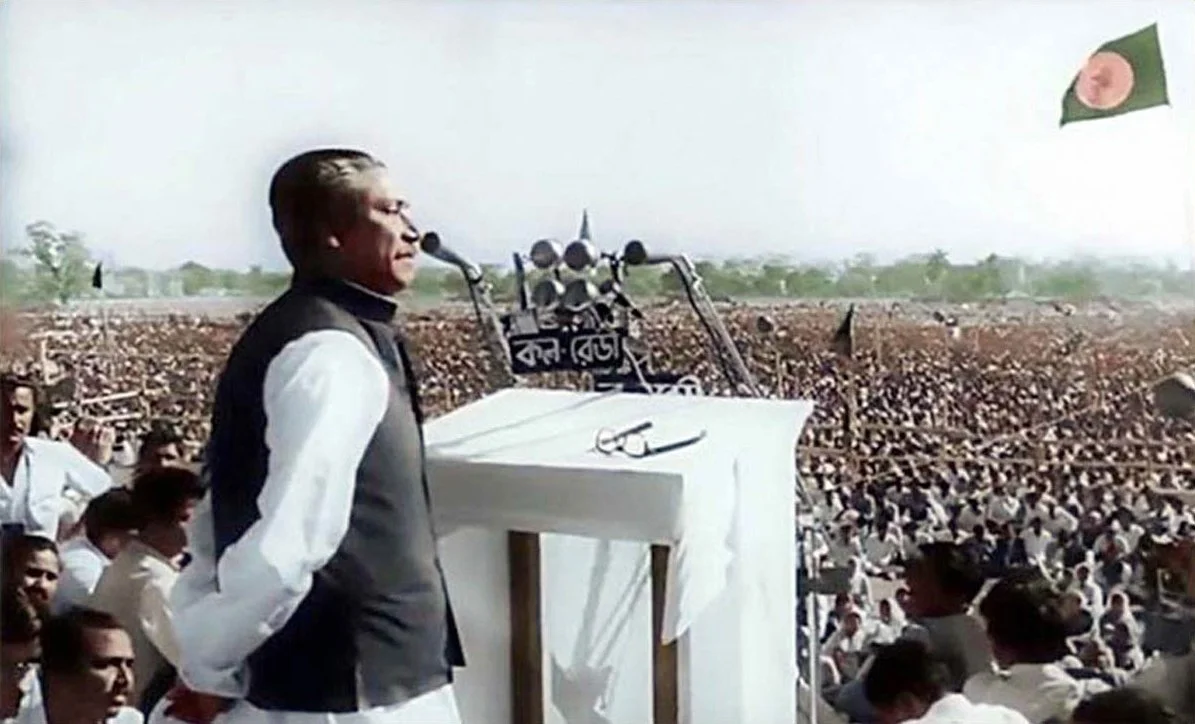
Mujibur Rahman 7th March Speech Race Course Maidan
An Election Nobody Was Allowed to Win
Pakistan finally held its first general election on the basis of one adult, one vote on 7 December 1970. The result was decisive: the Awami League took 160 of East Pakistan's 162 contested seats and, once reserved seats were added, 167 of the 313 seats in the National Assembly, an outright majority for the country as a whole. Zulfiqar Ali Bhutto's Pakistan People's Party ran a distant second, dominant in parts of the west but without a single seat in the east. By any conventional parliamentary arithmetic, Mujib should have become Pakistan's next prime minister. Instead, President Yahya Khan, the general who had promised the vote in the first place, kept delaying the opening of the new assembly, while Bhutto refused to sit in an assembly he did not control.
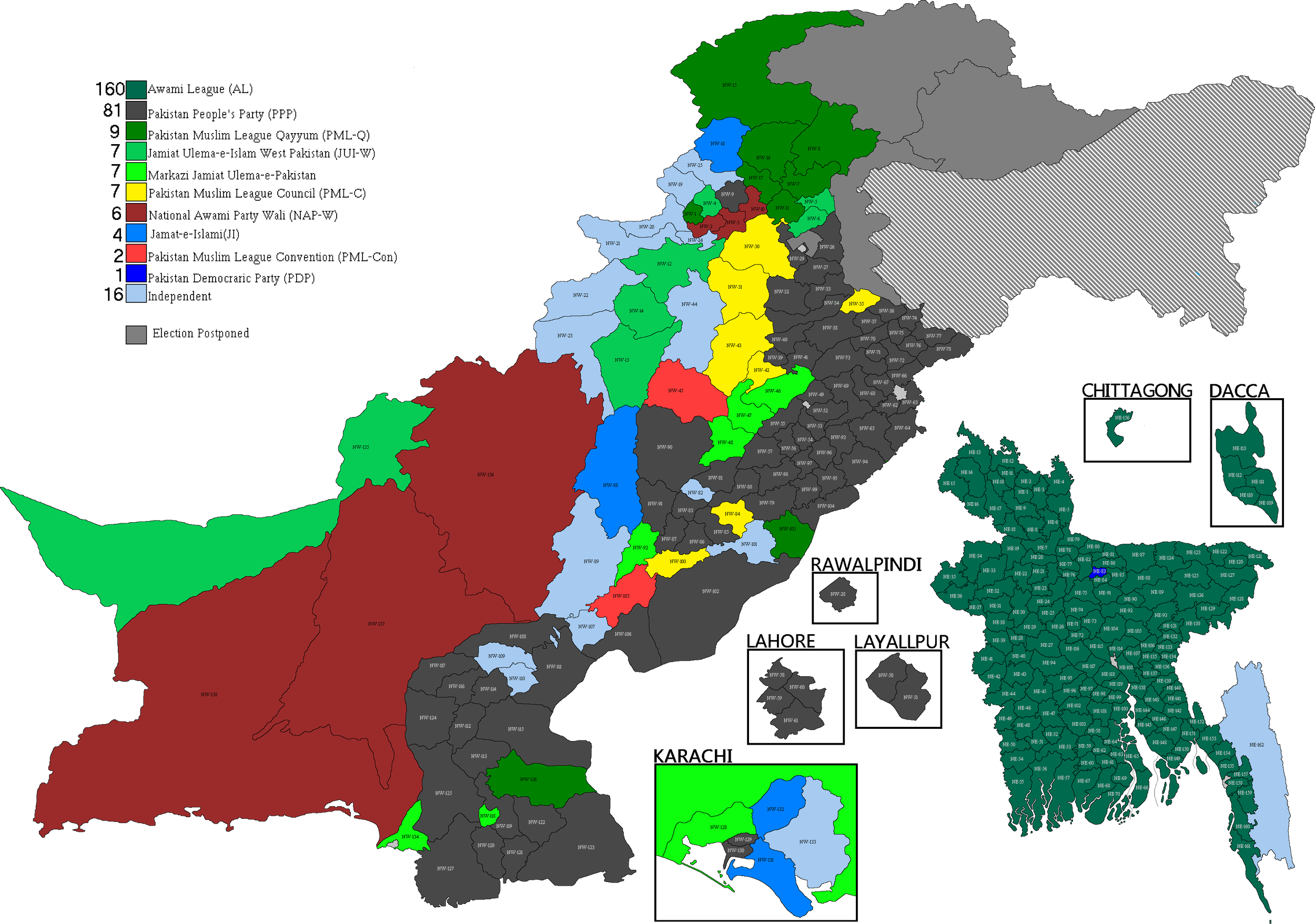
Map of Pakistan Showing National Assembly Constituencies and winning Parties. Awami League Awami League took 160 of East Pakistan's 162.
Negotiations dragged on through March 1971, even as, without Mujib's knowledge, Pakistani troops and equipment were already being flown into Dhaka in civilian clothing and shipped in through Chittagong under cover of the talks. One vessel alone, the MV Swat, delivered some seven thousand tonnes of ammunition to the port in the weeks before the crackdown.
Operation Searchlight
The military plan carried the codename Operation Searchlight, and its purpose was simple: arrest or kill the Awami League leadership, disarm Bengali units within the police and paramilitary forces, and crush the independence movement before it could organise a response. Lieutenant General Tikka Khan, who took command of the Eastern operation, is reported to have told a colleague beforehand, "I don't need people, just the soil." The crackdown began after nightfall on 25 March 1971. Troops moved on Dhaka University, on newspaper offices, on police barracks, and on Hindu neighbourhoods in particular, in an operation that continued in one form or another for weeks afterward. How many died over the following nine months is a question this article returns to, since the honest answer is less settled than most accounts admit, but even cautious estimates describe killing on a scale that appalled the foreign diplomats sent to report on it. By November, close to ten million refugees, most of them Hindu, had crossed into India, the largest single refugee movement the world had seen since 1945.
The Cable Washington Tried to Ignore
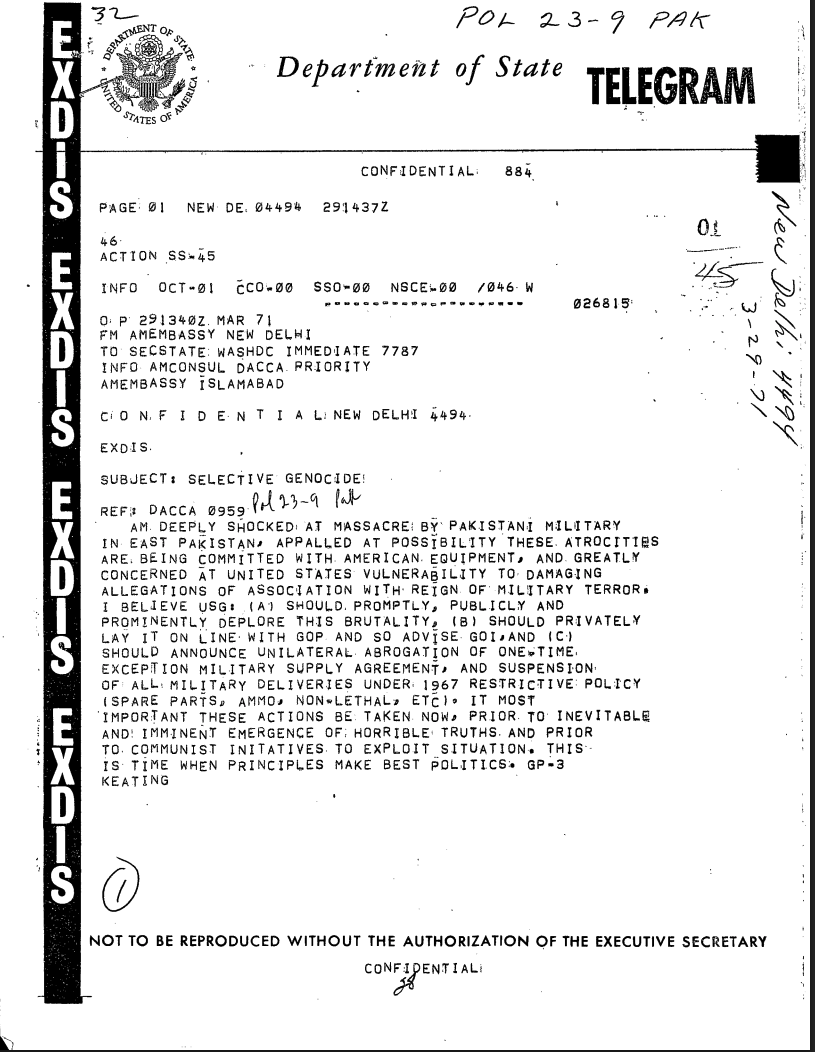
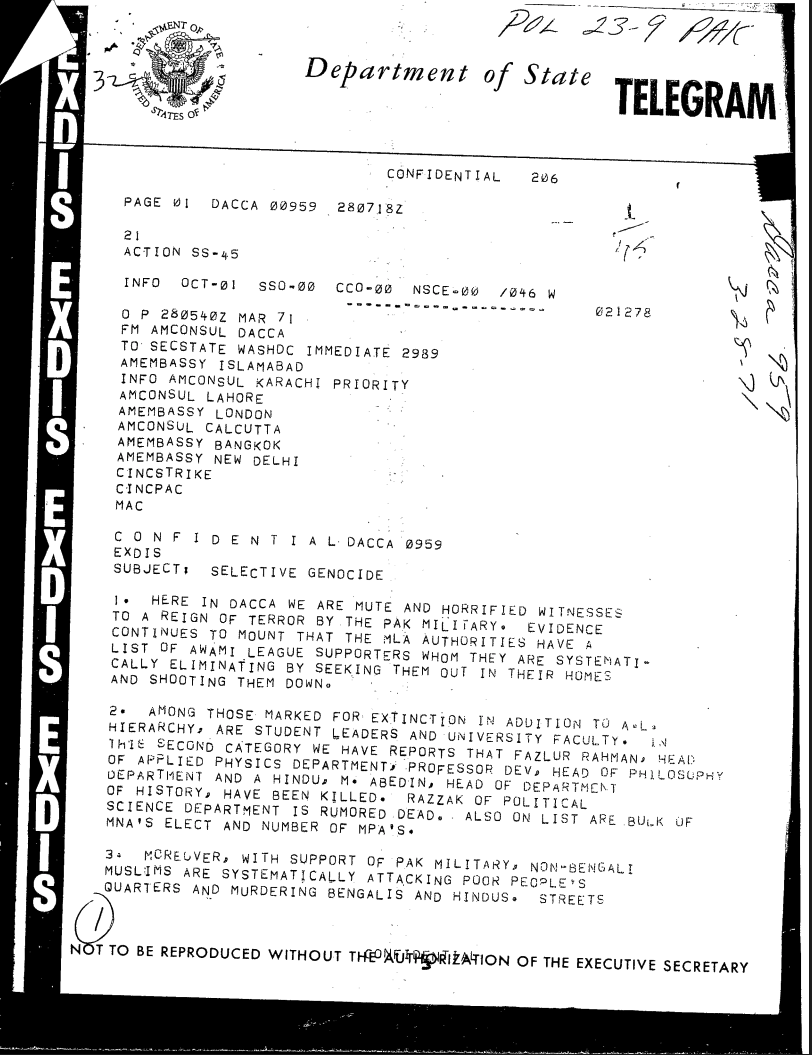
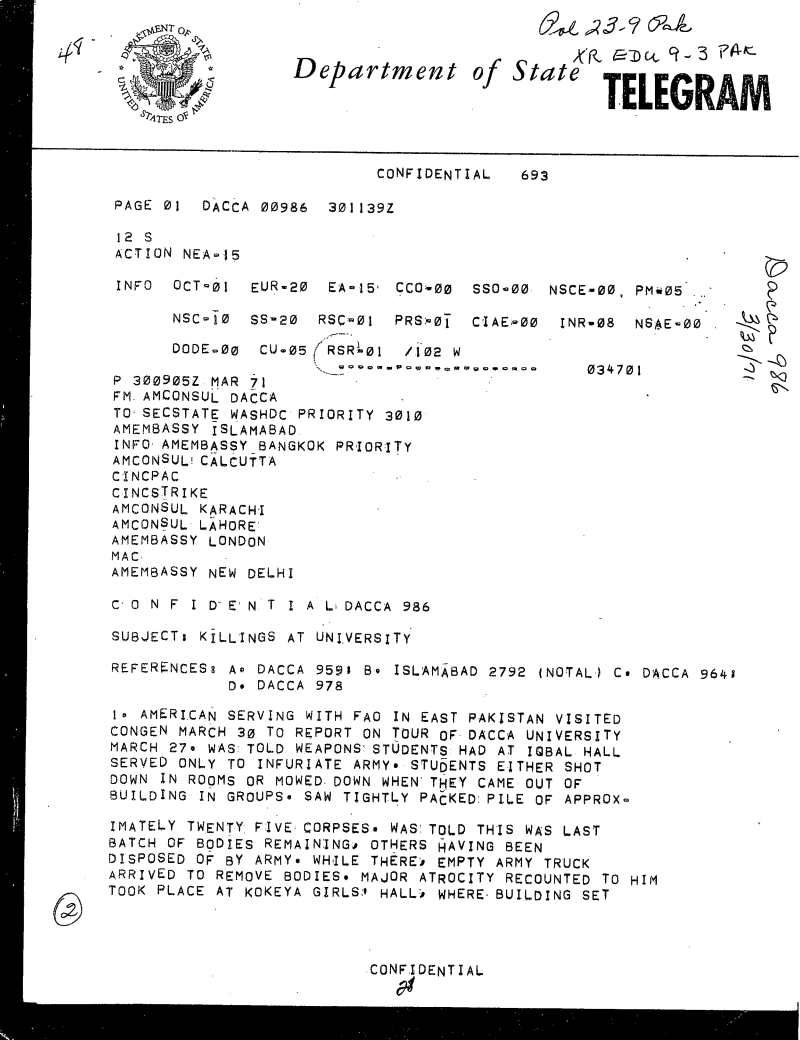
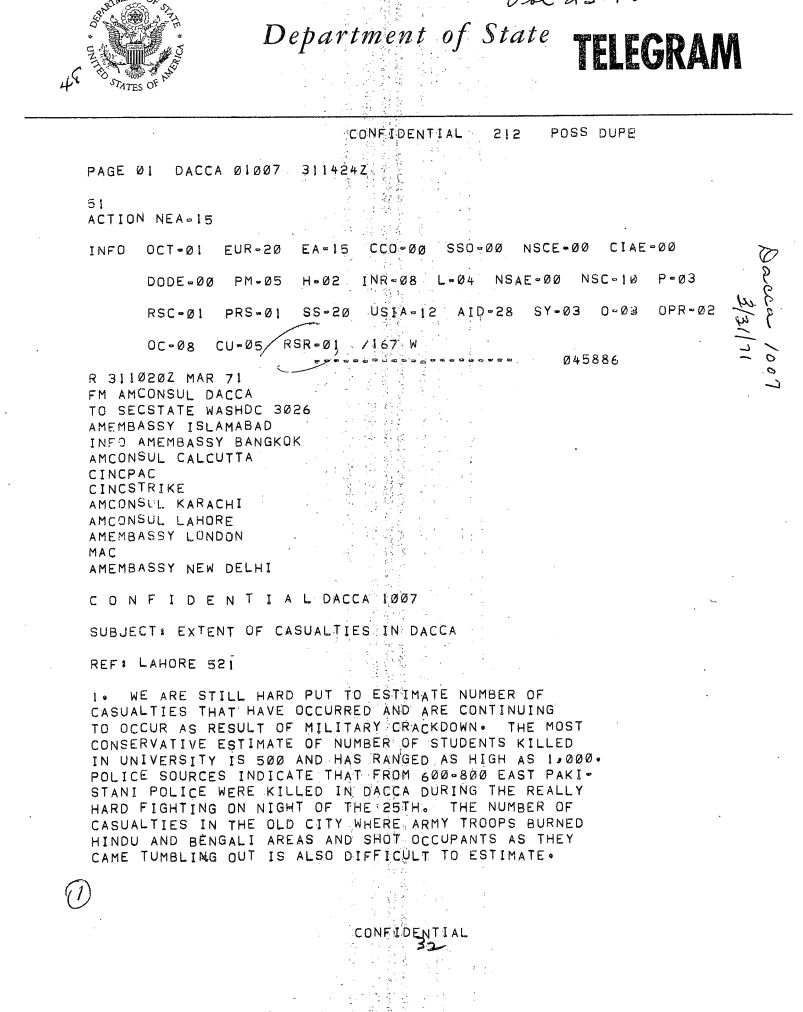
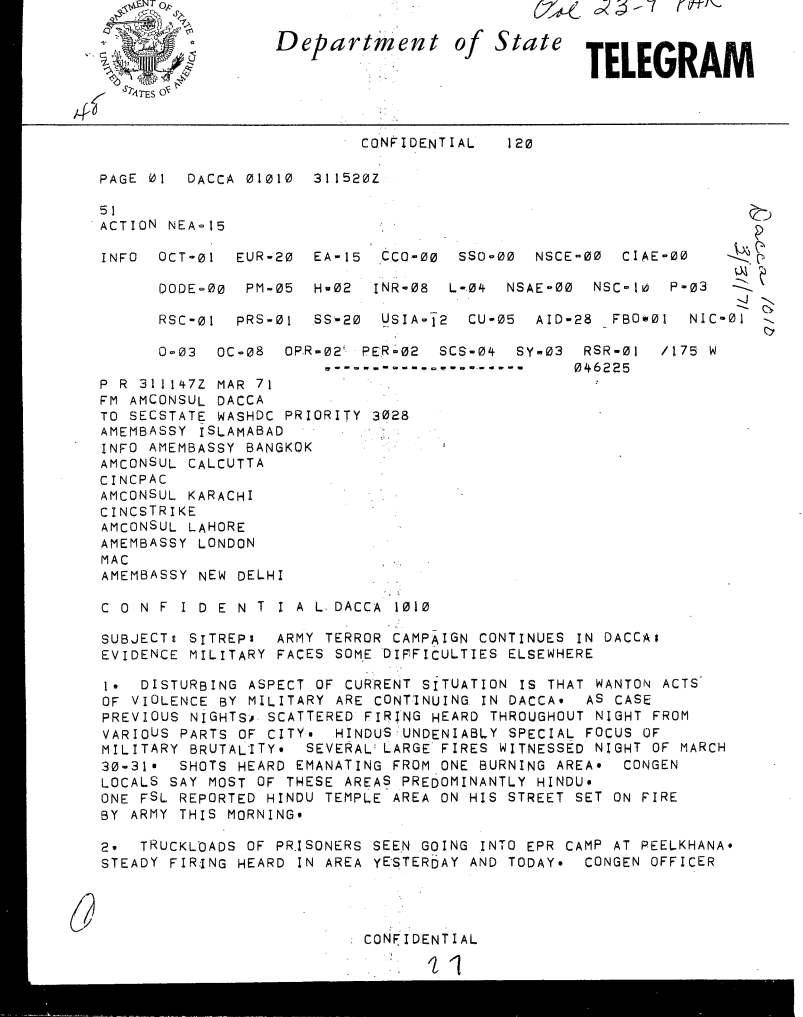
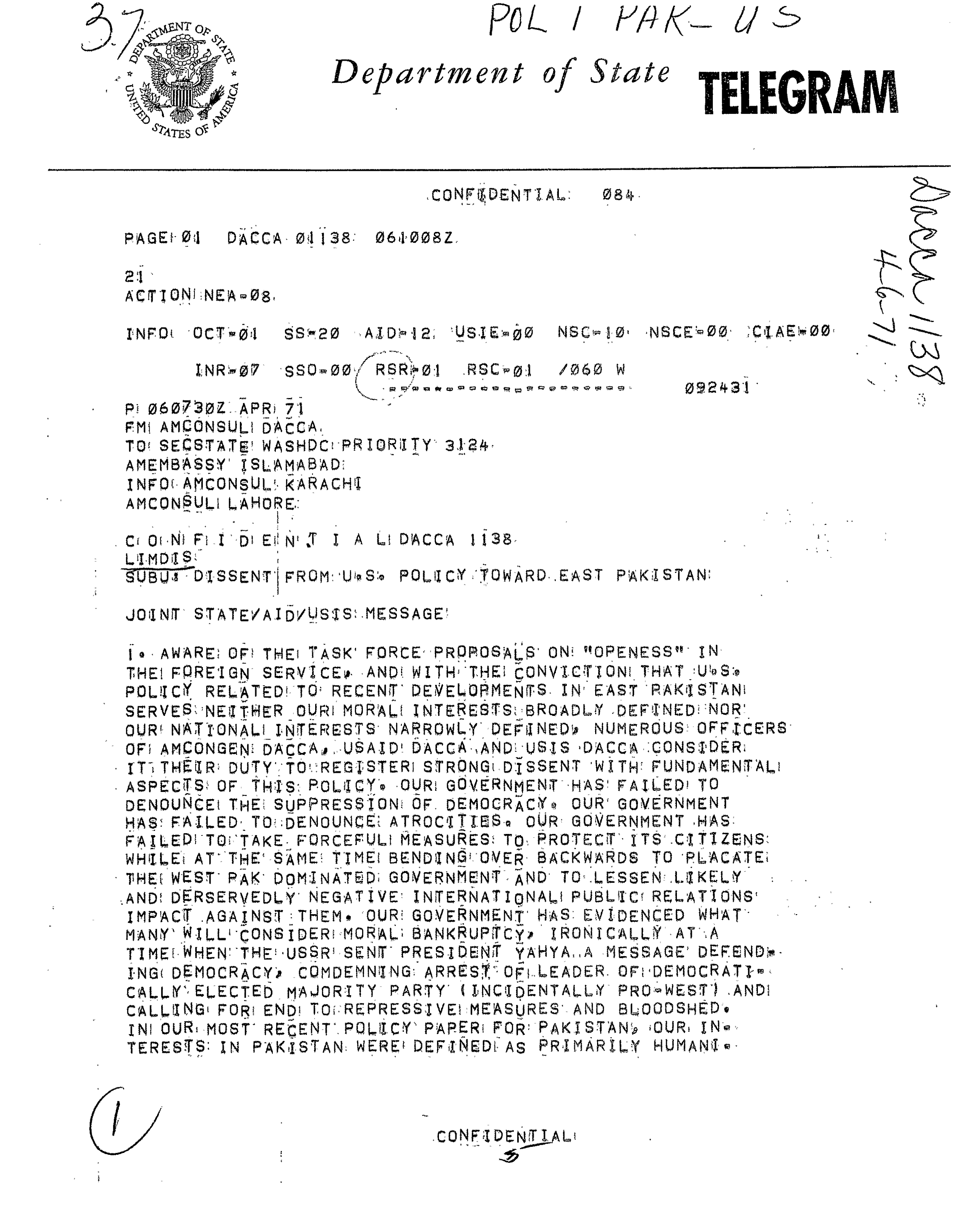
Among the diplomats watching this unfold was Archer Blood, the American consul general in Dhaka. Blood and his staff had been cabling Washington throughout the crackdown, describing exactly what they were witnessing. When the Nixon administration's response amounted to near total silence, Blood took an extraordinary step. On 6 April 1971 he endorsed a formal dissent cable, signed by twenty of his own officers, accusing the United States government of failing to condemn either the killing or the destruction of an elected government's mandate. It became known simply as the Blood Telegram, and it still stands as one of the bluntest rebukes any groupof American diplomats has sent to its own government. Henry Kissinger's private reaction, later captured on the White House taping system, was pure contempt. He referred to Blood as "this maniac in Dhaka" and had him pulled from his post within weeks, effectively ending his career for a decade. The dismissal had little to do with whether Blood's reporting was accurate. It had everything to do with what the Nixon White House needed from Pakistan just then, and that need had nothing to do with the suffering in East Bengal.
Kissinger's Secret Flight and the Price of Silence
For two years, Pakistan had quietly served as the intermediary through which Washington and Beijing tested the possibility of ending more than two decades of mutual isolation. In July 1971, that discreet diplomacy reached its climax. Kissinger arrived in Islamabad on a publicly announced tour ofAsia, then complained of a stomach ailment and retreated to the hill station of Nathiagalito recover, or so the official story went. In the early hours of 9 July, he was in fact driven to a military airfield and flown to Beijing under the codename Polo for two days of talks with Premier Zhou Enlai, arranged entirely through Yahya Khan's government. He arrived in such a hurry that he had forgotten a change of clothes and had to borrow a shirt from an aide six inches taller than himself. The trip produced the framework for Richard Nixon's own visit to China the following February, arguably the single most consequential piece of American diplomacy of the entire Cold War. The timing was no coincidence. Yahya Khan was, at that very moment, the general overseeing the Bengal crackdown, and he was also indispensable to the China opening. Shielding him from international censure, and protecting the secrecy of the Beijing channel itself, gave Washington every incentive to downplay what its own diplomats were calling genocide. When Kissinger and Zhou discussed South Asia during their Beijing meetings, both men treated India, rather than the Pakistani army, as the destabilising force in the region. Realpolitik had made its choice, and Bengali civilians paid the price of it.
Delhi Turns to Moscow
India watched the Kissinger visit and its aftermath with genuine alarm. An American tilt toward Pakistan, now reinforced by an emerging working relationship between Washington and Beijing, raised the prospect of India facing a hostile grouping on almost every side. Prime Minister Indira Gandhi, who had until then kept some distance from Moscow out of deference to India's official Non-Alignment, changed course. On 9 August 1971, Foreign Minister Swaran Singh and his Soviet counterpart Andrei Gromyko signed the Indo-Soviet Treaty of Peace, Friendshipand Cooperation in New Delhi, under which each side agreed to consult the other immediately in the event of an attack or the threat of one. The treaty stopped short of a formal military alliance, but nobody in Delhior Islamabad mistook its meaning, and domestic critics in India understood it just as clearly. Opposition leaderAtal BihariVajpayee condemned it as "a Soviet stab in the Indian back." Whatever one made of it politically, the treaty secured something India would need in the months ahead: assurance that neither Washington nor Beijing was likely to intervene militarily if war came, and a patron willing to run interference at the United Nations.
Thirteen Days in December
That patronage mattered most once the shooting started. When Pakistan launched preemptive air strikes on Indian air bases on 3 December, under the codename Operation Chengiz Khan, India declared war the same day and pushed into East Pakistan on multiple fronts alongside Mukti Bahini guerrillas. As the United States pressed the Security Council for an immediate ceasefire that would have frozen the fighting with Pakistaniforces still intact, the Soviet Union vetoed the American resolution three times within nine days, buying India the weeks it needed to finish the campaign it had started. The campaign itself moved with startling speed. Indian paratroopers seized river crossings ahead of the main advance, armoured columns bypassed fortified towns rather than waste time reducing them, and the Indian Air Force established control of the skies within days. By 12th December, Indian forces were closing in on Dhaka. Four days later, with the city surrounded and further resistance pointless, Niazi signed the instrument of surrender before Aurora at the Ramna Race Course, the scene with which this article began. The next day, Indira Gandhi rose in the Indian Parliament to declare, "Dhaka is now the free capital of a free country" and contemporary accounts describe the chamber, and the country beyond it, erupting in celebration.
What the Numbers Cannot Settle
Ask how many people died in 1971 and the honest answer is that nobody knows for certain, and the size of the disagreement is itself part of the history. Bangladesh's government has long cited a figure of three million dead, a number now fixed in national memory and marked every year on Genocide Day. Some independent researchers, working from more limited documentary evidence, have arrived at considerably lower totals, with estimates of deliberate killing running into the hundreds of thousands, alongside a further and substantial toll from disease, exposure, and hunger among the refugee population. Pakistani official accounts have historically minimised the violence or rejected the word genocide altogether. None of that uncertainty erases the facts that serious historians do not seriously dispute: a military crackdown targeted political leaders, students, and religious minorities in a deliberate and organised way; widespread sexual violence against women was documented at the time by observers on the ground and by the American diplomats writing home about it; and close to ten million people fled their homes within a matter of months. Where the record runs out is in converting those facts into one defensible number, and honest history has to sit with that gaprather than smooth it over with whichever figure best suits the argument being made.
Shimla and the Shape of a New South Asia
The story did not end with Niazi's signature. India was holding roughly 93,000 Pakistani prisoners of war and captured territory on the western front, leverage it carried into the negotiations that followed. On 2 July 1972, Indira Gandhi and Zulfiqar Ali Bhutto, by then Pakistan's president, signed the Simla Agreement at Barnes Court in Shimla, converting the wartime ceasefire line in Kashmir into what became the Line of Control and committing both governments to resolving future disputes bilaterally, without outside mediation. India returned the prisoners and the occupied territory in the months that followed, a decision many observers at the time considered remarkably generous given the scale of the victory that preceded it. The consequences of those nine months outlasted the agreement that closed them. Pakistan lost more than half its population and the eastern wing that had never sat comfortably within it, a loss that reshaped its military doctrine and its sense of itself for decades to come. India emerged as the unrivalled power in South Asia, a position it has not relinquished since. Bangladesh, born into violence and famine, spent its early years wrestling with the economic and political wreckage the war had left behind, wreckage that some historians believe made the country's later turbulence, including the assassination of Mujib himself in 1975, considerably more likely. There is a wider lesson here too, one that reaches well past the subcontinent. The Nixon administration knew, from the reports of its own people on the ground, that a government it was actively supporting was carrying out mass killing(refer De-Classified Diplomatic Cables attached in this article), and it chose silence because a separate strategic project mattered more to it. That is not a uniquely American failing, and it is not confined to 1971. It is closer to a recurring pattern in how great powers behave whenever moral clarity and strategic calculation point in different directions. Bangladesh exists today partly because a small group of American diplomats refused to stay quiet about that choice, even though the government they served did not listen to them until it was far too late to matter.
Sources and Further Reading
Gary J. Bass, The Blood Telegram: Nixon, Kissinger, and a Forgotten Genocide (New York: Knopf, 2013).
Srinath Raghavan, 1971: A Global History of the Creation of Bangladesh (Cambridge, MA: Harvard University Press, 2013).
Richard Sisson and Leo E. Rose, War and Secession: Pakistan, India, and the Creation of Bangladesh (Berkeley: University of California Press, 1990).
National Security Archive, George Washington University: declassified State Department cables and White House transcripts on the 1971 Bangladesh crisis.
United States Department of State, Office of the Historian, Foreign Relations of the United States, 1969 to 1976, Volume XI: South Asia Crisis, 1971.
UNHCR, The State of the World's Refugees 2000: Fifty Years of Humanitarian Action
(Oxford: Oxford University Press, 2000).
About the Author
Ankita Banerjee is a B.S.–M.S. student in Computer Science and Data Analytics at the Indian Institute of Technology (IIT) Patna. Her technical research spans drone guidance systems, artificial intelligence, and digital infrastructure, while her academic interests extend to the study of ancient Indian knowledge systems and their relevance to contemporary political thought and statecraft.
She has presented research at institutions including the Indian Statistical Institute, Central Sanskrit University (Jaipur), and the Central University of Gujarat. She also holds an IKS Educator Certificate from Madras Sanskrit College.
Through her writing, Ankita critically examines the assumptions of Western-centric political theory and seeks to reinterpret classical Indian texts within their own intellectual and civilizational context, highlighting their continuing relevance for modern debates on governance, ethics, and statecraft.