
Operation Tupac: an unending operation by Pakistan
Watch the full documentary on this topic here. Introduction
In December 1971, the Pakistan Army suffered a defeat so complete that it altered the strategic thinking of an entire generation of its officer corps. Ninety-three thousand soldiers surrendered to Indian forces and the Mukti Bahini in the space of thirteen days, the largest capitulation of an army since the Second World War. East Pakistan ceased to exist and became Bangladesh. For a military establishment that had built its identity around parity with India, the humiliation was total, and it demanded a response that conventional arms could no longer supply.
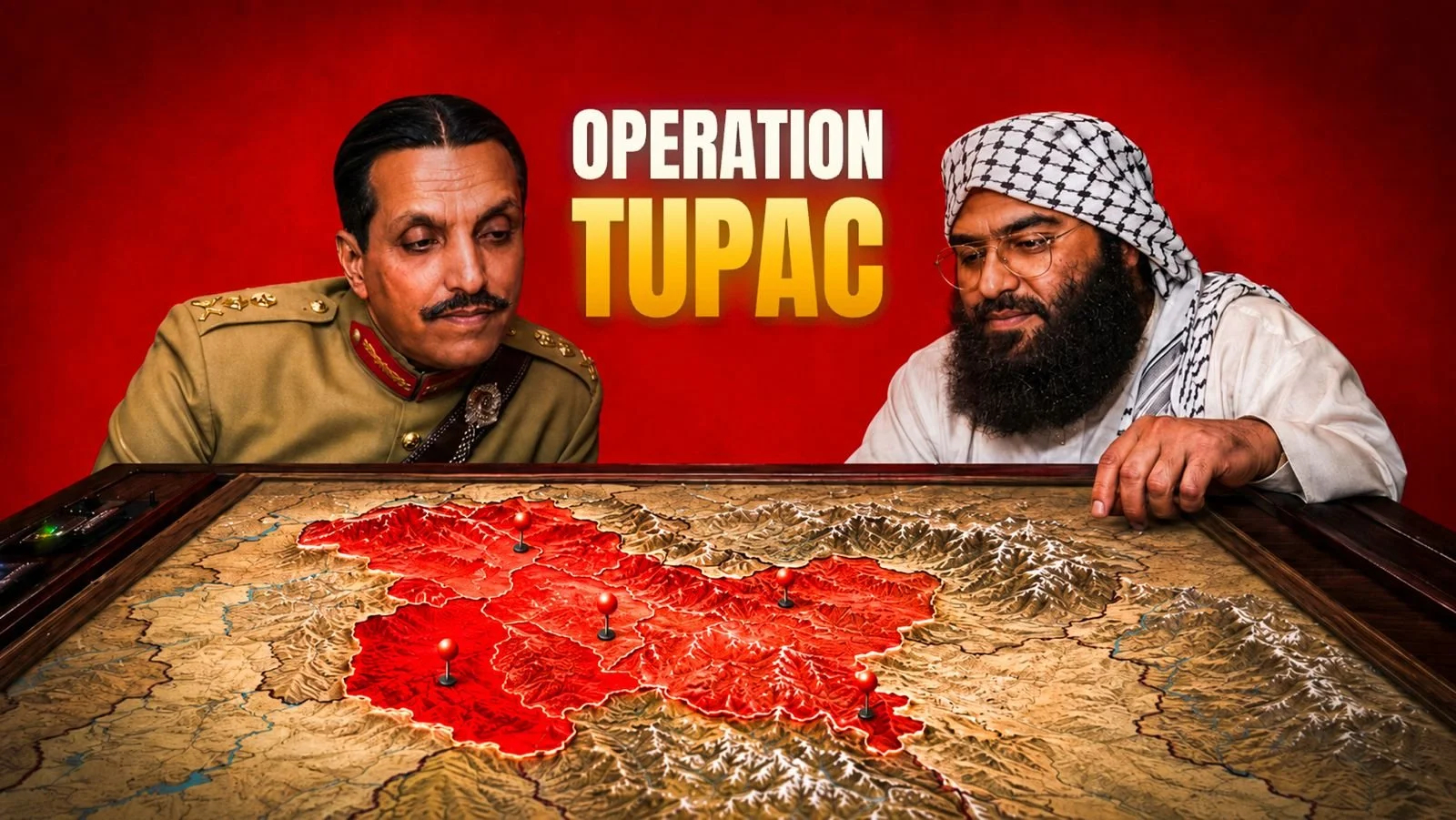
That response did not arrive immediately, and it did not arrive in the form of tanks or fighter jets. It arrived, over the following decade and a half, as a doctrine: since Pakistan could not defeat India on a battlefield, it would bleed the country through what strategists on both sides of the border came to call "a thousand cuts." The doctrine acquired an official shape in 1988, when President Muhammad Zia-ul-Haq is reported to have authorised the Inter-Services Intelligence directorate to launch a covert programme aimed at prising Jammu & Kashmir away from India. That programme became known as Operation Tupac (also transliterated as Topac or Topaz).
Decades later, Indian officials at the highest levels have spoken about it in public. National Security Adviser Ajit Doval has stated that Islamabad used the constitutional provisions of Article 370 to catalyse insurgency in the Kashmir Valley, and that the operating logic of the campaign borrowed directly from the tactics Pakistani-backed non-state actors had already perfected in Afghanistan. What follows is an account, drawn substantially from the book Terror Financing in Kashmir by Abhinav Pandey along with the writings of former R&AW chief Vikram Sood and a range of published reporting, of how that doctrine actually functioned, not as a single operation frozen in 1988, but as a living architecture that adapted itself across four decades, from AK-47s smuggled over mountain passes to disinformation seeded through smartphones.
The Punjab Rehearsal
Before a single militant crossed into Kashmir under ISI direction, Pakistan tested its low-cost insurgency model in Punjab. The aim was straightforward: cultivate disaffected Sikh youth around the demand for an independent Khalistan, tie down the Indian Army in internal security duties in a second front-line state, and erode the conventional superiority of a force that could otherwise be concentrated against Pakistan. It was, in essence, a pilot programme: proof that a state without the resources for open war could still generate strategic paralysis in its rival simply by keeping security forces occupied at home. When the Punjab insurgency was contained through the 1990s, the same institutional muscle memory was redirected toward Kashmir, this time with a much larger and more durable investment of money, training infrastructure, and ideological groundwork.
Capturing the Mainstream, Not Just the Militant
One of the more unsettling arguments running through this history is that Pakistan's proxy war in Kashmir was never fought exclusively through militants. According to the sourced material, an entire ecosystem, legitimate charities, financial institutions, sections of the media, and even mainstream politicians, became entangled with the insurgency over time, in some cases willingly and in others without full awareness of whose interests they were ultimately serving.
Accounts drawn from intelligence circles describe mainstream politicians allegedly sheltering militants, facilitating their movement, and in isolated instances even allowing weapons to travel in official vehicles. One such case, involving former PDP leader Waheed Para, became the subject of a formal investigation into his alleged role in supplying weapons to a Hizbul Mujahideen operative. Separately, veteran Kashmir journalist Ahmad Ali Fayaaz has written that from the year 2000 onward, recommendations from banned organisations such as Jamaat-i-Islami played a quiet but significant role in determining recruitments, postings, and transfers across the administration, academia, police, and banking sector in the Valley, recommendations allegedly exchanged for money that then flowed back to separatist and militant networks.
Vikram Sood has recounted being told by a journalist that the ISI's opening move with reporters was often to instruct them to approach India's Intelligence Bureau and R&AW and volunteer as double agents, a detail that, if accurate, illustrates just how porous the boundary between journalism and intelligence work became in the Valley.
The Arithmetic of Terror Financing
The financial scale of the operation, as reconstructed from open intelligence estimates, is difficult to absorb at a single reading. The South Asian Terrorism Portal has estimated that between 250 and 300 million US dollars were funnelled annually into the Kashmir Valley to sustain militancy. Indian intelligence assessments place the more granular annual outlay at roughly 150 to 200 crore rupees, with the bulk, perhaps 100 to 150 crore, spent not on weapons but on logistics, and a further 50 crore directed toward arms smuggling for groups such as Jaish-e-Mohammad, Hizbul Mujahideen, and Lashkar-e-Taiba.
What is genuinely striking is the ratio between violence and narrative-building. According to journalist Ahmad Fayaz, only about a fifth of Pakistan's Kashmir-directed funding was ever spent on actual terrorist operations. The remaining four-fifths, by his estimate, went toward controlling the religious and political narrative: cultivating journalists, intellectuals, civil rights activists, administrative officials, and religious leaders. If that estimate holds even approximately, it reframes Operation Tupac less as a terrorism campaign with a public-relations budget, and more as an information campaign that happened to retain an armed wing.
Individual episodes bear this out. A sting operation conducted by India Today in 2017 recorded veteran separatist Nayeem Khan describing ISI funding for the mass unrest that followed the 2016 killing of Hizbul Mujahideen commander Burhan Wani, with figures running into hundreds of crores of rupees moved through hawala channels from Pakistan and other countries in the Gulf, reaching separatist leaders, non-governmental organisations, and trusts.
The Media Dimension and the Cyber Extension
Terror financing in Kashmir has a media chapter that runs almost as deep as its financial one. The sourced material alleges that a militant outfit called the Muslim Jambaz Force, later reconstituted as Al-Jihad, provided funding to prominent Kashmiri newspapers, and that similar allegations have circled around other regional outlets over the years.
The clearest and most recent illustration is the Jammu & Kashmir Police's investigation into the Kashmir Fight blog, an anonymous platform that reportedly profiled journalists, bureaucrats, and civil society figures as "pro-India" or as traitors, designations that, once attached to a name, appear to have functioned in the Valley almost as a marked-for-death list. The blog has been linked by investigators to the killings of journalist Shujaat Bukhari, jeweller Satpal Nishchal, and lawyer Babur Qadri. Police investigations into individuals with alleged digital contact with the blog's operators, reported to include Lashkar-linked figures, drew wider public attention to how deeply militant messaging had penetrated ordinary information networks in Kashmir, extending into contributions for national and international outlets.
This is where the operation's evolution becomes most visible. What began with smuggled weapons and hawala transfers has, over the past decade, folded itself into an openly digital campaign: social media accounts, encrypted messaging groups, and coordinated content designed to shape how the Kashmir conflict, and India more broadly, is perceived both domestically and internationally. Reporting cited in the source material describes cyber-jihadi networks operating not only from Pakistan and Pakistan-administered Kashmir but from locations as far afield as Spain and Russia.
Buying Loyalty Through Medical Seats
Among the more inventive financing mechanisms described is the Pakistan Technical Assistance Programme, an ISI-linked scholarship scheme that allotted quota seats in Pakistani medical colleges to Kashmiri students. According to accounts from retired police and intelligence officials, the scheme began around 1995 and expanded considerably after the Srinagar–Muzaffarabad road opened in 2004, when cross-border travel by Hurriyat leaders became more frequent.
The mechanics, as described, are worth setting out plainly: full scholarships were priced at roughly 20 to 25 lakh rupees, and semi-scholarships at 8 to 12 lakh rupees, with separatist coordinators, often local Jamaat-i-Islami office-holders, collecting payment from families in Kashmir before names were forwarded to Islamabad and onward to the Pakistan High Commission in Delhi for visa clearance. Indian security agencies have separately flagged a disturbing pattern among youths who travelled to Pakistan or Bangladesh for education between 2015 and 2018: of forty such travellers examined, twenty-eight are reported to have returned as trained militants after completing a six-week course, and around a hundred more never returned at all.
An International Propaganda Axis
The operation's reach was never confined to the subcontinent. A published investigative report cited in the source material alleges that Turkish state media outlets, principally TRT World and the Anadolu Agency, became focal points for a coordinated propaganda effort involving Turkey's intelligence service and the ISI, drawing on Kashmiri journalists with documented ties to separatist and extremist figures. Turkey has also run scholarship and exchange programmes for Indian Muslim students, some of whom, once in the country, were reportedly approached by Pakistani proxies operating there. President Erdoğan has repeatedly invoked Kashmir in his public messaging to South Asian Muslim audiences, a rhetorical strategy aimed at building solidarity across a religious community that had, until recently, shown limited engagement with the Kashmir issue specifically.
The Exodus That the Doctrine Made Possible
No account of this period is complete without the displacement of the Kashmiri Pandit community. The ideological groundwork that made Operation Tupac's local recruitment so effective, the steady erosion of Kashmir's syncretic Sufi tradition in favour of a harder-edged political Islam through the 1980s, created the conditions in which the Valley's Hindu minority became a target. The Muslim United Front's 1987 election campaign, fought partly on the promise of an Islamic state, was followed by communal violence in Anantnag in 1986 and, by 1990, the forced departure of an estimated 300,000 Kashmiri Pandits amid killings that official figures place at 219 between 1990 and 2004, though unofficial estimates run considerably higher, toward 1,200.
Pakistan's own strategists, according to the source material, were reportedly surprised by how enthusiastically radicalised local Kashmiris volunteered for training once the infrastructure in Pakistan-administered Kashmir was in place, a sign of how far the ideological preparation of the preceding decade had already gone before the first cross-border militant ever picked up a weapon.
Between 1990 and 2019, the resulting conflict is estimated to have produced nearly 42,000 casualties across more than 71,000 recorded incidents of violence, encompassing civilians, security personnel, and militants alike.
The Afghan Pipeline and the Money Behind the Guns
Operation Tupac could not have been funded, armed, or staffed at the scale it reached without the residue of the Afghan war against Soviet occupation. The ISI is reported to have diverted a substantial share, accounts put it near 60 percent, of the weapons and ammunition supplied by the CIA for the Afghan mujahideen, redirecting the surplus toward Kashmir once Soviet forces withdrew in 1989. Layered on top of this was a financial architecture built during the Afghan jihad: petrodollar funding from Gulf donors, and, according to veteran Indian intelligence officer B. Raman, revenue from opium processing and heroin refining along the Afghan-Pakistan border that Raman estimated at a scale roughly a fifth larger than Pakistan's formal economy, proceeds that Indian assessments have linked, controversially, to the financing of Pakistan's nuclear programme as well as insurgency in Kashmir, Punjab, and the northeast.
The pattern has proven durable. Following the Taliban's return to power in Kabul in 2021, analysts have pointed to renewed sanctuary for training camps, reduced international scrutiny under the Financial Action Task Force framework, and a fresh revenue stream from the opium trade, along with concern that a portion of the roughly 600,000 assault rifles left behind by departing American forces could eventually surface in Kashmir as Pakistan-backed groups there face weapons shortages.
A Doctrine That Never Formally Ended
The most unsettling feature of this history is not any single episode within it, but its apparent continuity. Days before the April 2025 terror attack on tourists at Pahalgam, Pakistan's army chief, General Asim Munir, told an audience of overseas Pakistanis in Islamabad that Kashmir remained, in his words, the country's "jugular vein," a claim he repeated for emphasis, adding that Pakistan would not forget it. The remark, delivered in the context of a broader speech invoking the two-nation theory and describing fundamental civilisational differences between Hindus and Muslims, drew a sharp rebuke from India's Ministry of External Affairs, which noted that Kashmir's only outstanding relationship with Pakistan was the vacation of territory it continues to occupy illegally.
Whatever one makes of any single statement from a serving military chief, the through-line from 1988 to the present is difficult to dismiss: a strategic logic first articulated after the humiliation of 1971, formalised under Zia-ul-Haq, tested in Punjab, scaled up in Kashmir through financing networks that reached from hawala counters in Dubai to medical college quotas in Lahore, and now extended into the far cheaper and far harder to police terrain of social media and international messaging. The infrastructure built across those four decades, the networks of couriers, sympathetic institutions, and ideological patrons, has proven durable enough that many of the attacks carried out in Kashmir in more recent years appear to trace back to relationships first established in the 1980s.
Whether current online activity that amplifies internal fault lines in Indian society, along caste, regional, or separatist lines, represents a genuine extension of this architecture, an opportunistic exploitation of it by unrelated actors, or simply the ordinary noise of a contentious democracy is a question that deserves more rigorous, source-by-source scrutiny than any single account can offer. What the historical record does support is that Operation Tupac was never a single covert action with a beginning, middle, and end. It was a doctrine, and doctrines, unlike operations, do not require fresh authorisation to keep running.
references
The Unending Game by Vikram Sood.
The Ultimate Goal by Vikram Sood.
Terror Financing in Kashmir by Abhinav Pandey.
