
Sainbari: When Political Ideology Became More Valuable Than Human Life
Written by Abhishek IyengarMarch 17, 1970. Burdwan, Bengal.
At the Sain family home in Pratapeswar Shibtala Lane, preparations were underway for a family ceremony to name a newborn child. Relatives had gathered. A religious ceremony was taking place. It was supposed to be a day of celebration.
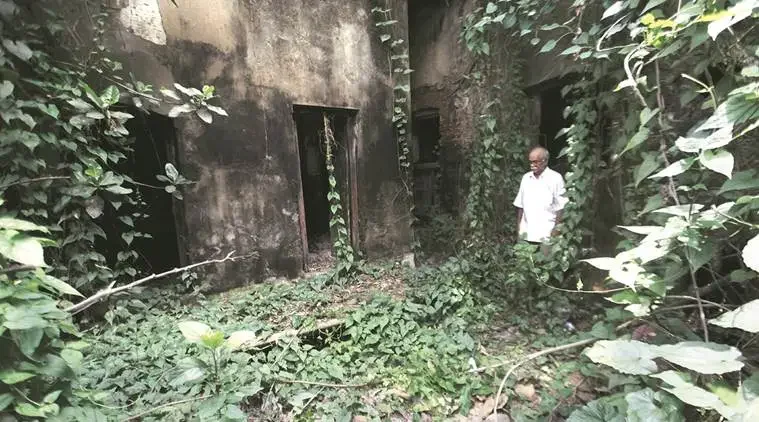
Bijay Kumar Sain, the youngest son of the Sain family, at Sainbari (Source: Express photo by Subham Dutta)
Outside, Bengal was entering another day of political confrontation.
The United Front government had collapsed the previous day, and the communists had called a hartal. A large political procession moved through the area. According to accounts of the incident, members of the procession entered the Sain residence, a house associated with supporters of the opposing political camp. Violence erupted inside the premises. The house was attacked and set on fire.
Malay Sain and Pranab Sain were killed. Their family tutor, Jitendranath Ray, was also killed. Accounts by the surviving family members say that the brothers were dragged out and attacked, while another account records that Malay, who had taken shelter in another house, was subsequently killed there.
What happened to their mother, Mriganayana Devi, became one of the most horrifying and contested elements of the Sainbari story. Family accounts alleged that she was forced to consume rice smeared with the blood of her murdered sons. There were also allegations that the infant whose ceremony was being conducted was threatened with being thrown into the sacrificial fire. The official inquiry, however, recorded that the blood-related allegation was not proved, citing discrepancies in the evidence.
That distinction must be made.
But it should not be used to obscure what is beyond dispute: three people were killed inside and around that house, a family was devastated, and Bengal witnessed another brutal manifestation of political violence. The inquiry also criticised the district administration and police for negligence in failing to take adequate preventive measures despite the known political tension. And this is where the Sainbari story becomes larger than one family because this was not simply a murder.
It was a warning about what happens when political ideology becomes so powerful that the political opponent ceases to be seen as a fellow citizen.
There are massacres that become national memories There are massacres that become political slogans and then there are massacres that slowly disappear into the footnotes because remembering them is inconvenient.
Sainbari belongs dangerously close to the third category.
When Political Opponents Become Enemies
The most disturbing lesson of Sainbari is not merely that people were killed. It is that political hatred had reached a point where a family home could become a battlefield. The Sain family were associated with the politica l camp opposed to the communists. The attackers were alleged to have been associated with the communist movement. The communist side, however, disputed the conventional Sainbari narrative and maintained that the Sain brothers were themselves involved in violence and that the mob had been provoked by an attack from the Sain residence. That competing account should be recorded but recording a competing narrative does not erase the fact that Malay Sain, Pranab Sain and Jitendranath Ray died. History must be honest enough to acknowledge competing claims and courageous enough not to let political narratives erase human beings.
The Blood Did Not End at Sainbari
Perhaps the most chilling aspect of Sainbari is that the violence did not end on March 17. The cycle continued. Naba Sain, the elder brother and an eyewitness to the events, was killed the following year another witness, Gonamoni Roy, was also killed. On the other side of the political divide, lawyer Bhabadish Roy, who represented communist leaders in the case, was murdered, with the killing attributed to supporters of the opposing political camp.
This is how political violence sustains itself. One murder becomes revenge. Revenge becomes justification. Justification becomes another murder and eventually an entire political culture learns to live with blood.
The Justice That Never Came
A commission was constituted in 1970 to investigate the Sainbari killings. The commission criticised the failure of the district administration and police to take adequate preventive action. A criminal case followed, and more than a hundred people were eventually named in the chargesheet, including communist leaders. Yet the accused were ultimately acquitted.
Decades later, another inquiry was initiated after the change of government in 2011, but that process too failed to provide the definitive closure the family had sought. The family's continuing frustration was that commissions and political changes had not delivered the justice they wanted and that is perhaps the second tragedy of Sainbari.
A massacre can kill people in one day. The failure to deliver justice can keep the wound alive for generations.
The Greatest Irony
Perhaps the greatest irony of Sainbari is the distance between political rhetoric and political reality. Communist ideology has historically spoken in the language of equality, justice, liberation and peace, but ideals are ultimately tested not by slogans or manifestos, but by how political opponents are treated. Sainbari raises an uncomfortable question: what happens to the language of human dignity when the opponent is reduced to a “class enemy” or an obstacle to the revolution?
A movement that speaks of equality cannot justify treating political opponents as disposable, just as a movement that speaks of justice cannot excuse political violence because the victims happen to belong to the other side. Peace cannot be preached from the podium and suspended at the doorstep of a political opponent.
The real hypocrisy lies in demanding that society remember the ideals of an ideology while conveniently forgetting the violence associated with its political history. Sainbari therefore deserves to remain uncomfortable—not because one political movement should be condemned forever, but because no ideology should receive a moral exemption from scrutiny. If communists speak of democracy, peace and justice today, those principles must apply equally to people who oppose them.
History is not a public-relations exercise; it does not exist to protect the reputation of political movements. It exists to remember what human beings did to other human beings. Peace is not a slogan, justice is not a party property, and human dignity cannot be reserved for ideological allies. The ultimate test of any political ideology is not how beautifully it describes the world it wants to create, but how it treats the human being standing on the other side of the barricade.
About author
Abhishek Iyengar is a theatre practitioner, writer, filmmaker and cultural professional based in Bengaluru. With over two decades of experience in theatre and the arts, he has written, directed and performed across various platforms. His interests extend beyond the performing arts to society, politics, culture and contemporary issues. Through his writing, Abhishek seeks to question conventional narratives, challenge assumptions and spark meaningful conversations.