
Mutiny Is Our Name:The Ghadar Party and the Conspiracy of February 1915
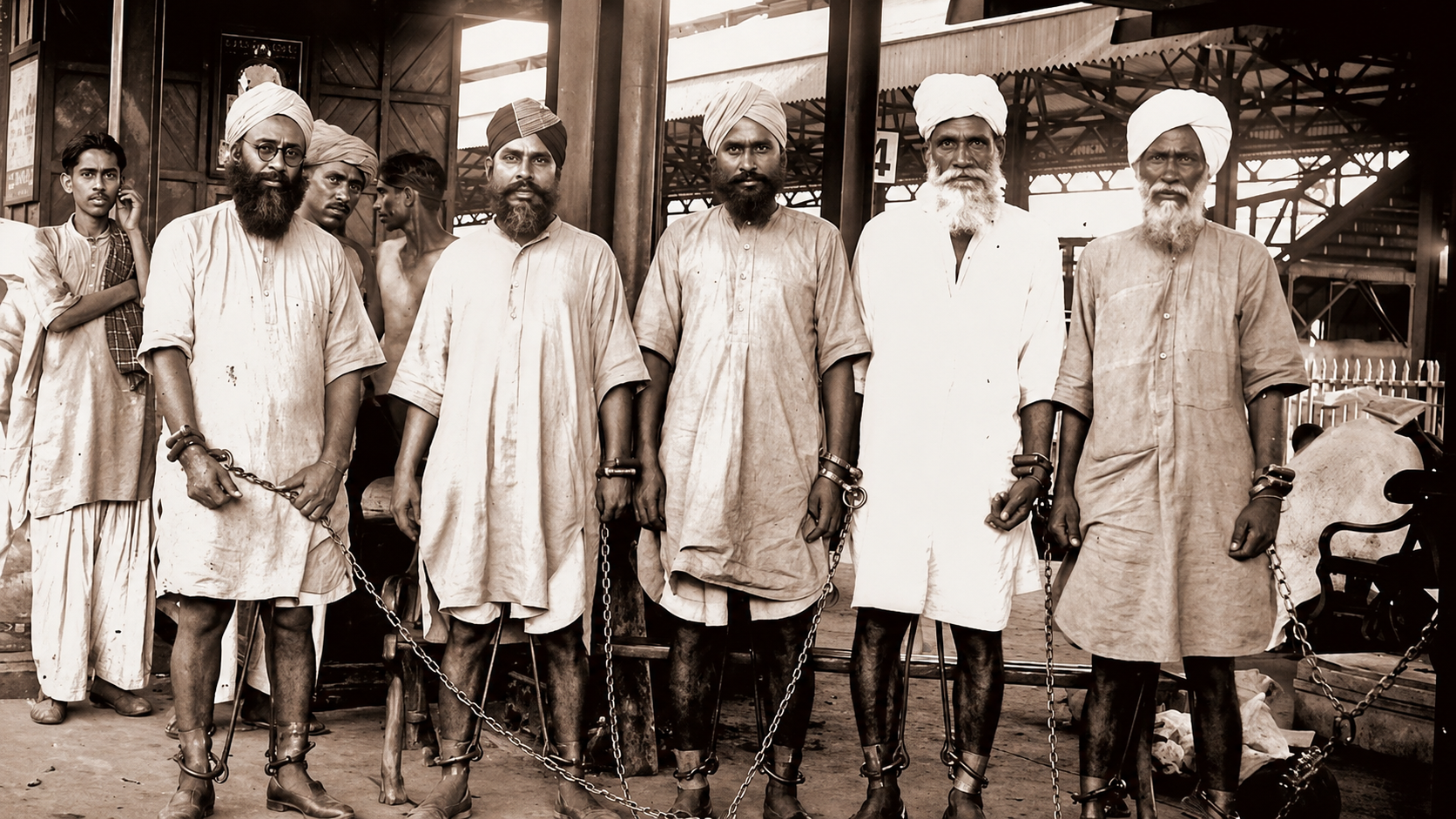
Introduction
The armed wing of the Indian freedom struggle is usually narrated as a sequence of individual acts, a bomb blast, a shooting of some British officers, or a hanging, rather than as an organisation with a strategy. The Ghadar Party resists that treatment. It had a headquarters, a treasury, an elected central committee, a printing press, a distribution network spanning the Pacific, a published programme, and a date.
It also had a target, and the target is the reason the episode matters beyond its own failure. The Ghadar programme aimed not at British officials but at the Indian soldiers who made British rule enforceable. Understood that way, February 1915 is not an isolated conspiracy but the first serious attempt at the manoeuvre that would eventually succeed, and the ferocity of the response is evidence of how clearly the colonial government understood what was being attempted.
Exclusion on the Pacific Coast
The movement began in humiliation rather than ideology. Majumdar’s account of Indian labour in North America is blunt about the conditions that radicalised it: “Everywhere they were insulted and despised. In hotels and trains, parks and theatres, they were discriminated against. Everywhere hung notice-boards: Hindus (i.e. Indians) and Dogs Not Allowed.” A white man, he adds, refused to sit at the same table even with the leading men of the Indian community.[1]
What converted humiliation into politics was the setting. These men were being denied ordinary dignity inside a republic that had itself been founded by rebellion against the same empire that governed their homeland. Majumdar records the effect directly: they “felt ashamed of their political status and realized the value of liberty and democracy of which the most shining example loomed large before them.”[2] Revolutionary papers already circulated among them, Shyamji Krishnavarma’s Indian Sociologist, Madam Cama’s Bande Mataram, and, from 1908, Taraknath Das’s Free Hindustan, which Majumdar calls probably the first regular propaganda sheet of its kind in the United States.[3]
Yugantar Ashram and The Ghadar
Several scattered associations coalesced into one party at a meeting of representative Indians at San Francisco on 1 November 1913. About fifteen thousand dollars was raised and the Hindi Association of America founded; the decision to publish a weekly named Ghadar, rebellion, in commemoration of 1857, gave the organisation the name by which it is remembered. [4] Its premises at 436 Hill Street were named Yugantar Ashram after the Calcutta revolutionary journal, a naming that signals how closely the Pacific coast movement understood itself as continuous with the Bengal one. [5]
The party's stated aim was, in Majumdar's summary of its founding resolutions, "the overthrow of imperialist Raj in India and the building up in its place of a national republic based on freedom and equality," achievable "only by an armed national revolution." A central committee, composed of delegates elected by state committees at Astoria, Marysville, Sacramento, Stockton, Fresno, Bakersfield, Los Angeles and Imperial Valley, met quarterly. [6] This is not the structure of a discussion circle.
Neither was the paper. Its first issue declared: "Today there begins in foreign lands, but in the language of the country, a war against English rule." [7] Majumdar preserves a blunter passage from the same issue: "What is our name? Mutiny. What is our work? Mutiny. Where will mutiny break out? In India. The time will soon come when rifles and blood will take the place of pens and ink." [8] The masthead carried Vande Mataram and the legend Angrezi Raj ka Dushman — enemy of British rule — and each issue ran a standing feature, Angrez Raj ka Kachcha Chittha, itemising the crimes of the administration. [9]
The programme it advocated was equally explicit. Among the measures Majumdar lists from the paper itself are the seduction of Indian troops, the hoisting of the revolutionary flag, the breaking of jails, the looting of treasuries, union with the foreign enemies of the British, the procuring of arms and manufacture of bombs, and the destruction of railways and telegraphs. [10] The Ghadar Party was a publishing house that intended to raise an army, and it said so in print.
Distribution ran by post and by hand to Trinidad, Singapore, Manila and Malaya, carried through the network of Sikh gurdwaras, where its verses were sung publicly. One widely circulated song asked Sikhs to expunge the memory of 1857: "We fought many a battle for the Whites, / That was a grave unwitting mistake, brothers … Get up! Let's wash away the stigma of treachery." [11]
British counter-measures followed quickly. The paper was banned under the Sea Customs Act, and on 30 January 1914 two hundred and fifteen bundles were intercepted at Bombay port. In March 1914 Har Dayal was served with a warrant on the complaint of the British Consul and left the United States on bail. [12] Ram Chandra Peshawari took over the editorship. Sanyal notes an outcome the authorities had not intended: the attempted arrest increased popular interest in the paper and the movement around it. [13]
The Komagata Maru
The episode that converted a readership into a cadre was not organised by the party. In 1914 Gurdit Singh chartered a Japanese coaling ship, the Komagata Maru, to test Canadian exclusion, leaving Hong Kong on 4 April with 165 passengers and reaching Vancouver on 23 May with 376, of whom 340 were Punjabi Sikhs. They were refused landing. Sanyal is careful about their politics at this stage: although many were readers of The Ghadar, "they had no real link with the movement at that stage." [14]
The voyage created the link. Forced out of Vancouver on 21 July under the guns of a Royal Navy cruiser, the ship reached Yokohama, where Sohan Singh Bhakna boarded, argued the Ghadar case to a now receptive audience, and smuggled pistols and ammunition aboard. [15] Six months at sea had done the party's recruiting for it.
The ending was worse. On 29 September 1914 the ship anchored at Budge Budge near Calcutta and the passengers were ordered directly onto trains for Punjab. Gurdit Singh placed the Guru Granth Sahib on his head and set out on foot for the local gurdwara instead; passengers followed him in the dark past heavy police deployment. An argument became a riot and then gunfire. Eighteen passengers and two Bengali passers-by were killed, along with two British officials and an Indian constable; more than two hundred were arrested. [16]
The reprisals that followed in Canada show how far the conflict had escalated. Ghadarites began killing the informants of the immigration officer William Hopkinson. His agent Bela Singh, fearing he would be next, opened fire at a funeral inside the gurdwara, killing two. At Bela Singh's arranged trial, Mewa Singh shot Hopkinson dead in the courtroom and was hanged for it. [17]
The Conspiracy of February 1915
The outbreak of war in Europe supplied the opening the revolutionaries had been waiting for. Majumdar records the calculation in the plainest terms: they felt, "like the Irish, that England's necessity was India's opportunity." [18] Rash Behari Bose and Sachindra Nath Sanyal, working from Varanasi, set about aiming the returning Ghadarites at the army itself.
The allocation of responsibility was deliberate. Kartar Singh Sarabha, formerly Har Dayal's assistant at Yugantar Ashram and barely eighteen, took the Lahore–Amritsar sector; Vishnu Ganesh Pingle was sent to the barracks at Meerut; Bagha Jatin's Jugantar group was given eastern India. [19] The rising was fixed for 21 February 1915, to begin at the Mian Mir cantonment at Lahore as the signal for Rawalpindi and Ferozepore, then Jubbalpore and Varanasi, and finally Bengal. [20]
It was betrayed from inside. Mula Singh was arrested on 13 February; a British informer, Kirpal Singh, had reached the inner circle and was seen on 15 February speaking to a police officer at Lahore station. Rash Behari advanced the date to 19 February, but could not neutralise the informer, who reported the new date as well. [21] Hours before the signal, police raided the Lahore hideouts, the army was placed on alert across the province, and every Indian guard at arms depots and key installations was replaced by a European.
Sarabha went to Ferozepore regardless, arriving that evening with between fifty and seventy lightly armed men to find the garrison already alerted and disarmed. [22] With nothing in the north-west, the intended chain reaction never began. It is worth registering what the counter-measures themselves concede: a colonial government that replaces every Indian sentry in a province overnight is not responding to a nuisance.
Singapore
One rising did occur. On 15 February 1915 the 5th Light Infantry, a battalion composed entirely of Muslims and on the eve of departure for Hong Kong, mutinied at Alexandra Barracks in Singapore. The mutineers split into parties, one to release German internees near Tanglin, one to attack the commanding officer's quarters, one to block relief from the town. The German prisoners declined the arms they were offered. Fighting continued through 16 and 17 February; the city was retaken on the 18th with help from French and Japanese cruisers, the sloop Cadmus, and the Sultan of Johore. [23]
British casualties were eight officers, one woman, nine soldiers and sixteen civilians. Of the mutineers, two leaders were hanged and thirty-eight shot, all in public. The regiment ceased to exist. [24] Sanyal notes the irony that Japanese marines helped hold Singapore for the British twenty-seven years before the same city fell to Japan. [25]
The Wider Conspiracy: Berlin, Kabul, Bangkok, San Francisco
The February plan was one component of a far larger design. In Berlin an Indian Independence Committee operated with German funding and diplomatic recognition; its members received training in explosives at a camp at Spandau, were shown modern weapons at arsenals, conducted propaganda among Indian prisoners of war, and consulted German naval officers on landing arms on the Indian coast. [26]
The arms themselves were purchased. On the instruction of Franz von Papen, military attaché at the German embassy, the New York agency of Krupp bought equipment for ten thousand men, and in January 1915 shipped eight thousand rifles and four million cartridges to San Diego. The consignment was to pass from the schooner Annie Larsen to the tanker Maverick and travel concealed in an oil tank. The Annie Larsen reached the rendezvous; the Maverick did not, and the scheme collapsed. [27]
The consequences reached Bengal, where the revolutionaries had organised around the expectation of that cargo. Jatin Mukherji took charge at Balasore and Jadugopal Mukherji at Raimangal, and men waited at the coast into late June for a ship that never came. Funds from German sources at Batavia totalling forty-three thousand rupees reached them, but the final instalment of ten thousand was intercepted and led police to Balasore, where Jatin Mukherji was mortally wounded in a twenty-minute engagement near the Buri Balam river. [28]
Further west the project acquired the trappings of a state. An Indo-German mission comprising Raja Mahendra Pratap, Maulana Barkatullah and Werner Otto von Hentig of the German diplomatic service reached Kabul on 2 October 1915, and on 1 December proclaimed a Provisional Government of India with Pratap as President, Barkatullah as Prime Minister and Obeidullah as Home Minister. It dealt directly with the Afghan government, drew up a treaty, and dispatched missions; Pratap wrote to the Czar of Russia on a plate of solid gold. [29] A related scheme, the so-called Silk Letters, set out a pan-Islamic "Army of God" headquartered at Medina, written in Persian on lengths of yellow silk sewn into a coat lining and dated 9 July 1916; it was intercepted when a suspicious father extracted a confession from the servant carrying it. [30] In Southeast Asia, depots were to be established on the Siamese frontier where German officers would train and equip revolutionaries for an attack on Burma; most of the party sent for the purpose was arrested at Bangkok in August 1915, shortly after arrival. [31]
The American end unravelled last and most bitterly. Chandra Kanta Chakravarty was arrested in New York on 6 March 1917 and gave up his associates; Ram Chandra and sixteen others were arrested at San Francisco on 7 April, the day after the United States entered the war. The trial opened on 20 November 1917 amid mutual accusations of embezzlement. On its final day a defendant, Ram Singh, put four bullets into Ram Chandra in the courtroom and was himself shot dead by a marshal. Of one hundred and five original defendants, twenty-nine were convicted. [32]
Repression and the Lahore Conspiracy Cases
In Punjab the response was immediate and unrestrained. Michael O'Dwyer, the lieutenant governor, exercised emergency powers to raid and arrest anyone suspected of Ghadarite sympathies. Sanyal records an aspect of this that nationalist narration tends to omit: the authorities "received enthusiastic support from members of the Punjabi elite, including the Chief Khalsa Diwan," who used their influence to help identify and hunt down Ghadarites. [33] Repression of the movement was not simply a colonial act; it was a collaboration.
The judicial reckoning came through a special tribunal sitting between 26 April and 13 September 1915 across what amounted to nine separate cases. Of two hundred and ninety-one convicted conspirators, forty-two were executed, one hundred and fourteen received life sentences and ninety-three terms of varying length; forty-two defendants were acquitted. [34] Among those hanged were Vishnu Ganesh Pingle and Kartar Singh Sarabha, executed together at Lahore Central Jail on 16 November 1915. [35]
Kartar Singh Sarabha and Revolutionary Memory
The Ghadar movement's most consequential afterlife was not organisational but exemplary, and it can be traced through a single document. In April and May 1927 the Punjabi monthly Kirti published a biography of Sarabha under the pen name Balwant. The author was Bhagat Singh. [36] The essay is therefore not a secondary account but testimony: one revolutionary constructing the model he intended to follow, twelve years after Sarabha's execution and four years before his own.
Its factual core is straightforward. Sarabha was born in 1896 in the village of Sarabha, Ludhiana district, the only son of a father who died young; he was an average and mischievous student nicknamed Aflatoon — Plato — and reached San Francisco in 1912. [37] Bhagat Singh reports his reply to immigration officers who questioned his admission, an argument for his own education as a public good: "In case I am not allowed to land here, won't the world suffer due to the lack of that great deed?" [38] What America then taught him is recorded more briefly: he "would go mad with anger upon hearing 'Damn Hindu' and 'Black Man.'" [39]
The essay's most revealing passage concerns a robbery undertaken to fund weapons. When one of the party seized a young woman's hand, Sarabha put a revolver to his temple and compelled him to kneel and beg forgiveness of the woman and her mother. Asked by the mother how so well-mannered a youth came to such work, he answered: "We aren't doing this because of greed … We need money to buy weapons. Where can we get it from?" She took a little for her daughter's marriage and returned the rest with a blessing. [40] Bhagat Singh includes the scene because it addresses the objection that revolutionary funding was indistinguishable from crime.
At trial Sarabha admitted every charge. The judge recorded that he was "among the most dangerous criminals amongst the accused," with no part of the conspiracy in which he had not played a pivotal role. [41] Warned to consider the consequences of his statement, he answered that the court could at most give him the hangman's noose, and then made a second statement harder than the first, concluding: "I shall prefer death, so that I can be reborn till Hindustan is liberated, and go to the gallows again and again." [42] He asked to be remembered by one title: "Kartar Singh, the Rebel." [43]
Bhagat Singh closes by putting the sceptic's question himself — "What benefit did his death have? Who did he die for?" — and answering it in terms of exemplarity rather than outcome. [44] That the answer took hold is documented elsewhere in the same volume: at public meetings Bhagat Singh's circle garlanded Sarabha's portrait and placed it on the platform. [45] The Ghadar rising failed as an operation and succeeded as a model.
The Har Dayal Question
The sources do not agree on the man most often credited with founding the movement, and the disagreement is worth preserving rather than resolving.
Majumdar reports that Bhupendranath Datta — Vivekananda's younger brother, an editor of the original Yugantar, and a participant in the Berlin committee — "attaches no importance to the role played by Hardayal" and makes many deprecatory remarks about him. Against this he sets an American study of the German plots which credits Har Dayal with organising the Indian Independence Committee together with von Wesendonck of the German Foreign Office, and describes him as in daily communication with that ministry. [46]
The evidence that complicates any straightforward verdict is Har Dayal's own. In 1919 he wrote: "I now believe that the consolidation of the British Empire in the East is necessary in the best interests of the people of India. Imperialism is always an evil, but British and French imperialism in its worst form is a thousand times preferable to German or Japanese imperialism." [47] The founder of the paper that declared war on British rule in 1913 was defending British rule six years later.
This is not a marginal detail. It bears directly on how the movement should be characterised: whether Ghadar is best understood as a coherent revolutionary programme or as a wartime coalition whose central figure abandoned its premise once the war ended. The present source base cannot settle the question, and a study that pretended otherwise would be overstating what it holds.
Limits of the Present Source Base
Several matters lie outside what these seven works can support, and are recorded here so that no claim rests on silence.
No figure for Ghadar Party membership, or for the number of Ghadarites who returned to India after 1914, appears anywhere in this source base. Any total would have to come from elsewhere. Kirpal Singh, on whose betrayal the February plan turned, appears in only two of these works and in neither with a biography or an account of his subsequent fate. Sohan Singh Bhakna, the party's first president, is barely covered. The movement after 1917 is almost absent: Majumdar disposes of its later history in two sentences, observing that its strength dwindled toward the end of the 1920s and that "there is some reason to suspect that its energies were diverted into the larger stream of international Communism." [48] No study confined to these sources should extend much past 1917.
Finally, the source base is entirely anglophone. Ghadar di Goonj is named in Bhagat Singh's essay but is not among the works consulted, [49] and no Punjabi or Urdu material has been used. For a movement that published principally in Gurmukhi and Urdu, this is the most serious limitation of the present study.
Conclusion
The Ghadar Party failed at everything it set out to do. The rising did not happen; the arms did not arrive; the provisional government in Kabul governed nothing; the American organisation destroyed itself in a courtroom. Judged by its own objectives the movement was a comprehensive defeat, and that is the judgement under which it is usually filed.
The judgement is too quick, for two reasons the sources themselves supply. The first is the scale of the response. Nine tribunals, two hundred and ninety-one convictions, forty-two executions, emergency powers across a province, and the overnight replacement of every Indian sentry at every arms depot are the reactions of an administration that understood precisely what had been aimed at. The Ghadar programme identified the load-bearing element of colonial power — the loyalty of Indian soldiers — and the government's conduct in 1915 is the best evidence that the identification was correct.
The second is transmission. A movement that failed operationally succeeded in producing a model, and the mechanism of that transmission is documented rather than inferred: Bhagat Singh wrote Sarabha's life, published it in a Punjabi monthly in 1927, and carried his portrait to public meetings. What the Ghadar Party could not accomplish with eight thousand rifles it accomplished with a newspaper and a biography.
ENDnote
Majumdar, R. C., gen. ed. n.d. Struggle for Freedom. The History and Culture of the Indian People, vol. 11. Mumbai: Bharatiya Vidya Bhavan. p. 207.
Ibid.
Ibid., pp. 207–08.
Ibid., p. 208.
Sanyal, Sanjeev. 2023. Revolutionaries. 1st hardback ed. Gurugram: HarperCollins Publishers India. p. 82 [PDF]. Page references to Sanyal are to the pagination of the digital edition consulted, which carries no printed folios; these are marked [PDF] throughout. Majumdar gives the same address; Majumdar, Struggle for Freedom, p. 208.
Majumdar, Struggle for Freedom, p. 208.
Sanyal 2023, p. 82 [PDF].
Majumdar, Struggle for Freedom, pp. 208–09.
Sanyal 2023, p. 82 [PDF]; Majumdar, Struggle for Freedom, p. 209.
Majumdar, Struggle for Freedom, p. 209.
Sanyal 2023, p. 83 [PDF].
Ibid. Sanyal dates the warrant to 24 March 1914 and has Har Dayal leave for Berlin; Majumdar dates it to 25 March and has him reach Geneva, where he edited Bande Mataram. Majumdar, Struggle for Freedom, p. 210. The accounts are probably reconcilable as one journey in two stages: Majumdar later has Mahendra Pratap meet Har Dayal at Geneva and travel on with him to Germany. Majumdar, Struggle for Freedom, p. 220.
Sanyal 2023, p. 83 [PDF].
Ibid., p. 84 [PDF].
Ibid., p. 85 [PDF].
Ibid.
Ibid., p. 86 [PDF].
Majumdar, Struggle for Freedom, p. 213.
Sanyal 2023, p. 87 [PDF].
Ibid., p. 89 [PDF].
Sanyal 2023, p. 90 [PDF]; Bhagat Singh. 2024. The Political Writings of Bhagat Singh. Ed. Chaman Lal and Michael D. Yates. U.S. ed. New York: Monthly Review Press. p. 187. The essay cited here, "Shri Kartar Singh Sarabha," was first published in Kirti (Amritsar), April–May 1927, under the pen name Balwant.
Sanyal 2023, p. 90 [PDF]; Bhagat Singh 2024, p. 187. Sanyal gives seventy men, Bhagat Singh fifty to sixty.
Majumdar, Struggle for Freedom, pp. 218–19.
Ibid., p. 219.
Sanyal 2023, p. 90 [PDF].
Majumdar, Struggle for Freedom, p. 214.
Ibid., p. 216.
Ibid., pp. 221–22.
Ibid., pp. 220–21.
Ibid., p. 223.
Ibid., p. 219.
Ibid., p. 217.
Sanyal 2023, p. 91 [PDF].
Juss, Satvinder Singh. 2022. Bhagat Singh: A Life in Revolution. Digital ed. Viking–Penguin Random House India. p. 129. (No place of publication is stated in the copy consulted.) Juss describes the tribunal as constituted under the "Defence of India Act 1925"; for a tribunal sitting in 1915 this must be the Defence of India Act 1915.
Rao, Y. Sudershan, gen. ed. 2014. Dictionary of Martyrs: India's Freedom Struggle (1857–1947), vol. 3, Maharashtra, Gujarat and Sind (1857–1947). 1st ed. New Delhi: Indian Council of Historical Research / Manak Publications. s.v. "Vishnu Ganesh Pingle," citing Lahore Conspiracy Case (TJ 1915–16), National Archives of India.
Bhagat Singh 2024, p. 182.
Ibid., p. 183. Sarabha's age is inconsistent across the source base. Bhagat Singh calls him "not even 20," then nineteen, then "merely 18½ years old" at trial; Sanyal has him seventeen at Yugantar Ashram and "barely eighteen" on his return. Bhagat Singh 2024, pp. 181–82, 189; Sanyal 2023, pp. 83, 87 [PDF]. A birth year of 1896 and execution in November 1915 gives nineteen.
Bhagat Singh 2024, p. 183.
Ibid.
Ibid., pp. 185–86.
Ibid., p. 189.
Ibid.
Ibid., p. 188.
Ibid., p. 190.
Chaman Lal, and Michael D. Yates. 2024. Introduction to The Political Writings of Bhagat Singh. U.S. ed. New York: Monthly Review Press. p. 21. This detail comes from the editors' introduction, not from Bhagat Singh's own text.
Majumdar, Struggle for Freedom, pp. 214–15.
Ibid., p. 215.
Ibid., p. 212.
Bhagat Singh 2024, p. 184.
Bibliography
Bhagat Singh. "Shri Kartar Singh Sarabha." In The Political Writings of Bhagat Singh, edited by Chaman Lal and Michael D. Yates, 181–91. New York: Monthly Review Press, 2024. First published in Kirti (Amritsar), April–May 1927, under the pen name Balwant. U.S. edition of a work originally published in India by LeftWord Books, 2023.
Dictionary of Martyrs: India's Freedom Struggle (1857–1947). Vol. 1, pt. 1, Delhi, Haryana, Punjab and Himachal Pradesh (1857–1919). General editor Sabyasachi Bhattacharya. New Delhi: Indian Council of Historical Research in association with Manak Publications, 2010.
Dictionary of Martyrs: India's Freedom Struggle (1857–1947). Vol. 3, Maharashtra, Gujarat and Sind (1857–1947). General editor Y. Sudershan Rao. New Delhi: Indian Council of Historical Research in association with Manak Publications, 2014.
Juss, Satvinder Singh. Bhagat Singh: A Life in Revolution. Viking–Penguin Random House India, 2022. Consulted as a digital edition; no place of publication is stated on the imprint page.
Majumdar, R. C., general editor. Struggle for Freedom. The History and Culture of the Indian People, vol. 11. Mumbai: Bharatiya Vidya Bhavan, n.d. Foreword by K. M. Munshi. The copy consulted is a scan whose imprint page did not survive; no year of publication could be recovered.
Mukherjee, Uma. Two Great Indian Revolutionaries: Rash Behari Bose & Jyotindra Nath Mukherjee. Calcutta: Firma K. L. Mukhopadhyay, 1966. Consulted but not cited.
Sanyal, Sanjeev. Revolutionaries. Gurugram: HarperCollins Publishers India, 2023.
