Manusmriti Is a Hindu Text, Not the Book of Hinduism
Written by Abhishek Iyengar · Edited by Pranav MDThere is a curious intellectual project that has been going on for decades. It begins with a deceptively simple proposition:
“Manusmriti is the Hindu book.”
Repeat it often enough, put it into textbooks, television debates, political speeches and social-media arguments—and eventually people begin to accept the premise. Then comes the next step:
“Manusmriti says this.”
“Manusmriti says that.”
“Therefore Hinduism says this.”
And finally comes the conclusion: “Hinduism is a religion based on a book, just like the Abrahamic religions.”
This is where the intellectual sleight of hand must be exposed. Manusmriti is a Hindu text. It is not the book of Hinduism. That distinction is not semantic. It is fundamental.
Hinduism did not begin with a book
Where is the founder of Hinduism? There isn't one. Where is the date on which Hinduism was established? There isn't one, Where is the single revelation that every Hindu is required to accept? There isn't one, Where is the single book whose acceptance makes a person Hindu? There isn't one.
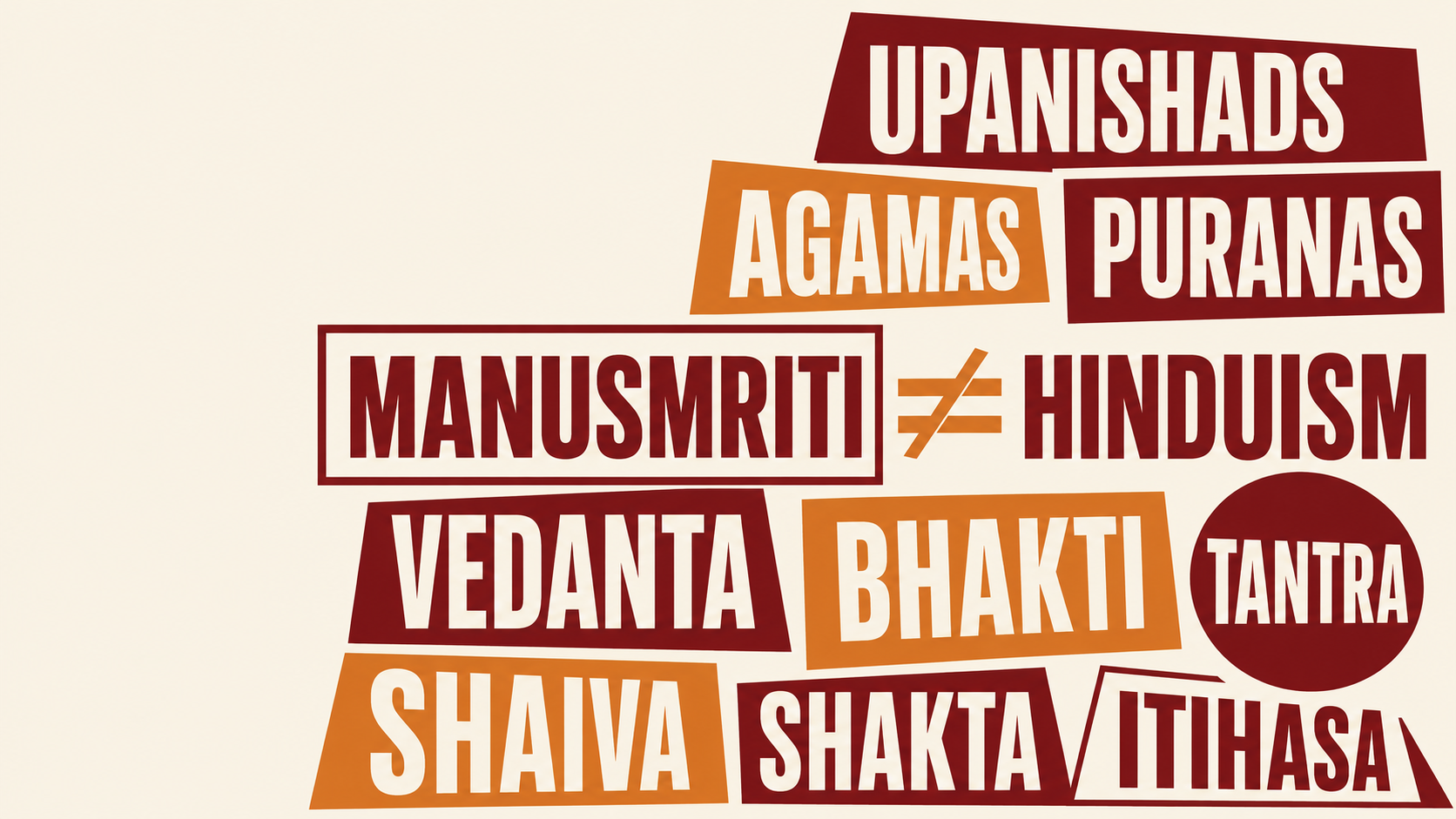
That alone should make us pause before importing a distinctly book-centred model of religion and forcing it upon Sanātana Dharma. The Vedas are foundational to Hindu traditions. So are the Upanishads. The Bhagavad Gita is revered enormously. The Ramayana and Mahabharata have shaped civilization. The Puranas shaped popular religious imagination. Agamas and Tantras guide numerous temple and devotional traditions. Philosophical schools developed their own sophisticated textual traditions and alongside all of this existed oral traditions, regional practices, temple traditions, family customs, festivals, pilgrimage traditions, guru-shishya lineages and innumerable forms of worship.
This is not a civilisation organised around one book. It is a civilisation that produced books.
Manusmriti is a text—not the Constitution of every Hindu
Manusmriti, or the Manusmṛti, belongs to the broader Dharmashastra tradition. It is a significant historical text. It contains discussions of dharma, social duties, law, conduct, ritual and kingship. It has had an important place in the history of Indian legal and social thought.
But to leap from: “This is an ancient Hindu text” to “This is the authoritative rulebook of Hinduism” is intellectually indefensible. There were other Dharmashastras. There were different Smritis. There were competing interpretations. There were regional customs. There were philosophical disagreements. There were movements that challenged established social practices. There were Bhakti traditions that placed devotion above social hierarchy. There were Shaiva, Vaishnava, Shakta, Smarta and numerous other traditions. There was never a single central ecclesiastical authority sitting in a room deciding, “From tomorrow, every Hindu must follow Manusmriti.”
And this is where the comparison with Abrahamic religions breaks down
The attempt to place Hinduism neatly into the template of “religion = founder + revelation + book + doctrine” is itself a product of a particular way of understanding religion. Sanātana Dharma does not fit comfortably inside that box. It is not merely a system of propositions that one must intellectually subscribe to. It is lived through dharma, karma, samsara, moksha, puja, yoga, pilgrimage, festivals, family traditions, temple worship, philosophy, meditation, stories, rituals and countless local practices.
And these traditions have existed within the broad civilisational framework we now call Hinduism. Where is the “single book” controlling all of this? There isn't one.
The Manusmriti obsession reveals the problem
Here is the fascinating part. When people want to criticise Hinduism, Manusmriti suddenly becomes the Hindu scripture. But when discussing Hindu philosophy, the Upanishads become Hinduism. When discussing spirituality, the Bhagavad Gita becomes Hinduism. When discussing mythology, the Puranas become Hinduism. When discussing temple traditions, the Agamas become Hinduism. When discussing yoga, Patanjali becomes Hinduism. When discussing Vedanta, the Brahma Sutras and Upanishads become central.
So which one is “the Hindu book”?
The answer is:
None of them, in the Abrahamic sense of the question.
That is precisely the point. The Hindu textual universe is plural. And that plurality is not a weakness. It is one of its defining characteristics.
Imagine defining an entire civilisation exclusively through one legal or social text and then using the most controversial passages of that text to represent every person within that civilisation.
Would that be intellectually responsible? Of course not.
Yet this is precisely what happens when Manusmriti is treated as a shorthand for Hinduism itself. The method is remarkably convenient, Find a controversial verse, Present it as:
“Hinduism says…”
Ignore the enormous diversity of Hindu philosophical and social traditions. Ignore other texts. Ignore commentarial traditions. Ignore historical context. Ignore the fact that Hindu society was never governed by one central religious authority enforcing one universally accepted code.
And then announce:
“This is what Hinduism is.”
That isn't a scholarship. That is reductionism.
Stop forcing Sanātana Dharma into someone else's template
There is nothing wrong with studying Hinduism comparatively. There is nothing wrong with comparing religions. There is nothing wrong with examining Hindu texts critically. But comparison becomes distortion when the categories of one religious civilisation are mechanically imposed upon another.
The question, “What is the Hindu equivalent of your Bible?” already contains an assumption.
It assumes that Hinduism must have one, Why? Because another religion has one? That is like asking, “Who is the Hindu Pope?”
The question itself is malformed. Not every civilisation is required to organise itself according to the institutional architecture of another.
The political convenience of the Manusmriti
There is also a political convenience to making Manusmriti synonymous with Hinduism. If you can convince people that Manusmriti is the Hindu equivalent of a single foundational scripture, then every criticism of Manusmriti can be presented as a criticism of the entire Hindu tradition. Suddenly:
Manusmriti = Hinduism.
One verse = Hindu doctrine.
One historical practice = Hindu theology.
One social custom = eternal Hindu commandment.
It is an extraordinarily efficient way of flattening a civilisation and the irony is that those making this argument often claim to be defending rational and historically sophisticated analysis. Hinduism can be studied as a religion while recognising that it is also a vast and internally diverse civilisational tradition.
Calling it merely a “way of life” can itself become an oversimplification if it is meant to deny its religious dimensions. But calling it a single-book religion is an even greater distortion. The more accurate description is that Hindu traditions constitute a diverse religious and philosophical civilisation without a single founder, single creed or universally binding scripture.
You cannot reduce such a civilisation with thousands of years of philosophical diversity to one text simply because that makes it easier to attack. You cannot turn Manusmriti into the Hindu Bible merely because you need Hinduism to look like an Abrahamic religion and you cannot understand Sanātana Dharma by forcing it into categories that were never designed to contain it.
Sanātana Dharma does not need to become somebody else's version of religion to be understood. It needs to be understood on its own terms.
About author
Abhishek Iyengar is a theatre practitioner, writer, filmmaker and cultural professional based in Bengaluru. With over two decades of experience in theatre and the arts, he has written, directed and performed across various platforms. His interests extend beyond the performing arts to society, politics, culture and contemporary issues. Through his writing, Abhishek seeks to question conventional narratives, challenge assumptions and spark meaningful conversations.