The Secularisation of Onam: When Inclusivity Becomes Erasure
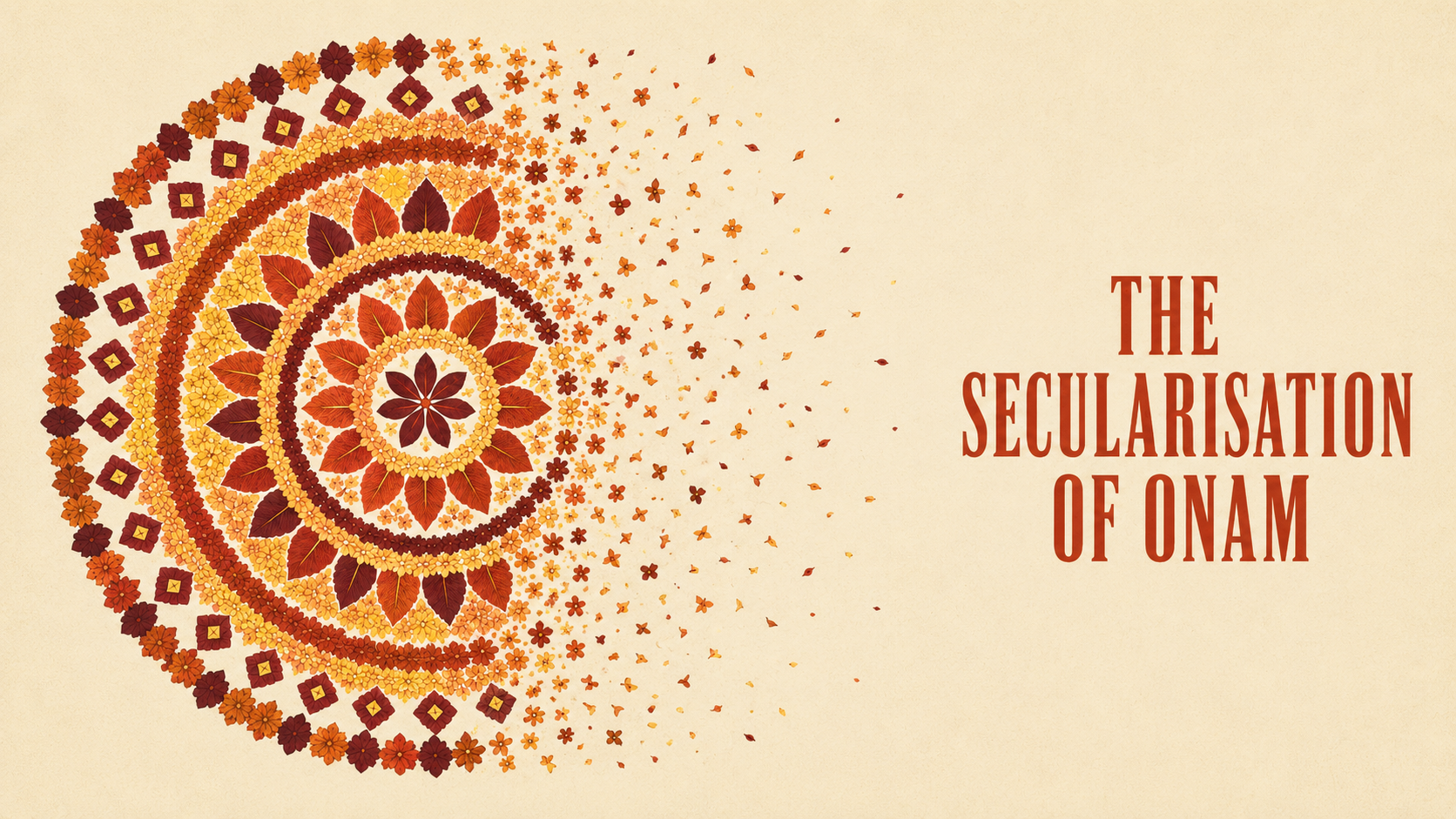
Written by Abhishek Iyengar · Edited by Pranav MDThere is something deeply ironic happening to Onam.
A festival rooted in Hindu mythology is increasingly being presented as though it was born without religion, without mythology and without a civilisation behind it. We are told that Onam is “everyone’s festival”—and certainly, it can be. But somewhere along the way, “everyone can celebrate it” has quietly become “no one should be allowed to call it Hindu.”
That distinction matters.
Onam is traditionally associated with Mahabali, Vamana and Vishnu. Its foundational narrative comes from Hindu religious tradition. Its rituals, stories and cultural memory evolved within that civilisational framework.
Yet today, Mahabali is retained as a cultural symbol while Vamana is increasingly pushed into the background.
Why?
Can a festival become secular without first becoming historically dishonest?
There is nothing wrong with a Christian celebrating Diwali, a Muslim participating in Onam, or a Hindu joining an Eid celebration. That is the beauty of Indian society. But participation does not change origins.
If everyone celebrating Christmas does not make Christmas non-Christian, why should everyone celebrating Onam make Onam non-Hindu?
A festival can be culturally shared without its origins being culturally erased.
This is where the modern obsession with “secularising” Hindu festivals becomes problematic. Secularism was never supposed to mean removing Hindu identity from Hindu traditions until they become sufficiently neutral for public consumption.
Secularism should mean equal respect—not selective amnesia.
We don't need to sanitise Hindu festivals to make them acceptable to a plural society.
We don't need to apologise for their mythology.
We don't need to hide Vamana to celebrate Mahabali.
And we certainly don't need to pretend that a tradition has no religious roots simply because millions of people from different communities now participate in it.
Imagine applying the same logic everywhere.
Would we describe Christmas merely as a “winter festival” because non-Christians celebrate it? Would we describe Eid simply as a “community festival” because people from other faiths participate in it?
Then why must Onam alone undergo this cultural sterilisation?
The answer may lie in a peculiar discomfort with acknowledging Hindu civilisational ownership of traditions.
A Hindu-origin festival does not become communal merely because we acknowledge that it is Hindu in origin.
History is not communal.
Mythology is not communal.
Cultural inheritance is not communal.
What is communal is the attempt to weaponise them against another community—not the simple act of acknowledging their origins.
There is another irony.
We proudly celebrate the diversity of India, but diversity becomes meaningless if one community's traditions are permitted to retain their religious identity while another community's traditions must be stripped of theirs in order to qualify as “secular.”
That isn't secularism.
That is asymmetrical secularism.
Onam should absolutely remain a celebration open to everyone. Let every Malayali celebrate it. Let people from every faith participate in the feast, the Pookalam, the games and the festivities.
But let us not confuse shared ownership with historical ownership.
Everyone may celebrate a tradition.
Not everyone gets to rewrite where it came from.
The mature way forward is simple:
Celebrate Onam together.
Respect its Hindu roots.
Welcome everyone.
Erase no one.
Because a confident civilisation does not fear sharing its traditions.
And it certainly does not need to erase their origins to prove that it is inclusive.
Onam can belong to everyone as a celebration without ceasing to belong to Hindu civilization as a tradition.
That is not communalism.
That is history.
About author
Abhishek Iyengar is a theatre practitioner, writer, filmmaker and cultural professional based in Bengaluru. With over two decades of experience in theatre and the arts, he has written, directed and performed across various platforms. His interests extend beyond the performing arts to society, politics, culture and contemporary issues. Through his writing, Abhishek seeks to question conventional narratives, challenge assumptions and spark meaningful conversations.