Lessons from the gupta Golden Age
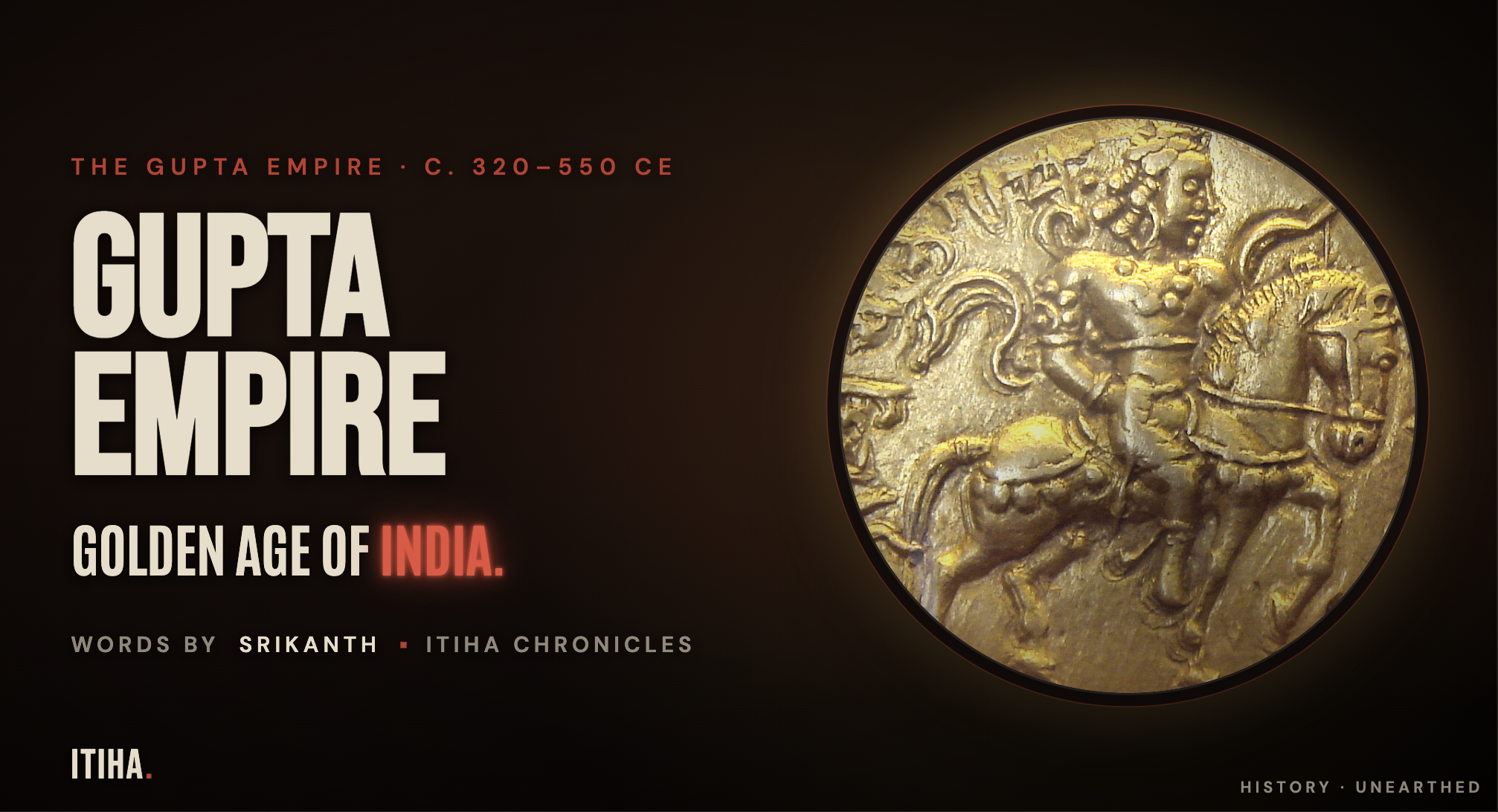
written by Srikaanth Sridhar
Edited by Pranav
History is not merely a record of the past; it is a guide for those who wish to build a future rooted in Dharma. The Gupta Empire (c. 319–550 CE), which arose from Magadha and united Bharat under one banner, stands as the finest example of this. It was an age when governance, commerce, science, and the arts flourished together, for the rulers understood that true prosperity flows from Dharmic principles.
The greatest among them was Chandragupta II, known to the world as Chandragupta Vikramaditya. He defeated the Sakas, extended the empire from sea to sea, and opened the wealth of maritime trade to the nation. Yet his true greatness lay in his court at Ujjain, adorned by the Navaratnas, the nine gems, whose wisdom served the welfare of the whole society. The Chinese traveller Faxian, who journeyed through the land during his reign, recorded a prosperous people governed with justice and benevolence. Vikramaditya became the very archetype of the ideal ruler, whose name later kings adopted as a title of honour.
What follows are the lessons this Golden Era offers us, for those willing to learn from it, here are the top things we can learn from Gupta Empire.
Always be rooted to Culture that will help us to achieve great heights.
The Gupta Empire was considered the Golden Era of India. The reason being the empire was rooted in the Indic school of thought, and thus they focused on sustainable development. They built civilization through the renovation of temples and also understood the point of Dharmasya moolam Artham, thus providing strong economic incentives. Along with this, they fostered a thriving commerce system, actively trading spices, textiles, and precious metals both internally and with foreign nations to build societal wealth. The government aided people with the construction of irrigation and other public welfare. Still, the misuse or vandalism of these resources was penalized by a penalty. This is one example of how the government was helpful and strict at the same time. The philosophy was such that it was real governance based on Dharmic principles of handling public issues and private properties. Guilds were permitted to take on public works in the form of a PPP, and they were permitted to build mandirs and contribute to society through public works.
Never subjugate the enemy of your own creed to total destruction.
The Gupta Empire had a form of conquest known as Dharma Vijaya. They never annihilated their feudatories or the conquered territories. They let them rule, with the central authority holding key positions, while local rulers were made governors under Gupta influence. Matrimonial alliances were encouraged. Prabhavati Gupta, daughter of Chandragupta Vikramaditya, was married to the Vakataka ruler Rudrasena. She later served as regent, thus building a strong empire. Feudatories were made an active part of governance for the larger cause; thus, until the decline, the feudatories were honored, and loyalty was gained.
Always be updated with technology and imbibe truth in the form of arts.
There was advancement in horse breeding and the development of horse archers as a major component of their army. In their combined war tactics, they used horse archers as part of their battle against the Sakas and Huns. Metallurgy was one of their major developments, and the creation of different alloys was at its pinnacle. The Iron Pillar in Delhi is a good example of the technical and scientific advancements of that era. Sugar crystallization was developed during the Gupta Empire, which was part of food science, making sugar a luxury commodity that also spread through sailors and traders.
The innovation by the Gupta Empire always kept them at their pinnacle.
Mudrarakshasa by Vishakhadatta, Meghadootam, Shakuntalam, and Malavikagnimitram by Kalidasa, and many such writers and poetic geniuses were encouraged, along with a multitude of scribes. The empire had an able Navaratna Sabha during the reign of Chandragupta Vikramaditya. Varahamihira laid his foundation in astronomy and mathematics. Kalidasa, Shanku the architect, Vetala Bhatta, Dhanvantari the master of Ayurveda, Amarasimha, Vararuchi, Kshapanaka, and Ghatakarpara all contributed their knowledge for the overall welfare of the nation. They remain relevant even today.
Nature can be furious even with a surplus, so be prepared for eventualities.
After the Skandagupta era, the empire faced internal decay, and at the same time, natural calamities like floods affected the internal stronghold. This hastened the decline of their hold on the heart provinces of the empire; thus, external invasion and internal decay led to the decline of the empire. Always, even the best must be prepared for eventualities.
Finally, even in your decline, never abandon Dharma and fellow Dharmics (Battle of Sondani).
When Hunnic invaders reached the heartlands of India during the decline of the empire, it led to the rise of the Second Aulikara Dynasty under Yashodharman, who confronted the Huns. Then, the Guptas under Narasimhagupta allied with him and drove the Alchon Huns out of India, reestablishing Dharma, which was continued by the Pushyabhutis of Thanesar. Thus, always side with Dharma even in decline.
Sources:
The Vakataka Gupta Age by RC Majumdar and AS Altekar.
Ancient India by RC Majumdar
The History and Culture of Indian People by RC Majumdar.