
Does India Need a Delimitation, or Something More Than That?
Before finding an answer to this question, we have to first address, perhaps a more important question, which is, What is a Delimitation? And the most well-known answer would be‘delimitation is the constitutional process of redrawing the boundaries of territorial constituencies to reflect changes in the population.’ This process is not rare or uncommon; in fact, almost every major democracy in the world does it. It is a routine and essential part of maintaining a fair, representative democracy. In countries that elect representatives from specific geographic areas, redrawing boundaries is standard practice. It is usually done every 5 to 10 years, immediately following a national census, to account for people moving, being born, or passing away. Here are few examples:
United States (known as "Redistricting"): This happens every 10 years after the national census. The total number of seats in the House of Representatives is permanently capped at 435. If states in the South and West grow faster than states in the Northeast, the growing states gain seats, and the slower-growing states lose them (a process called reapportionment).
United Kingdom (known as "Boundary Reviews"): Independent Boundary Commissions for England, Scotland, Wales, and Northern Ireland periodically review and redraw maps to ensure each Member of Parliament represents roughly the same number of voters.
Australia (known as "Redistribution"): Australia is highly proactive. They review electoral boundaries at least every 7 years, or sooner if the population in a specific state changes significantly.
Canada: The constitution requires a readjustment of federal electoral districts every 10 years following the decennial census.
But India has a different case. No other democracy paused its democratic reapportionment for half a century to accommodate demographic policies (family planning). In the US, if a state's population shrinks, it simply loses political power immediately at the next census. India froze its system to protect states that were succeeding in national initiatives actively.
The Inequal Processes
The inequality in the current democratic process stems from the fact that the foundational rule of democracy, "one person, one vote, one value," is mathematically broken. This inequality currently plays out in two distinct ways: the reality of unequal vote values today, and the looming threat of a demographic penalty tomorrow. Because the number of Lok Sabha seats has been frozen since the 1971 census, the size of constituencies has grown wildly out of proportion with the modern population. Today, an MP from a fast-growing Northern state represents almost double the number of people as an MP from a Southern state.
To see exactly how this inequality plays out mathematically, you can use the simulator chart below:
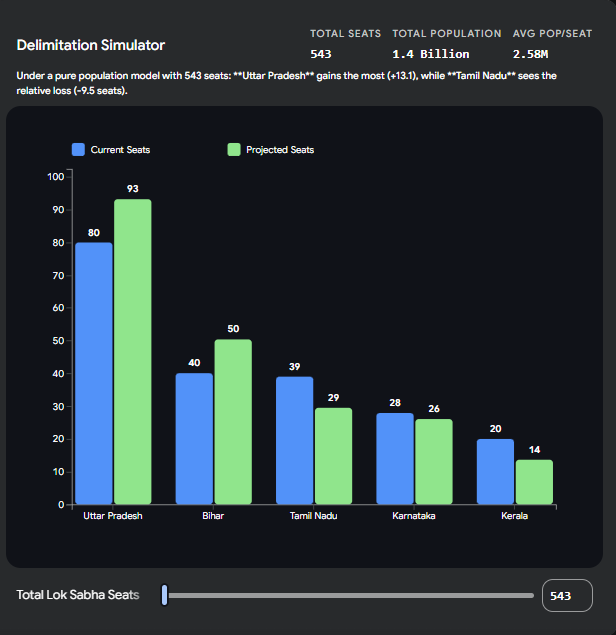
With 543 Seats
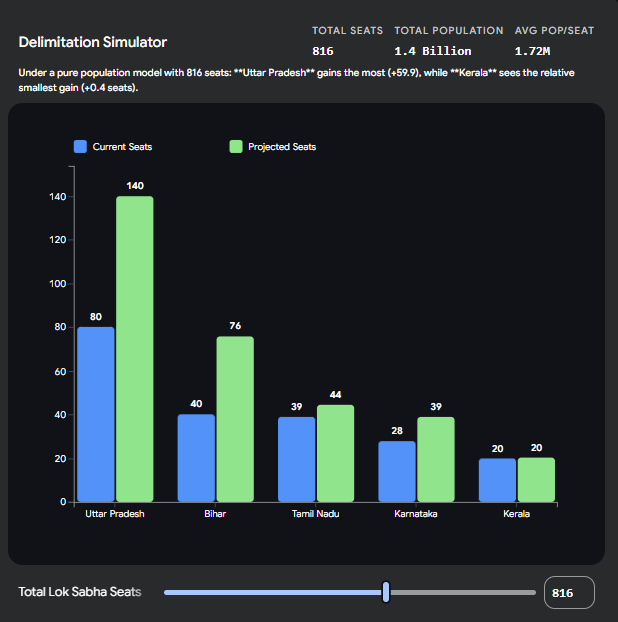
With 816 Seats
Because a representative in Uttar Pradesh serves 3 million citizens, while a representative in Kerala serves 1.75 million, the actual "weight" or "value" of a single voter's voice in the North is significantly diluted. The obvious solution is to unfreeze the seats and redraw the maps based on current populations. However, doing this creates a different, arguably more dangerous kind of inequality: punishing effective governance. When analyzing the history of institutional management in India, Southern states like Karnataka, Tamil Nadu, and Kerala successfully implemented national directives on education, family planning, and public health. This effectively stabilized their populations. Conversely, states in the Hindi heartland saw massive population surges over the same 50-year period. If seats are redistributed strictly by today's population numbers, the states that governed best will lose their national political voice. They face a massive "demographic penalty" for their success, while states that failed to control population growth are rewarded with immense, disproportionate political dominance in parliament.
The 50% Proportion Increase Clause
As mentioned earlier, if the government redistributed Lok Sabha seats based strictly on today's population (using the 2011 or upcoming census), Southern states would lose a massive share of their political power because they successfully controlled their population growth, while Northern states would gain immense power. To prevent the South from being punished for its successful governance, the government has proposed abandoning the strict population-to-seat mathematical formula. Instead, they plan to apply a flat, across-the-board 50% increase to the current seat count of every single state. The overall size of the Lok Sabha will increase by 50%, jumping from the current 543 seats to around 816 seats. Under this model, Uttar Pradesh's seats will increase from 80 to 120. Simultaneously, Tamil Nadu's seats will increase from 39 to 59, and Kerala's will increase from 20 to 30.
The genius of this clause is that while the absolute number of seats goes up for everyone, the percentage share of power remains perfectly frozen in place. For example, Karnataka currently holds 28 out of 543 seats, giving it 5.15% of the voting power in the Lok Sabha. Under the new model, Karnataka gets 42 out of 816 seats, which keeps its voting power at roughly 5.14%. By using the 50% proportion increase clause, the government can achieve its goal of expanding the Parliament and fulfilling the requirement to implement the 33% Women's Reservation Bill, without altering the federal balance of power that has existed between the North and South since 1971. But the 131st Constitutional Amendment Bill has been voted down in the Lok Sabha, so what’s next?
Things may happen, Things may not
The 131st Constitutional Amendment Bill has been defeated in the Lok Sabha, but that doesn't close the chapter on delimitation. The process remains constitutionally inevitable. Under the 84th Amendment, the freeze on seat reallocation was always temporary, set to lift after 2026. Once the next census is conducted, the constitutional machinery will automatically come into motion, triggering a fresh delimitation exercise based on updated population figures. And crucially, when that moment arrives, the legislation required to enact it will need nothing more than a simple parliamentary majority to pass.
Between 2027 and 2029, the BJP is likely to position women's reservation in legislatures as a defining political cause, potentially making it a centerpiece of their 2029 general election campaign. A decisive victory in that election would give the party the mandate and the muscle to push it through in full.
Over the next two to three years, expect this issue to grow into the kind of galvanizing force that Ram Mandir, Article 370, CAA, and the UCC once were for the BJP. Since 2024, the party has been in search of a singular issue powerful enough to consolidate a broad electoral majority. The collapse of the 131st Amendment may have handed them exactly that. The Prime Minister's address to the nation, in that sense, wasn't just a response to a legislative defeat; it was the opening move in a carefully calculated political campaign.
A New Idea
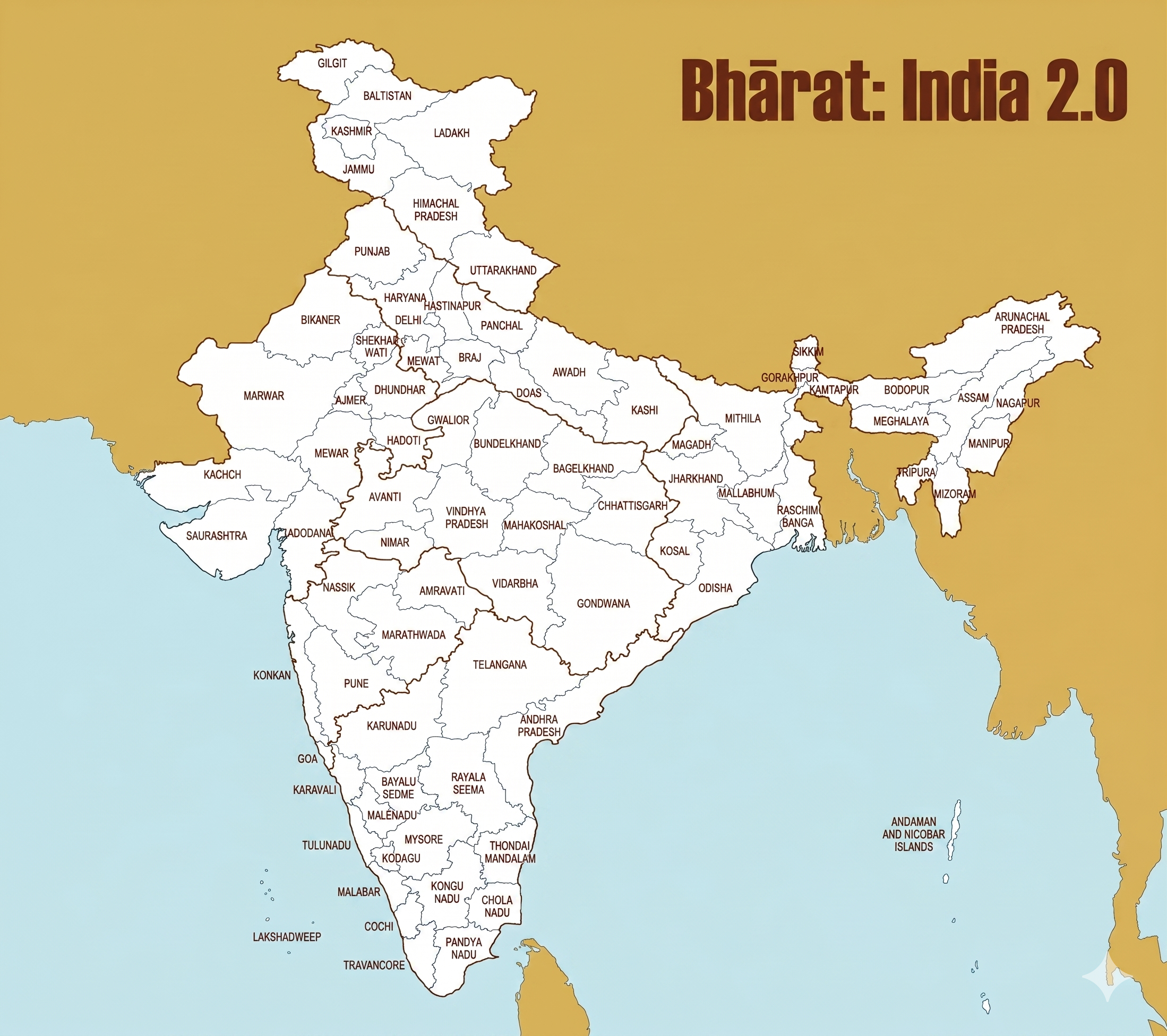
In the book Bhārat: India 2.0, the author, Gautam Desiraju, argues that the current state sizes are too large to properly capture the nation's rich diversity. The central proposal of the book is a demarcation of India into seventy-five states with roughly equal populations of approximately two crores (20 million) each. The primary objective of this exercise is administrative convenience and the optimal expression of national diversity. New state boundaries should be determined by a logical, rather than political, analysis of geography, history, culture, language, and religion. NOT JUST LANGUAGE. The author suggests respecting historical regions (e.g., Mithila, Rayalaseema), tribal belts (Gondwana), and restoring the borders of well-administered Princely States (e.g., Mysore, Travancore).
To further highlight the country's diversity, the proposed 75 states are demarcated into eight specific zones: Himalayan, Northern, Central, Western, Southwestern, North-eastern, Eastern, and Southern. These zones are viewed as "macro-level diversity lines" that should be respected in governance.
In a proposed "India 2.0" model, where the executive and legislative wings are completely separated:
Lok Sabha: Constituencies would continue to be demarcated primarily by population, and occasionally by area.
State Assemblies: New state legislatures would be elected from assembly constituencies that are significantly smaller than the national ones, reflecting the more compact nature of the 75 new states.
The States Reorganisation Act of 1956 represents one of India's earliest institutional attempts to accommodate diversity, carving the country along linguistic lines at a time when language was seen as the primary marker of regional identity. The author acknowledges this legacy while pointing out that identity has since grown far more complex, with language now just one thread in a much richer fabric.
In Article 3 of the Indian Constitution, the author makes a more proactive case. Rather than waiting for political discontent to boil over into agitation, he argues that the Union should actively deploy its broad reorganisation powers to get ahead of the problem. In his reading, Article 3 isn't merely a reactive instrument; it is a constitutional mandate for dynamic, forward-looking statecraft. The key reasons for this proposal are:
1. Capturing True Diversity
The author argues that the current state sizes are too large to capture the intricate layers of Indian diversity. He uses a pointillist analogy, suggesting that just as a painting's image becomes clearer with smaller, more numerous dots, the true "panorama" of India's civilisational identity only emerges when states are small enough to represent specific geographical, historical, and cultural nuances. Smaller states allow for "civilisational blooming" and a truer depiction of diversity at the national level.
2. Administrative Efficiency and Responsive Governance
A central theme is that "small can often be beautiful" in administration. Smaller states are easier to manage, lead to more responsive governance, and improve the "ease of living" for ordinary citizens. The author notes that India's current average of approximately 50 million people per state is unwieldy compared to other federal systems like Switzerland or the U.S.A. He suggests an optimal size of roughly two crore (20 million) people per state to ensure manageable units.
3. Balancing Federal Power
Large states currently wield disproportionate influence, which the author believes "plagues the country". By creating seventy-five states of roughly equal population, the model ensures that no single large state can "arm-twist" the Union or hold national governance to ransom on critical issues like security, finance, or education. This radical decentralisation is intended to make the country "truly federal".
4. Strengthening National Unity
The author addresses the fear that more states might lead to fragmentation, arguing that in a "civilisational state" like India, the opposite is true. He believes that ancient Indian civilisation provides a "powerful glue" that will keep the country together even with more internal boundaries. By logically determining boundaries based on history, culture, and geography rather than just political agitation, these smaller states would remain stable and actually strengthen the Union.
5. Promoting Economic Prosperity
The proposal aims to move away from using "false measures" of identity like language to define states. Instead, smaller states would allow regions to leverage their unique local advantages, such as specific geographical features or urban nuclei, to increase productivity and wealth. This is seen as a path to "exponential rise" for the nation by aligning governance with both economic interests (artha) and civilisational values (dharma).
One may agree or disagree with his views, but his books demand that you think, and before arriving at any conclusion, reading at least two of them would be well worth your time.
Bhārat: India 2.0 by Gautam Desiraju.
Delimitation and States Reorganization: For a Better Democracy in Bharat by Gautam R. Desiraju & Deekhit Bhattacharya.
