
The Vanishing of Subhas Chandra Bose
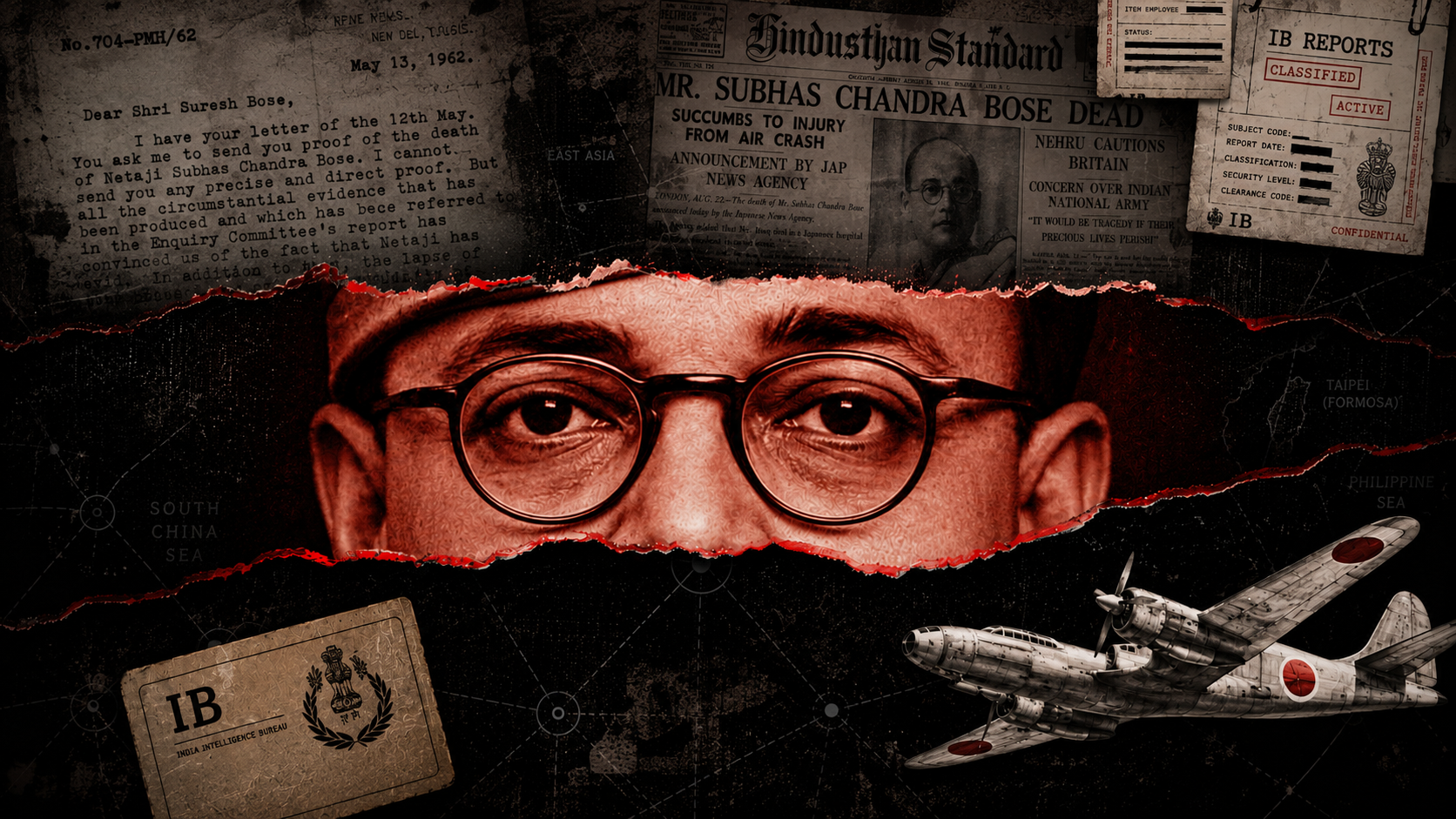
Everything in this article is drawn from the evidence and arguments presented in Anuj Dhar and Chandrachur Ghose's The Bose Deception: Declassified (Vintage/Penguin Random House India, 2024). Page numbers refer to the ebook edition consulted, which carries no printed pagination.The story the world was told
On 23 August 1945, a Japanese news agency announcement went out across the world. Five days earlier, it said, a plane carrying Subhas Chandra Bose to Tokyo had crashed at the Taihoku airfield, today's Taipei, at two in the afternoon. Bose was given treatment in hospital, where he died at midnight. Lieutenant General Tsunamasa Shidei was killed instantly. Bose's adjutant Habibur Rahman and four Japanese officers were injured.[1]
In India the news landed like a blow. Condolence meetings formed on the streets of Kolkata. Markets stayed shut in Amritsar and Ahmedabad. Gandhi wrote that Bose had "died well." Nehru told a public meeting that Bose had escaped the troubles brave soldiers face at the end. His brother Sarat, imprisoned in Coonoor, read it in the morning papers and wrote of a blow too hard to bear.[2]
That is the official account. It became the position of the Indian state in October 1946, when Nehru confirmed it, though the first response from Home Member Vallabhbhai Patel had been that the government was not sure whether the news was correct at all.[3]
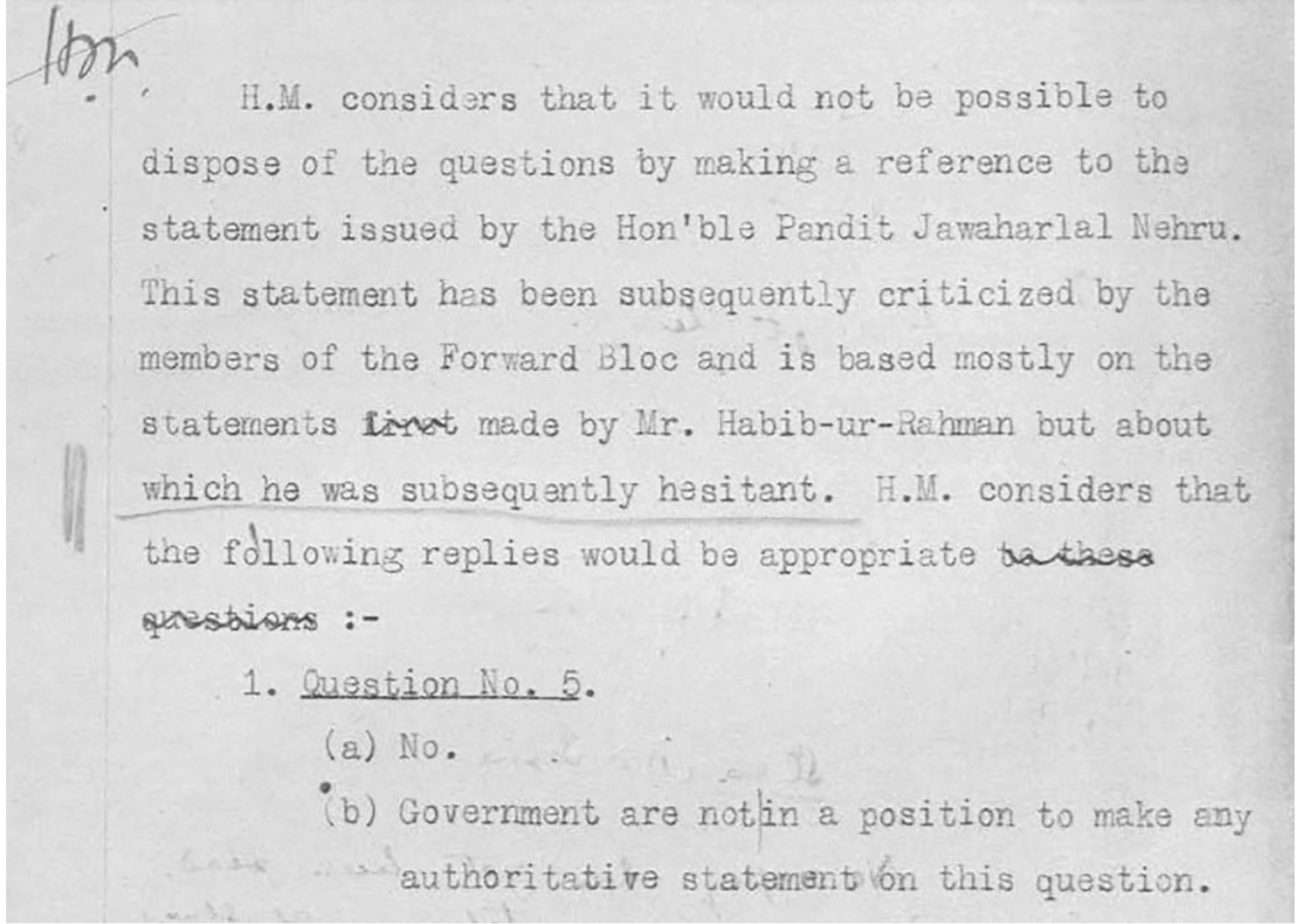
Figure 3.9, p 72
It has never formally been replaced. But it has been investigated four times, and the fourth inquiry rejected it.
The doubts began immediately
Four days after mourning him, Gandhi changed his mind. On 27 August he sent a telegram to Amiya Nath saying he was suspicious of the news, and that if the family shared his suspicion they should not perform the funeral ceremony.[4]
He was not alone, and the other doubter is the more surprising one. Viceroy Field Marshal Archibald Wavell wrote in his diary on 23 August, the very day the news broke, that the announcement was "just what should be given out if he meant to go underground".[5] Wavell's instinct was to order an inquiry.
Consider what that means. The head of the British administration in India, the man with most to gain from Bose being dead, did not believe it.
Then, on 29 August, at a Nehru press conference, an American journalist from the Chicago Tribune named Alfred Wag stood up and challenged the report. He said he had seen Bose in Saigon days after the alleged crash, and asked why Bose should not be tried as a war criminal. Reporting it, the Sunday Observer of London added that the story of Bose's death was not believed in British and American military circles.[6]
Within eleven days of the announcement, the two governments best placed to know had privately declined to accept it.
What British intelligence actually found
This is where the official story begins to come apart, and it comes apart in Britain's own files.
On 22 November 1945, the Saigon Control Commission reported that "there is still no proof of Bose's death though it is assumed".[7] An earlier assessment from Allied headquarters in Saigon, built on interviews with Japanese officers, recorded something stranger. The Japanese believed Bose was dead, but were in no doubt he had long been preparing an alternative. Bose intended to reach Manchuria, and from there to contact Russian forces. That, they said, was why he left Singapore on 16 August.[8]
The documentary version of this investigation runs twelve minutes: the Taihoku crash, the death record no government ever filed, and the cremation register that names someone else.
Hold on to that detail. It returns later, and it changes the shape of everything.
Photographs taken by the Japanese at Taipei reached New Delhi that November. There were five. One showed Rahman sitting, bandaged. One showed a shrouded corpse. The remaining three showed the wreckage of a plane. Not one of them showed Bose's body.[9]
Rahman himself was flown to Delhi and interrogated repeatedly. On 7 January 1946 the head of British counter-intelligence in India wrote that the results established "beyond any doubt" that Bose had died of his injuries, and then, in the same breath, asked for a team to be sent to Taiwan to examine the hospital records.[10] Certainty that requires confirmation is not certainty.
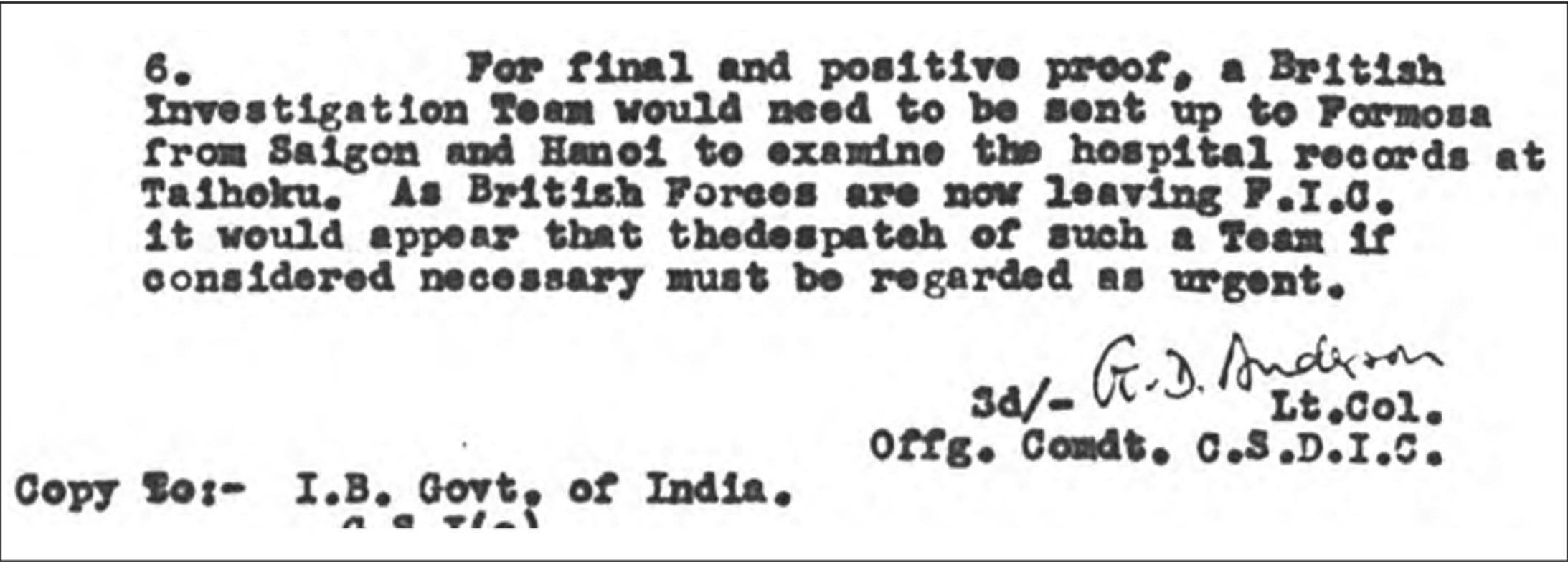
Figure 3.7, p 69
The confirmation never came. Instead the doubts grew. Bose's closest aides, Gulzara Singh, Pritam Singh, Abid Hasan, A.C. Chatterji, Anand Mohan Sahay, John Thivy, were interrogated separately and turned out to have no positive information about his death at all.[11]
Major Hugh Toye, who would later write Bose's first serious biography, asked a question nobody could answer. Why did Bose need the entire top leadership of his government and army gathered around him in Bangkok if he was, as claimed, merely going to arrange a separate surrender? "To what end this wealth of talent," Toye wrote, if Bose was "only going on a routine INA job which Bhonsle or Kiani could have done just as well?"[12]
The witness everything depends on
Habibur Rahman was the only Indian said to have been beside Bose from the crash to his death. Everything rests on him.
Rahman told a US Army interrogator in Tokyo that after the crash "he had no knowledge of how Bose escaped or was removed from the plane." To the interrogator in Delhi he gave a detailed account instead: the impact burst open the celluloid cover above the cockpit, and Bose crawled through it and dropped to the ground. In Tokyo he said his own coat was on fire. In Delhi he said his clothes were not on fire.[13]
These are not differences of emphasis. A man either knows how his commander left a burning aircraft or he does not.
The deputy director of the Intelligence Bureau, reviewing the evidence on 19 February 1946, wrote that the result was "not entirely satisfactory for it reveals many discrepancies," and described Rahman's statements as "unsatisfactory".[14]
His conclusion is the most quietly devastating sentence in the whole affair: unless there was "a very cleverly contrived and executed deception plot involving a very few of the highest Japanese officials, Bose is almost certainly dead".[15]
Read that again. The senior intelligence officer assessing the case had identified the only alternative explanation, a small, high-level Japanese deception, and could not rule it out. His certainty was conditional, and the condition was precisely the thing he had no way to test.
The doctor was no steadier. Dr Yoshimi, the senior surgeon said to have treated Bose, made contradictory statements to his own interrogator from the War Crimes Liaison section.[16]
How the British closed the file
In May 1946 the Allied command in Southeast Asia directed Lieutenant Colonel John Figgess, attached to MacArthur's headquarters in Tokyo, to make a fresh inquiry.[17] Figgess produced the report that effectively settled the matter for the British, the report on which the official version has rested ever since.
Two things about it deserve attention.
First, its timing. As matters stood in the first half of 1946, neither the British nor the Americans were fully convinced of Bose's death, despite detailed investigation by the agencies of both countries.[18] The file was not closed because the evidence had become overwhelming. It was closed because somebody was asked to close it.
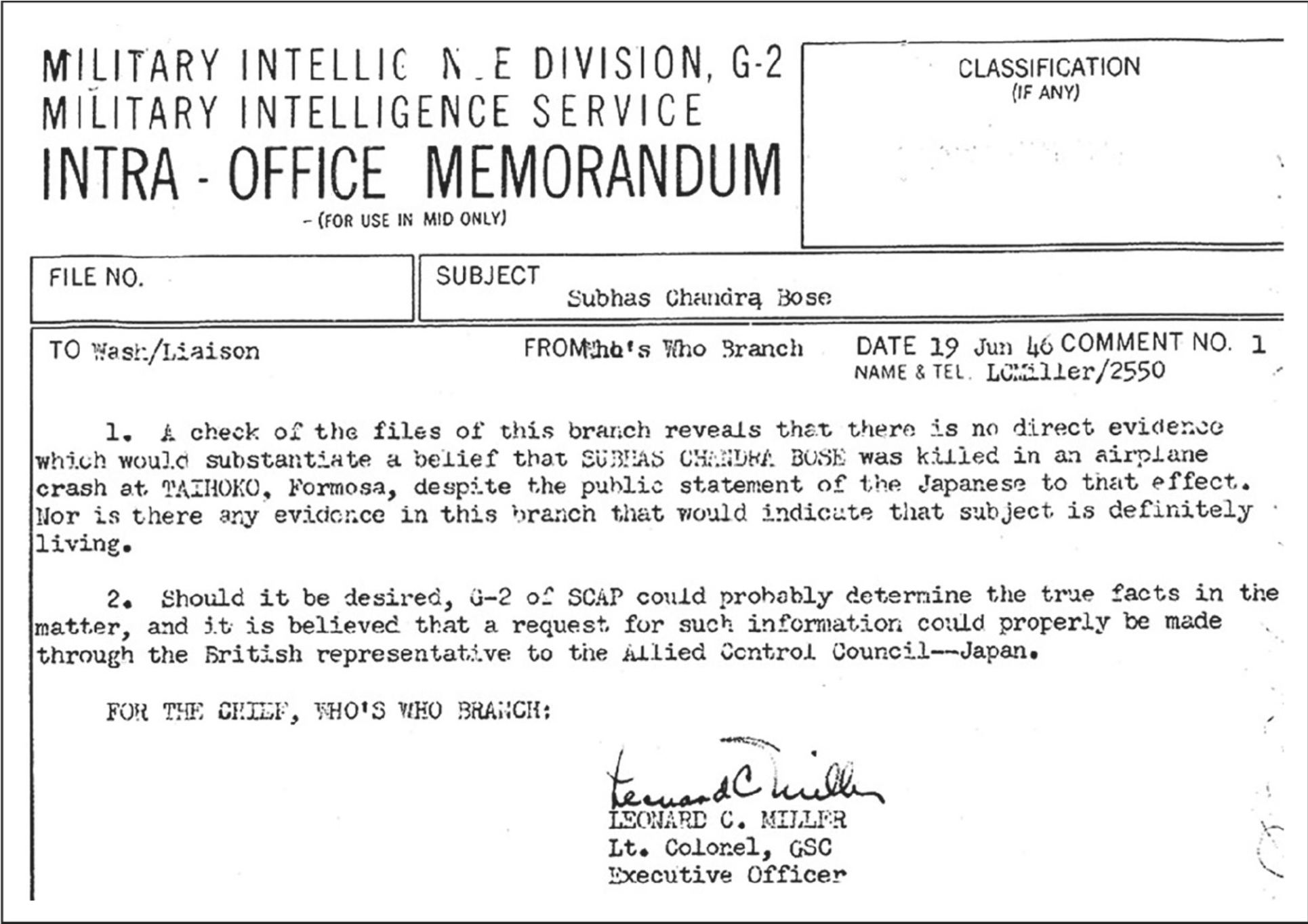
Figure 3.6, p 67
Second, its foundation. Figgess recorded a firm conclusion based on what one Japanese witness, Tsuruta, told him, while the senior surgeon at the same hospital, Yoshimi, was giving contradictory statements to a different British interrogator.[19] Two doctors, one hospital, one patient, two irreconcilable accounts. The inquiry that closed the case relied on one and did not resolve the other.
Figgess ended his report with an offer that reads oddly in hindsight: "The ashes of Subhas Chandra Bose now repose in a Buddhist temple in Tokyo where the casket was lodged by Mr Munga Ramamurti... If it is considered desirable, the ashes can be returned to the relatives in India".[20] Nobody had established that the ashes were his. The report simply assumed it.
The inquiry that confirmed the death, and listed its own contradictions
In 1956 the Indian government appointed a committee under INA General Shah Nawaz Khan. It upheld the Taipei death theory. For nearly seventy years it has been cited as the answer. Almost nobody reads what it actually says.
The book reproduces a selection from the Shah Nawaz Khan Committee report verbatim.[21] What follows is not criticism of the report by its opponents. It is the report's own accounting of the evidence it received: Different witnesses gave the time of the halt at Taipei airfield as anywhere from half an hour to two hours. Witnesses inside the plane gave different estimates of the height it fell from.[22]
On the aircraft itself: Habibur Rahman said the plane split at the front. Captain Nakamura was positive the plane was intact and the body of the aircraft not broken. Lieutenant Colonel Nonogaki said the two split parts went in different directions on the ground.[23] Three men in the same crash could not agree on whether the aeroplane broke apart.
On Bose leaving the plane: Major Takahashi said he saw Bose get out from the left front portion, clothes on fire, trying to remove his coat, and that Takahashi himself went to him, rolled him on the ground and put out the flames, with Rahman present but playing a passive role.[24] Rahman's own account gave that role to himself.
On who died: Captain Nakamura said definitely that Pilot Takizawa and Co-Pilot Ayoagi perished along with General Shidei, and that he helped bury their remains and place their ashes in three boxes. Doctors Yoshimi and Tsuruta said definitely that they treated Co-Pilot Ayoagi, who died later in hospital.[25] One man says he cremated the co-pilot at the crash site. Two doctors say they treated him afterwards in a hospital bed.
On the treatment itself: Rahman said Bose was taken to an operation theatre and given a white transfusion he thought was camphor. The Japanese doctors made no reference to any operation theatre. Yoshimi described drawing off about 200cc of Bose's blood and transfusing 400cc in its place. Dr Tsuruta, who also attended Bose, stated that no blood transfusion was given. Rahman, in the same ward, could not remember whether there was one.[26] The committee's own words on this: "There is no way of reconciling these different statements and they must remain as they are".[27] On the injuries: Rahman said Bose had a four-inch cut on his head which was bleeding. The report notes flatly: "This is a discrepancy".[28]
On who was even present: there was disagreement among the witnesses about who was in the same ward as Bose.[29]
On the moment of death: "the time of death cannot be established with accuracy; it could be any time between 8pm and midnight on the 18th August 1945." Nonogaki said staff officers arrived while Bose was still alive. The staff officers themselves, Colonel Miyata and Major Nagatomo, said they arrived after he had died.[30]
And on what happened next: the news was kept secret and known only to high-ranking officers, and "apparently, no particular interest was taken by the local army command as to what happened to Netaji's body".[31]
There is one more line, and it is the report quietly admitting the hole at its centre: "One would have at least expected a formal inquiry into the air crash".[32] There was none. Having catalogued all of this, the committee still reached its conclusion, but notice how it had to be phrased. Not that the ashes at Renkoji are Bose's, but that "it can be said that, in all probability, the ashes kept in Renkoji temple, Tokyo, are the ashes of Netaji Subhas Chandra Bose".[33] This is the finding that closed the question for the Indian state. It is written in the language of an estimate.
The brother who refused to sign
The Shah Nawaz Committee had three members. One of them was Bose's own elder brother, Suresh Chandra Bose. He did not sign.
Suresh had begun as a participant in good faith. Over the course of the inquiry he came to a different view, and told his colleagues he was veering towards the conclusion that the Taipei plane crash theory was untrue. Shah Nawaz Khan told him that in that case he would have to write a separate dissenting report. Suresh asked for copies of the relevant papers, exhibits and photographs so he could do so.[34]
What happened next is part of the record. On 29 July 1956 he received a communication demanding he submit his dissent within two days. He saw the government's hand behind the pressure. A few days later, the majority findings were leaked to a Kolkata newspaper before publication.[35] Suresh submitted his dissent in October 1956, ascribing the delay to the government and to Shah Nawaz Khan.[36]
He ended it not by asserting that his brother was alive, but with an appeal: that Indians should accept neither his report nor the majority one, and should instead demand that the government make all the records public and judge for themselves which version was correct.[37] Sixty-eight years later, that is still the unanswered demand.
The documents that do not exist
Testimony can be mistaken, coached, or simply confused after decades. Paper is harder to argue with. So the natural question is what the records show. The answer is that there are none. In November 2002, the secretary of the Mukherjee Commission recorded that the commission had not found any authentic contemporary death certificate, cremation certificate, or cremation permit for Bose.[38] Not a disputed one. None.
India asked Japan for the originals, the register of cremation permits for 18 to 21 August 1945. Japanese officials tried, and reported back in September 2003: "We have tried our best to find in our old files, a copy of the documents … However, we are not able to find it so far. You may understand how difficult it is to find nearly half-a-century old documents".[39]
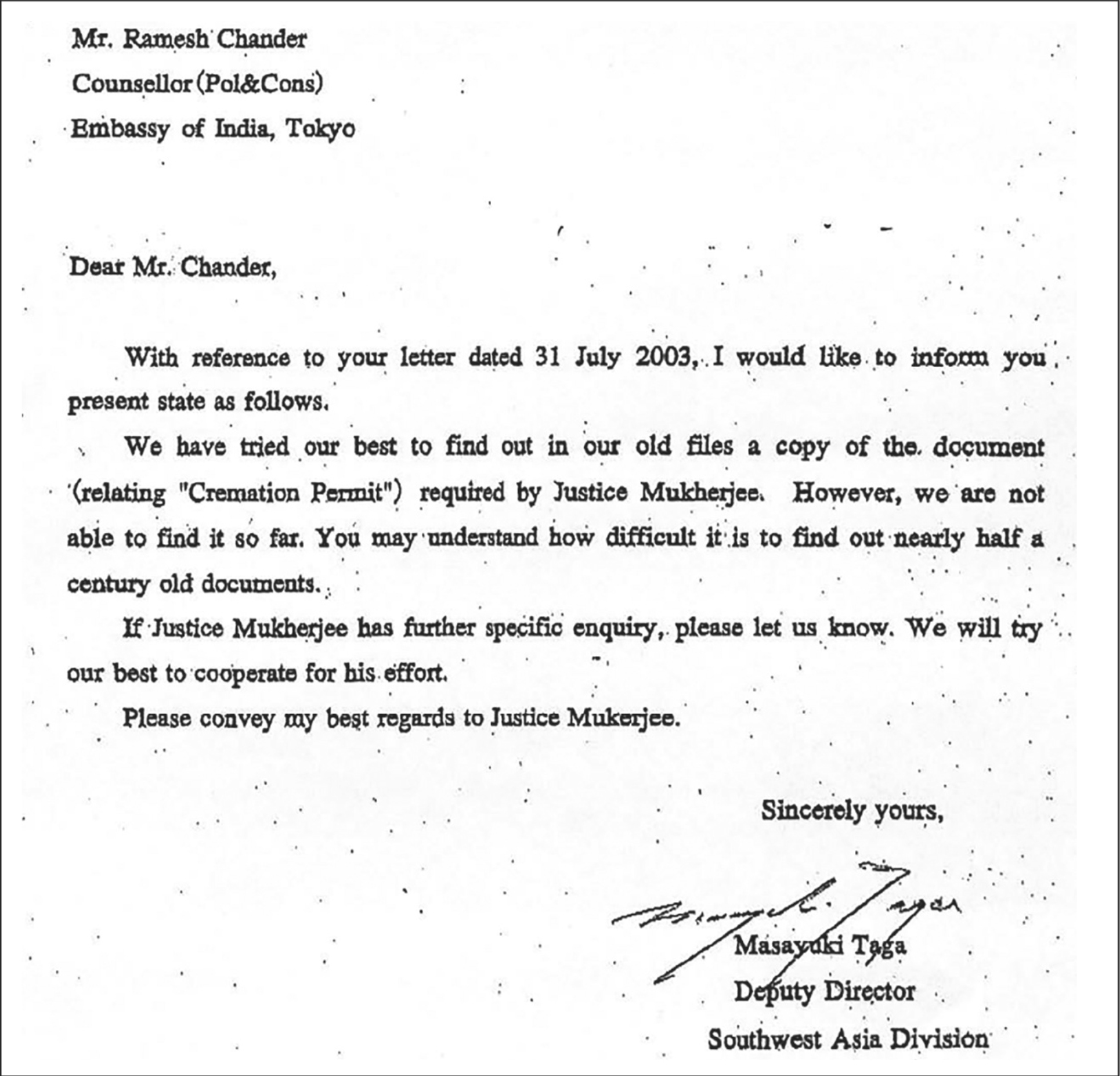
Figure 8.7, p 240
The book's response to that is worth pausing on, because it converts an excuse into evidence. When Pervez Musharraf visited India in 2005, Delhi municipal clerks located his family's 1940s birth records in a single day's search of ledgers. When the journalist Mark Tully needed his 1935 Indian birth certificate in 2013, Kolkata's corporation found it and handed it to him at a ceremony.[40] Ordinary people's wartime paperwork survives routinely, in both countries. The paperwork for the death of the most wanted man in Asia does not.
Before the Mukherjee Commission, the counsel, including counsel for the Government of India, argued that "not a scrap of paper, not to speak of any contemporary official document" corroborated the crash, though records would have been kept in the ordinary course of business for the deaths of a major ally of Japan and a general of the Japanese army.[41]
The same counsel raised a physical objection that is easy to picture. On Rahman's own evidence, when the plane nosedived from a considerable height, the passengers were squatting on the floor, not strapped into seats. If that were so, everyone and everything inside would have been hurled forward, and in that event "even half of the passengers could not have survived or come out of the plane either unhurt or with some minor injuries as claimed by them." Bose, seated beneath a fuel tank, could not have been drenched in petrol at the moment of impact, because he could not still have been in his original position on the floor.[42]
Ichiro Okura
There is one document. It is the strangest thing in the case.
When the journalist Harin Shah went to Taipei in 1946 and asked the health bureau for the records of Bose's death and cremation, clerks who had been on duty in August 1945 produced three papers: a doctor's report, a police report, and a certificate permitting cremation. All three were in the name of Ichiro Okura, a Japanese soldier who had died of a heart attack on 19 August.[43]
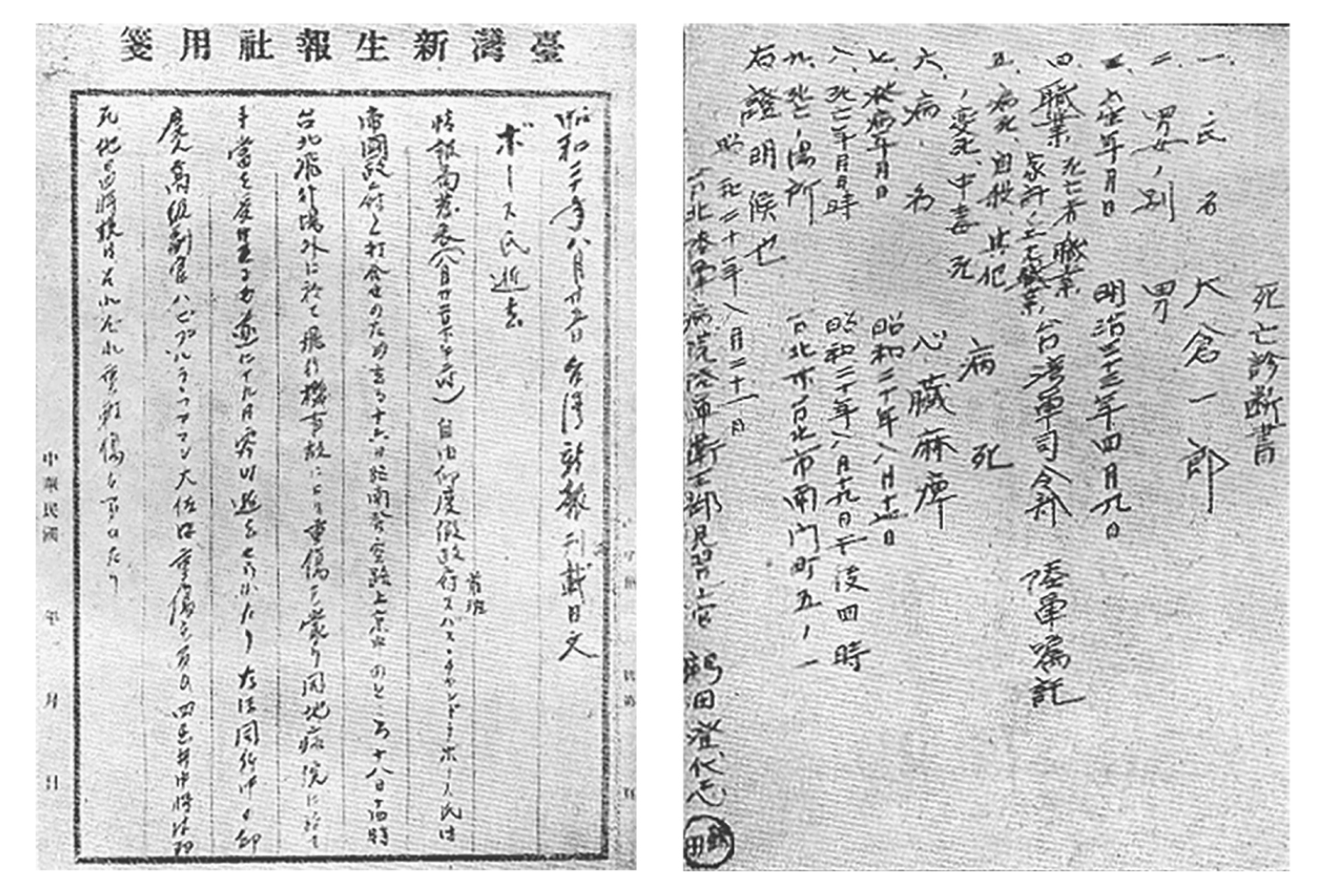
Figure 3.8, p 71
Asked why the particulars were false, the clerks said a Japanese officer accompanying the body had told them the identity had to be kept confidential for reasons of state.[44]
That explanation held for decades. It is the version Shah himself accepted, testifying later that although the papers named Okura they in fact related to Bose, a false name having been used to keep the death secret.[45] Then it broke on a date.
Every account, including the Japanese government's, places Bose's death on 18 August. Okura died on the 19th. The permit therefore cannot be Bose's.[46] Worse, Dr Yoshimi, the doctor who supposedly treated Bose and applied for the permit, testified under oath before Justice Mukherjee that he had applied using a death certificate he issued in the name of Chandra Bose. He denied issuing any certificate for Okura. He denied knowing anyone by that name.[47]
So the only surviving cremation document is one the applying doctor says he never applied for, in a name he says he never heard, for a death on the wrong day.
This is not a fringe reading. Justice Khosla, who accepted the crash theory and whose 1970 commission upheld it, looked at these same papers and wrote that they "relate to a totally different person and not Bose at all".[48]
Both judges who examined the Okura documents concluded they were not about Bose. The difference is that one of them then went looking for the documents that were.
Why a missing permit matters more than it looks
It would be easy to treat a missing certificate as bureaucratic untidiness in a collapsing empire. The book shows why it is not, and this is where the case tightens.
Taiwanese regulations in 1945 required a specific sequence. First, a doctor's report of the death. Then an application in a prescribed form, filed by a family member, giving the date of birth, the nature of the illness causing death, and the date and time of death. Then, and this is the part that matters, the body had to be brought before the bureau so that officials could verify the particulars against it. Only after that verification was a permit issued, and only with that permit could a cremation proceed.[49]
A body could not be burned in Taipei without officials looking at it and writing down what they saw.
So if Bose's body was cremated in Taipei in August 1945, a specific chain of paper was created by law: a doctor's report, a family member's application, an inspection, a permit. Four documents, at least, in the ordinary course of an administration that was still functioning well enough to process Ichiro Okura's cremation three days later. None of it exists.
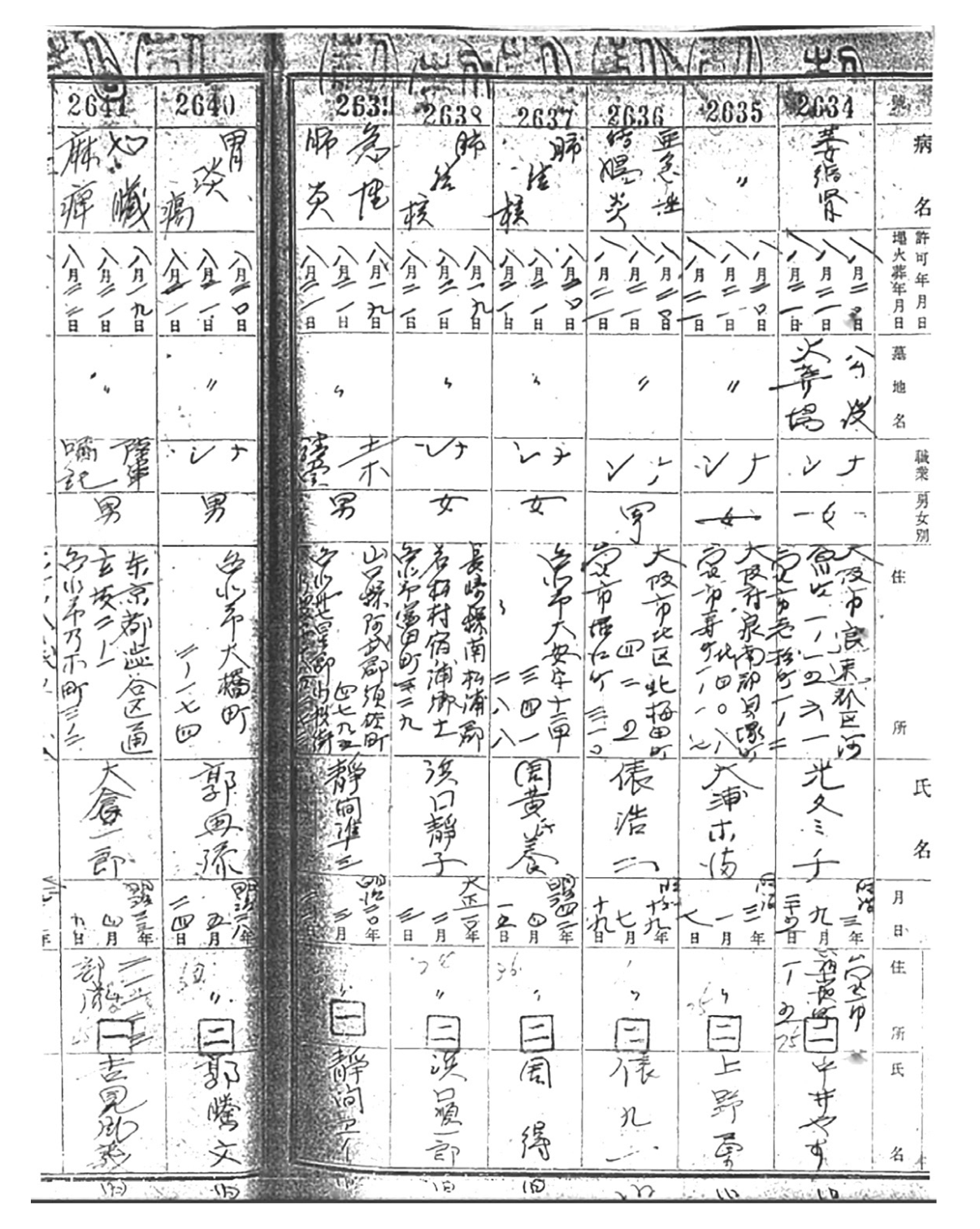
Figure 8.13, p 251
That is the difference between a missing record and an absent one. A missing record is a filing failure. An absent record is evidence that the event which would have generated it did not occur in the way described.
Taiwan's own answer
Justice Mukherjee went to Taipei. He asked the city government for the basis of their statement that there had been no plane crash on 18 August 1945. They told him it rested on contemporary newspaper archives, and a visit to the Institute of Taiwanese History confirmed it in the microfilmed dailies.[50]
Others had reached the same place independently, decades earlier. Investigating in Taiwan, Satya Narayan Sinha spoke to local officials, including men from the fire brigade, as one of them put it, the people who rush to the site of an accident first. After seven days he concluded there had been no plane crash on 18 August 1945.[51]
And in 1956, at Britain's request, Taiwanese police conducted their own inquiry. The report was handed to New Delhi and then buried; the book notes that never a word was uttered about it by anyone. Its contents are not sensational. Its title is. It reads: "Failed to prove that Indian National Army leader Bose died in Taiwan during World War II".[52]
The Indian government has held that document since 1956.
The ashes
The remains at the Renkoji temple in Tokyo have been offered for eighty years as the physical proof. Their history is more casual than most people assume.
An urn was brought to Tokyo and handed to S.A. Ayer at the entrance to the Imperial Military Headquarters. What survived of the INA treasure Bose had been carrying went separately to Munga Ramamurti, a local leader of the Indian Independence League. Ayer and Ramamurti took the urn to Renkoji temple in suburban Tokyo so that it would not fall into Allied hands. The priest, Reverend Kyoei Mochizuki, who admired Bose, agreed to keep it temporarily.[53] The temporary arrangement has now lasted eight decades.
They have never been tested. The one attempt to look inside is instructive. A CNN bureau chief, told that Habibur Rahman had placed a burnt gold-plated tooth of Bose's into the urn, brought a portable X-ray device to the temple and asked to scan it. The priest refused, saying he was hearing about the gold-plated tooth for the first time.[54]
Calls for a DNA test have come from people on both sides of the argument, including from within Bose's own family and from those who firmly believe the Taipei account.[55] It has not been done.
Eighty years, four inquiries, and the one object that could settle the question by physical evidence has never been examined.
Where was he actually going?
Every account so far has treated the flight as a journey to Tokyo interrupted by an accident. The evidence in the book suggests the destination was somewhere else entirely, and that the Japanese high command knew it.
American signals intelligence intercepted Japanese diplomatic traffic in 1945. In it, Bose had repeatedly asked the Japanese government to use its good offices "in establishing contacts between the Indian provisional government and the Soviet Union." On 24 June, the Japanese foreign minister forwarded a message Bose wanted secretly conveyed to the physicist Meghnad Saha, then in Moscow, asking him to do his best "to arouse the sympathy of the Russian government toward the fight for Indian independence".[56]
Anand Mohan Sahay told British interrogators that Japanese foreign office officials said Bose had wanted to contact the Russian ambassador on his last visit to Tokyo but could not, for lack of Japanese support. Bose later told Sahay directly that he had asked the Japanese Army to arrange his passage to Russia via Manchuria.[57]
Then comes the testimony that matters most, because it came from a Japanese officer who was in the room. Lieutenant Colonel Morio Takakura told the Khosla Commission that in June 1945 he attended a meeting in Bangkok where Bose, Field Marshal Terauchi and General Isoda worked through Tokyo's inability to approach the Russians on Bose's behalf. The outcome, in Takakura's words: "The HQ at Tokyo accepted the plan of Netaji for his going to Russia via Dairen and the HQ selected Lt Gen Shidei to accompany Netaji".[58]
Shidei, the general who died instantly in the crash, had been chosen to escort Bose to Soviet territory.
Justice Khosla was impressed by Takakura, calling his manner entirely disinterested and writing in his report that "there is no reason why reliance should not be placed on his testimony".[59] He then concluded that Bose and Rahman were a "sudden and unanticipated addition" to a flight arranged to carry Shidei and other Japanese officers.[60] He believed the witness and rejected what the witness said.
Others corroborated it. Taro Kono, one of the survivors of the reported crash, recalled Shidei telling him that Bose was going to the Soviet Union and that he was to accompany and look after him. General Isoda testified that he and Bose worked out the last-minute arrangements for the transfer to Manchuria in Bangkok on 16 August 1945, and told Khosla that Bose was on his way to Russia to continue the struggle.[61]
Major Bhaskaran Menon, Bose's confidential secretary, told the Khosla Commission that Bose had sent a secret message to the USSR, something he could not have done without prior contact. Thirty years later he affirmed to the Mukherjee Commission that from April 1945 onwards Bose had discussed his plan to reach Russia through Manchuria with General Isoda on a number of occasions.[62]
Menon also described Bose's last night. After the Bangkok meeting Bose grew restless in a way Menon had never seen. He did not sleep. He spent the night issuing instructions and settling matters as though it were his last day at work, dictating message after message. And he dictated one line whose meaning only became clear later: "I am writing all this to you on the eve of a long journey by air and who knows an accident may not overtake me".[63]
Colonel Pritam Singh, who stayed by Bose's side until the evening of 17 August and expected to follow him to the USSR, told the Mukherjee Commission that Bose had confided that the negotiations with the Russians had succeeded and that he would be welcome. Bose told him to prepare for a long absence: "we might have to stay outside India for about ten years or even more, depending upon the world situation".[64]
And Bose's own reasoning, recorded by the Japanese interpreter Kinji Watanabe in a statement to Indian intelligence, explains why Tokyo would agree. If Japan let him approach Moscow, Bose argued, he could persuade Russia to help Indian independence and simultaneously improve Japanese–Soviet relations, easing the threat on the Manchurian frontier. "I trust if I succeed it will result in killing two birds with one stone. And if my trial proves unsuccessful, I shall only lose my face, that's all".[65]
Two independent sources, the intercepted diplomatic cable and the interpreter's statement, converge on the same plan.[66]
None of this proves Bose survived. What it establishes is motive and mechanism: a man with a documented plan to disappear into Soviet territory, a Japanese high command that had agreed to it, and a general assigned to take him there, all in the same fortnight as an announced death that the British immediately read as cover for going underground.
Khosla's answer was that Bose had contemplated Russian aid but had not made up his mind, his plans "vague and amorphous" amid the chaos.[67] That is a possible reading. It is not an easy one to square with a general being formally assigned to the journey.
What the judge concluded
Justice Mukherjee did not begin by rejecting the crash. He began by assuming it was true, and asked what evidence would be needed to establish it. He set a standard any reader can follow: probability, and the old rule that "men may lie but circumstances do not".[68]
His view was that the only evidence which could unmistakably prove death and cremation was contemporaneous official records, and that without them no firm finding could rest on assertions alone.[69] He noted that the earlier inquiries had relied solely on oral testimony without ever searching the records of Taipei airport, the army hospital, the municipal health bureau or the crematorium, or recording the fact if no such records existed.[70]
He looked for them himself. In Delhi, in Tokyo, in Taipei. They were not there, while, as the book notes drily, the personnel files of peons attached to an earlier commission had survived perfectly well in the Indian archives.[71]
He told the authors privately that he had many reasons to reject the plane crash theory, but confined his report to those he considered legally unassailable.[72]
His conclusion was that the official version of Bose's death in a plane crash was a smokescreen for his escape towards Soviet Russia.[73]
What the government did with the answer
A commission of inquiry is meant to settle a public question. What happened to this one is part of the evidence.
The Mukherjee Commission reported in September 2005. The judge did not deliver it in person; an official arrived instead, saying he was unwell. Months earlier the same judge had been summoned before the home minister, not offered a seat, and reprimanded for wasting money.[74]
The report was then treated as top secret. Three printing presses were inspected before one was chosen, the deciding factor being that its owner had a CCTV camera at his desk from which he could watch the workers handling a job "of Secret nature." A dozen ministry officials supervised the printing, and Delhi Police were stationed at the press around the clock.[75]
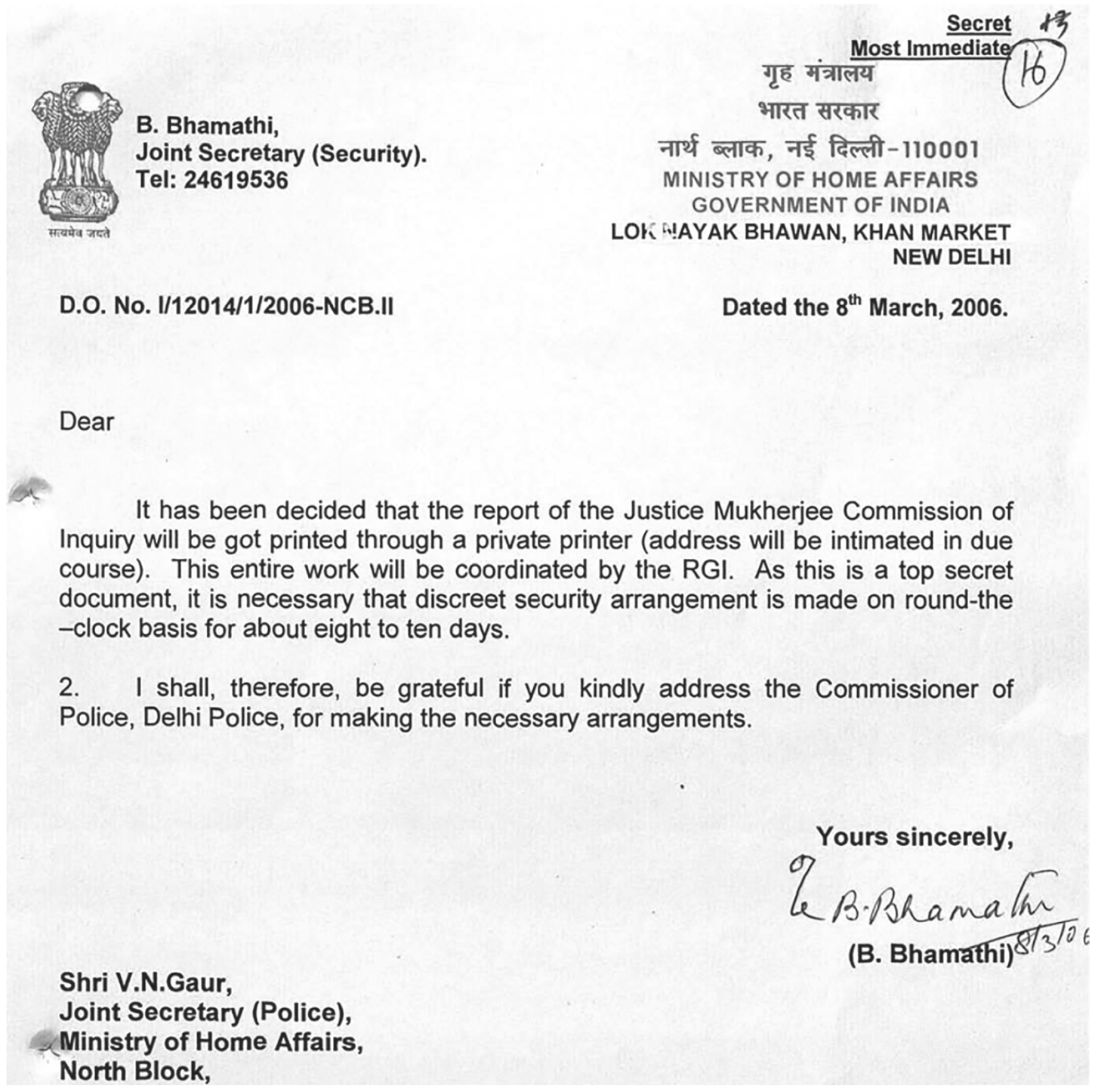
Figure 1.2, p 11
The government rejected the report's central finding.[76]
The book notes that this had happened before. In 1956 the Shah Nawaz Committee's conclusion was leaked to a Kolkata daily a month before publication; when a member complained, the prime minister suggested it was "some kind of an intelligent guess by some reporter or some clerk in our office".[77] In 2006 the government's dismissal of Mukherjee's findings reached the front page of the Hindustan Times while the presses were still running.[78]
Four inquiries in sixty years. The three that endorsed the official story were accepted. The one that did not was guarded like a state secret and then set aside.
Bringing it together
Take the pieces separately and each has an answer. Wartime chaos. Faulty memory. Lost paperwork. Secrecy. Decades between event and testimony.
Take them together and the answers stop working.
There is no death certificate. No cremation certificate. No cremation permit — under a system that could not have issued one without an official physically inspecting the body. No formal inquiry into the crash, as the Shah Nawaz report itself noted with evident discomfort. No photograph of the body, from five photographs taken at the scene.
The witnesses cannot agree on whether the aircraft broke apart, how long it had waited at the airfield, how high it fell from, who pulled Bose from the wreck, whether he was given a blood transfusion, who was in his ward, or what hour he died. The co-pilot was cremated at the crash site by one witness and treated in hospital by two others. The committee that recorded all this wrote that there was no way of reconciling the statements, and then concluded that Bose had probably died anyway.
The sole Indian eyewitness contradicted himself between Tokyo and Delhi, and British intelligence called him unsatisfactory at the time. The senior surgeon contradicted his own interrogator, and now denies the one surviving document. That document is in another man's name, for a death on a different day — and both judges who examined it agreed it was not about Bose.
Taiwan's contemporary newspapers record no crash. Taiwanese police reported a failure to prove the death. The ashes have never been tested. And a Japanese general had been formally assigned to escort Bose into Soviet territory in exactly the days when he is said to have died on the way to Tokyo.
The mystery here is not built from imagination. It is built from the gaps in the official story itself.
Conclusion
The claim that Subhas Chandra Bose died at Taihoku on 18 August 1945 rests entirely on testimony — and that testimony, tested, does not hold. It is contradicted internally on nearly every material fact. It was doubted at the time by the intelligence services of the very government that most wanted him dead. It is unsupported by a single contemporaneous official document anywhere in three countries. And it is contradicted by the records of the place where it is said to have happened.
The reasoning that follows is simple enough for anyone. To establish that a man died, you need evidence of his death. If the evidence offered is contradictory wherever it is detailed, missing wherever it should exist, and in another man's name wherever it survives, then the death is not established. It may still have happened. But it has not been shown, and eighty years is long enough to have shown it.
On the evidence assembled in The Bose Deception, the reported plane crash did not take place, and the official account of Bose's death cannot be accepted as fact.
That is why this remains among the most important unresolved questions in modern Indian history. Not because people wish to believe a romantic story about a leader who escaped, but because eighty years on, the state has never produced the ordinary paperwork that any ordinary death produces, and has treated the one inquiry that said so as a document to be hidden rather than answered.
Suresh Chandra Bose, refusing to sign the report that buried his brother, did not ask his countrymen to believe him. He asked that the records be opened so they could judge for themselves.[79]
That request has still not been granted. Until it is, the questions will not go away, and they were never invented by those who ask them. They were created by the answer that was given, and by everything that was never found afterwards.
Notes
All notes refer to Anuj Dhar and Chandrachur Ghose, The Bose Deception: Declassified (Vintage/Penguin Random House India, 2024), shortened below to The Bose Deception. Page numbers are pages of the ebook edition consulted. Each page number is followed by the primary source the book itself gives for that passage.
Abbreviations:
NAI: National Archives of India, New Delhi.
MoD, MEA, MHA: files of the Ministry of Defence, Ministry of External Affairs and Ministry of Home Affairs, held at the NAI.
NARA: US National Archives and Records Administration, College Park, Maryland.
CSDIC: Combined Services Detailed Interrogation Centre (India).
SACSEA: Supreme Allied Command, Southeast Asia.
IB: Intelligence Bureau.
RTI: Right to Information Act, 2005.
Shah Nawaz report: Netaji Inquiry Committee Report (Government of India Press, New Delhi, 1956).
Dissentient Report: Suresh Chandra Bose's dissent from that committee, MEA file 24(20)-FEA/56, NAI.
Khosla report: Report of the One-Man Commission of Inquiry into the Disappearance of Netaji Subhas Chandra Bose (30 June 1974).
Mukherjee report: Report of the Justice Mukherjee Commission of Inquiry on the Alleged Disappearance of Netaji Subhas Chandra Bose, Vol. I.
[1] The Bose Deception, p 38, citing Hindusthan Standard, 25 August 1945, p 1.
[2] The Bose Deception, p 38. Gandhi: letter to Amrit Kaur, in The Collected Works of Mahatma Gandhi (electronic book, Publications Division, Government of India, 1999), Vol. 87, pp 398–99. Nehru: speech to a public meeting, in S. Gopal (ed.), Selected Works of Jawaharlal Nehru, Vol. 14 (Orient Longman, 1981), p 336. Sarat Bose: the book quotes him from Sugata Bose, 'The mortal end of a deathless hero', Indian Express, 21 May 2006, a later article rather than a 1945 document. The book gives no source for the condolence meetings or the closed markets.
[3] The Bose Deception, pp 9 and 71. Page 9 gives no source. Page 71 gives the dates and the file. Nehru said on 12 October 1946 that he believed Bose had died in Taipei. On 30 October 1946 Patel told the Central Assembly that "the government are not in a position to make any authoritative statement as to whether Subhas Chandra Bose is dead or alive". Source: Home Department file 22/79/46-Pol (II), NAI, also catalogued as HOME_POLITICAL_I_1946_NA_F-22-79. By these dates, Patel's statement came after Nehru's.
[4] The Bose Deception, p 39, citing Gandhi's telegram of 27 August 1945 to Amiya Nath Bose, in The Collected Works of Mahatma Gandhi, Vol. 87, p 407.
[5] The Bose Deception, p 39, citing Penderel Moon (ed.), Wavell: The Viceroy's Journal (Oxford University Press, Delhi, 1973), p 164, entry for 23 August 1945. The book gives no separate source for Wavell's wish to order an inquiry.
[6] The Bose Deception, p 39, citing 'Subhas said to be alive: Seen in Saigon', Hindusthan Standard, 30 August 1945, and 'Death of Subhas Bose: Disbelieved in military circles', Hindusthan Standard, 2 September 1945, which reported the Sunday Observer story.
[7] The Bose Deception, p 56, citing Letter No. UB/DO/4, 22 November 1945, from the Saigon Control Commission to the Officer Commanding, CSDIC (India), MoD file INA 400, NAI.
[8] The Bose Deception, p 56, citing the report of 6 November 1945 from SACSEA Commission No. 1, Saigon, MoD file INA 400, NAI.
[9] The Bose Deception, p 56. John Figgess forwarded the photographs to GHQ India on 17 November 1945. A copy of his covering letter is in the IB dossier given to the Shah Nawaz Khan Committee, MHA file I-12014/13/2000-IS(D-III), NAI. The photographs themselves are in MEA file PS-56/NEC, NAI.
[10] The Bose Deception, p 57. Rahman's interrogation: CSDIC (India) Section Report No. 1156, 31 December 1945, MoD file INA 249, NAI. The letter of 7 January 1946: Letter No. 310/B1269 from G.D. Anderson of CSDIC to the Combined Section and the IB, Khosla Commission exhibit No. 23 A, obtained by the authors under the RTI Act. The book reproduces this letter as Figure 3.7 (pp 69–70).
[11] The Bose Deception, p 57, citing Letter No. ST/12/66, 15 January 1946, from S Section, SEAC, to CSDIC, MoD file INA 400, NAI.
[12] The Bose Deception, p 58, citing the same letter of 15 January 1946, MoD file INA 400, NAI.
[13] The Bose Deception, p 58. The Tokyo statement: report by the Counter Intelligence Corps, GHQ, US Army Forces Pacific, Tokyo, 29 September 1945, copy in MoD file INA 400, NAI. The Delhi statement: CSDIC (India) Section Report No. 1156, 31 December 1945, MoD file INA 249, NAI.
[14] The Bose Deception, p 58, citing a letter of 19 February 1946 from W. Mck Wright, deputy director of the IB, to Maj. Courtenay Young of MI5, then at SACSEA headquarters, MoD file INA 273, NAI.
[15] The Bose Deception, p 58, citing the same letter of 19 February 1946, MoD file INA 273, NAI.
[16] The Bose Deception, pp 68–69, citing Dr Taneyoshi Yoshimi's statement of 19 October 1946, taken by Capt. Alfred Raymond Turner of the War Crimes Liaison Section at Stanley Gaol, Hong Kong, MoD file INA 249, NAI.
[17] The Bose Deception, p 64. The book gives no source for the directive of 16 May 1946. Figgess's resulting report, 'Report on the death of Subhas Chandra Bose', 25 July 1946, is cited from Record Group 319, file X8083767, NARA (p 65).
[18] The Bose Deception, p 64. This is the authors' own summary. For the American side, the book (p 66) quotes the reply sent to the US consulate in Bombay in June 1946, after the State Department consulted the War Department: "there is no direct evidence that Subhas Chandra Bose was killed in an airplane crash at Taipei". Source: Record Group 319, file X8083767, NARA. The book reproduces it as Figure 3.6 (p 68).
[19] The Bose Deception, pp 66–69. The comparison is the authors'. Tsuruta's account is taken from Figgess's report of 25 July 1946 (Record Group 319, file X8083767, NARA), which does not mention Yoshimi. Yoshimi's account is his statement of 19 October 1946 (MoD file INA 249, NAI), made three months after Figgess's report.
[20] The Bose Deception, p 66, quoting the last paragraph of Figgess's report of 25 July 1946, Record Group 319, file X8083767, NARA.
[21] The Bose Deception, pp 102–104. The book reproduces these extracts from the Shah Nawaz report word for word, but it does not give the report's own page numbers. Notes 22 to 33 refer to the same extract.
[22] The Bose Deception, p 102, quoting the Shah Nawaz report (see note 21).
[23] The Bose Deception, p 103, quoting the Shah Nawaz report.
[24] The Bose Deception, p 103, quoting the Shah Nawaz report.
[25] The Bose Deception, p 103, quoting the Shah Nawaz report.
[26] The Bose Deception, p 103, quoting the Shah Nawaz report.
[27] The Bose Deception, p 103, quoting the Shah Nawaz report.
[28] The Bose Deception, p 103, quoting the Shah Nawaz report.
[29] The Bose Deception, p 104, quoting the Shah Nawaz report.
[30] The Bose Deception, p 104, quoting the Shah Nawaz report.
[31] The Bose Deception, p 104, quoting the Shah Nawaz report, which gives the secrecy point as J. Nakamura's evidence.
[32] The Bose Deception, p 104, quoting the Shah Nawaz report.
[33] The Bose Deception, p 104, quoting the Shah Nawaz report. On p 110 the book also quotes the report's formal conclusion, citing the Shah Nawaz report, p 61: "Bose met his death in an air crash, and that the ashes now at Renkoji temple, Tokyo, are his ashes".
[34] The Bose Deception, p 108. The book draws Suresh Bose's side of these events from the Dissentient Report.
[35] The Bose Deception, p 110. The two-day deadline and the leak come from Suresh Bose's account in the Dissentient Report. His letter of protest to the prime minister, 15 August 1956, is printed as Appendix G of that report.
[36] The Bose Deception, p 125, citing the Dissentient Report.
[37] The Bose Deception, p 125, citing the Dissentient Report.
[38] The Bose Deception, pp 237–238, citing a letter of 27 November 2002 from P.K. Sengupta, secretary of the Mukherjee Commission, to the Foreign Secretary, MEA file TOK/102/02/03, pp 457–59, NAI. The letter notes that the only related paper the commission had received was a 1956 letter from the Japanese official Hisaji Hattori to A.K. Dar of the Indian embassy, enclosing a certified copy of the Ichiro Okura cremation permit.
[39] The Bose Deception, p 238. The request for the original register is in Sengupta's letter of 27 November 2002 (note 38). Japan's reply: letter of 10 September 2003 from Masayuki Taga, assistant director, South-West Asia Division, Japanese Ministry of Foreign Affairs, to Ramesh Chander, counsellor, Indian embassy, Tokyo, MEA file TOK/102/02/03, p 397, NAI. The book reproduces it as Figure 8.7 (p 240).
[40] The Bose Deception, pp 238–240. These are press reports. Musharraf: 'Manmohan to present Musharraf his birth certificate', Business Recorder, 17 April 2005; 'Gift for Mush: His birth certificate', Times of India, 15 April 2005. Tully: 'Why Mark Tully needs a Calcutta birth certificate at 78', BBC News, 20 August 2013; Saikat Ray and Subhro Niyogi, 'At 78, Kolkata-born British journalist Mark Tully to get his birth certificate', Times of India (Kolkata), 19 November 2013; 'Padma Bhushan-awardee Mark Tully gets birth certificate after 78 years', NDTV, 26 November 2013.
[41] The Bose Deception, pp 253–254, citing the Mukherjee report, Vol. I, p 52, which sets out the counsel's arguments.
[42] The Bose Deception, p 253, citing the Mukherjee report, Vol. I, pp 51–52.
[43] The Bose Deception, pp 254–255, citing the Mukherjee report, Vol. I, pp 61–62, which summarises Harin Shah's evidence to the Shah Nawaz Khan Committee. Shah printed copies of the doctor's report and the cremation permit in his book Verdict from Formosa: Gallant End of Netaji Subhas Chandra Bose (Atma Ram & Sons, New Delhi). The Bose Deception reproduces them as Figure 3.8 (p 71).
[44] The Bose Deception, p 255, citing the Mukherjee report, Vol. I, pp 61–62.
[45] The Bose Deception, p 255, citing the Mukherjee report, Vol. I, p 62.
[46] The Bose Deception, p 238, citing Sengupta's letter of 27 November 2002 (note 38).
[47] The Bose Deception, pp 237–238, citing the same letter, which reports Yoshimi's sworn evidence before Justice Mukherjee.
[48] The Bose Deception, pp 255–256, citing the Mukherjee report, Vol. I, p 66, which quotes the Khosla report.
[49] The Bose Deception, p 256, citing the Mukherjee report, Vol. I, pp 66–67, which draws on the evidence of Harin Shah and the Taiwanese clerks. On the same page the book quotes Chen Chih-Chih, who was in charge of cremations in 1945. He told a 1956 Taiwanese inquiry that for military personnel with no family in Taiwan, a certificate from a military hospital was accepted in place of a family application (Mukherjee report, Vol. I, p 68).
[50] The Bose Deception, p 306, citing the Mukherjee report, Vol. I, p 94. In the passage the book quotes, Justice Mukherjee adds that this "by itself does not negate the story of the plane crash", but that it supports the finding he had already reached on other evidence.
[51] The Bose Deception, pp 149–150. The fireman's words are cited from Satyanarayan Sinha, Netaji Mystery (Prakash Chandra Saha, 1965), p 12. The book says Sinha's official itinerary in Taiwan comes from Taiwanese records found for the authors by Saurav Dangar, but the note for this (chapter 6, note 1) is blank in the ebook.
[52] The Bose Deception, pp 252–253. The book says the report is among the Taiwanese records Saurav Dangar found at Academia Historica, Taipei, and that it was among the papers the British handed to New Delhi in 1956. The note for it (chapter 8, note 56) is blank in the ebook, so no file reference is given.
[53] The Bose Deception, p 50. The book gives no source for this passage.
[54] The Bose Deception, p 202. The CNN bureau chief was Ashis Ray. The book cites a handwritten note of the Indian embassy, Tokyo, dated 28 April 1994, MEA file TOK/551/1/81, pp 6–15, and Ray's memo of 1 August 1994 to A.N. Varma, principal private secretary to the prime minister, MEA file TOK/102/2/92 to 2000, pp 187–88, NAI.
[55] The Bose Deception, pp 212 and 379. Lakshmi Sahgal, who accepted the Taipei account: her letter of 15 March 1999, MHA file VI/11034/18/98-D.III Vol. 1, p 239, NAI. Anita Bose Pfaff, Bose's daughter: Prasun Sonwalkar, 'Netaji's daughter convinced he died in crash, wants DNA test of remains', Hindustan Times, 22 January 2016; Sandeep Unnithan, 'You can present any amount of proof, but certain people will not believe it: Anita Bose', India Today, 8 February 2016. The book also records that the urn was opened and photographed for the Mukherjee Commission in 2002, but that no DNA test could be carried out (pp 226–229). It also records that Sugata Bose tried a DNA test at Harvard on a portion of the remains, without result (p 379).
[56] The Bose Deception, pp 322–323, citing 'Magic' Diplomatic Summary No. 1188, 26 June 1945, Office of the Assistant Chief of Staff, G-2, US War Department, held by the US Army Heritage and Education Center.
[57] The Bose Deception, p 323, citing Maj. Hugh Toye's report to the Commandant, CSDIC (India), Red Fort, 28 February 1946, MoD file INA 400, NAI.
[58] The Bose Deception, pp 323–324, citing Takakura's evidence in the record of proceedings of the Khosla Commission, Vol. VI, p 2450, obtained under the RTI Act.
[59] The Bose Deception, p 324, citing the Khosla report, p 22.
[60] The Bose Deception, p 324, citing the Khosla report, p 38.
[61] The Bose Deception, p 324. The book gives no separate source for Kono's and Isoda's evidence, beyond saying that Isoda gave his to Justice Khosla.
[62] The Bose Deception, p 324. The book gives no source for Menon's evidence to the Khosla Commission. His statement to the Mukherjee Commission is cited from the record of his deposition of 15 July 2000.
[63] The Bose Deception, pp 45–46 and 324, citing Bhaskaran Menon's deposition before the Mukherjee Commission, 15 July 2000.
[64] The Bose Deception, p 325, citing Col Pritam Singh's deposition before the Mukherjee Commission, 22 July 2000.
[65] The Bose Deception, p 325, citing an extract from Kinji Watanabe's written statement to P.E.S. Finney of the IB, MoD file INA 273, NAI.
[66] The Bose Deception, p 325. This is the authors' observation, based on the two sources in notes 56 and 65.
[67] The Bose Deception, pp 325–326, citing the Khosla report, p 18.
[68] The Bose Deception, p 254, citing the Mukherjee report, Vol. I, p 59.
[69] The Bose Deception, p 254, citing the Mukherjee report, Vol. I, p 59.
[70] The Bose Deception, p 254. The book quotes the Mukherjee report here without a page number. Its note at this point (chapter 8, note 62) adds only that CSDIC's January 1946 request to check the Taipei hospital records was apparently never carried out.
[71] The Bose Deception, p 241. The book reproduces a list of these records as Figure 8.8, from MHA file I-12014/13/2000-IS(D-III) Vol. 1 (Main), NAI.
[72] The Bose Deception, p 253. The source is the authors' private conversations with Justice Mukherjee. There is no document.
[73] The Bose Deception, p 12. The judge's own words are quoted on p 262 from the Mukherjee report, Vol. I, p 98. He found that passing off Okura's death and cremation as Bose's was "eloquent proof of their ensuring Netaji's safe passage by creating a smokescreen".
[74] The Bose Deception, p 10. The book gives no source for how the report was delivered. The meeting with Patil is cited as recounted by Justice Mukherjee to the authors. The book also refers to Udayan Namboodiri, 'Is Congress Scared of KGB Files?', Pioneer, 7 February 2005.
[75] The Bose Deception, pp 10–12. All of these papers are in MHA file 12014/1/06-NCB.II, NAI: action points from the home secretary's meeting of 14 March 2006 (file p 20); a note by section officer S.N. Singh, 9 March 2006 (file p 8); a note by D.N. Kataria, 10 March 2006, on the press owner's CCTV camera (file p 10); a letter from B. Bhamathi, joint secretary (security), 8 March 2006, seeking Delhi Police cover; and a letter from Under Secretary S.K. Goswami to the printer, 23 March 2006 (file p 128). The book reproduces two pages from this file as Figures 1.1 and 1.2 (pp 9 and 12).
[76] The Bose Deception, pp 12–14, 34 and 271–272. The decision not to accept the finding was taken at an MHA meeting on 8 March 2006 (MHA file 12014/8/2005-NCB-II, Vol. I, NAI). The draft Action Taken Report is in MHA file 12014/8/06-NCB-II, NAI. The MHA's note for the Cabinet, dated 4 May 2006 and signed by Joint Secretary B. Bhamathi, is in Cabinet Secretariat file 261/1/6/2006-Cab, pp 2–12, NAI (cited on p 304). Home Minister Shivraj Patil defended the rejection in the Rajya Sabha on 24 August 2006 (Rajya Sabha debates, p 391).
[77] The Bose Deception, pp 12 and 110, citing the prime minister's letter No. 414-PMO/56, as printed in the Dissentient Report.
[78] The Bose Deception, p 12. The book names the article in its text but gives no note: Rajnish Sharma, 'Dead or Alive: Netaji Commission Report Comes a Cropper', Hindustan Times, 6 April 2006.
[79] The Bose Deception, p 125, citing the Dissentient Report.
