
Drafts Which Shaped the Indian Constitution
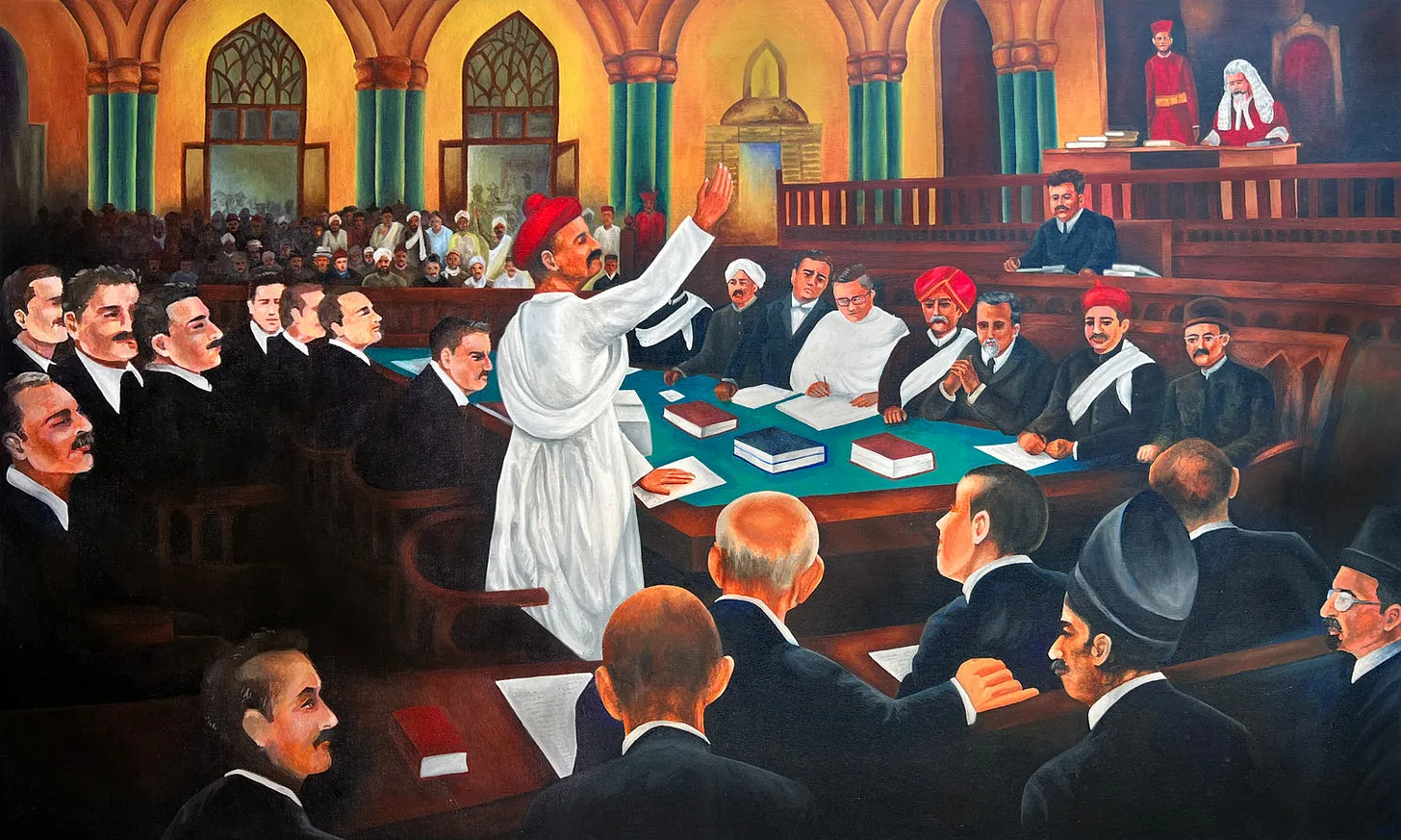
The Swaraj Bill of 1895
"Swaraj is my birthright." - Bal Gangadhar Tilak
The first non-official initiative to draft a Constitution for India incorporating a parliamentary system of government was undertaken in 1895 under the inspiration of Lokmanya Bal Gangadhar Tilak. In a brief preface to what he described as a “Home Rule Bill” (Swaraj Bill),[1] Tilak outlined the framework of a Constitution that he envisioned India would obtain from the British Government. This proposed document, titled the Constitution of India Act, envisaged the establishment of a Parliament of India, defined as an assembly comprising both official and non-official representatives of the Indian nation.
The proposed Parliament was to function as a forum in which every citizen could freely express opinions through speech or writing and publish them without fear of censorship or penalty, subject only to accountability for any abuse of this right. It further affirmed the principle that no individual should be punished except by a competent authority and that the law should apply equally to all citizens. The draft also provided for universal voting rights, granting every citizen one vote for the election of members of Parliament and one vote for the election of members of the local legislative councils. The document was drafted in a formal legal style and comprised 110 articles.[2]
Historical Context: Nationalism’s Constitutional Stirrings
The Swaraj Bill arrived at a pivotal moment. The Indian National Congress, founded in 1885, was evolving from a platform for moderate reforms to a voice demanding greater self-governance. Influenced by British liberal ideals and global democratic experiments, like the U.S. Bill of Rights and the French Declaration of the Rights of Man, the bill rejected outright independence but sought dominion status within the British Empire. Its preamble invoked the “Queen’s Most Excellent Majesty” while asserting that sovereign, legislative, judicial, and executive powers were “delegated by the Nation” and vested in a Parliament of India. This hybrid vision reflected the era’s pragmatism: loyalty to the Crown paired with an unyielding call for Indian agency.
At its core, the bill’s emphasis on fundamental rights (outlined in Sections 13–26) was revolutionary. These provisions were not mere appendages but the bedrock of citizenship, ensuring that individual liberties underpinned the state’s structure. In an age when Indians were subjects rather than citizens, denied basic political rights under the Indian Councils Act of 1892, the bill’s declaration that “the law shall be equal to all” (Section 20) stood as a defiant rebuke to colonial hierarchies based on race, caste, and creed.
Fundamental Rights: Pillars of Liberty and Dignity
The Swaraj Bill’s fundamental rights section reads like a manifesto for human dignity, predating similar enumerations in 20th-century constitutions. Spanning Sections 13–26, these rights were framed as inherent to Indian citizenship, applicable to all born in India, children of Indian parents (even abroad under certain conditions), or naturalized foreigners. Loss of these rights was narrowly circumscribed, through naturalization abroad, acceptance of foreign honors without license, or criminal sentences, ensuring protections were not easily revoked.
Some sections of the bill are worth mentioning:
Participation in Governance (Section 13): “Every citizen has a right to take part in the affairs of his country.” This democratic cornerstone allowed citizens to engage via means prescribed by Parliament, foreshadowing universal suffrage.
Right to Bear Arms (Section 14): Citizens were “required to bear arms, to maintain and defend the Empire against its internal and external enemies.” While tied to imperial defense, this affirmed a collective duty to national security, empowering individuals as active protectors rather than passive subjects.
Rule of Law (Section 15): “No citizen shall do, or omit to do, any act unless by virtue of law.” This enshrined the principle that all actions must align with legal bounds, preventing arbitrary state overreach.
Freedom of Expression (Section 16): “Every citizen may express his thoughts by words or writings, and publish them in print without liability to censure, but they shall be answerable for abuses, which they may commit in the exercise of this right, in the cases and in the mode the Parliament shall determine.” A balanced safeguard against sedition laws, it protected speech while allowing parliamentary regulation—progressive for its time.
Personal Security and Privacy (Sections 17–19): Homes were declared “inviolable asylums,” no one could be imprisoned without a “special crime proved against him according to law,” and sentencing required “competent authority.” These clauses directly challenged colonial practices like warrantless searches and indefinite detention.
Right to Property and Petition (Sections 23–24): Citizens enjoyed “right of property to its fullest extent, except where the law determines otherwise,” and could “present to his Sovereign or to the Parliament... claims, petitions and complaints.” Property as a fundamental entitlement countered land revenue exploitations, while petition rights democratized access to justice.
Education as a Right (Sections 25–26): “State Education shall be Free in the Empire” and “Primary Education shall be Compulsory.” This visionary mandate aimed to uplift the masses, recognizing education as essential for equality.
Voting rights (Section 29) further democratized these liberties: “Every citizen has a right to give one vote for electing a member to the Parliament of India and one to the Local Legislative Council.” Though limited by qualifications like age (25) and citizenship tenure (10 years), it marked a leap toward representative rule.
Equality: The Bill’s Beating Heart
Amid these rights, equality emerges as the bill’s moral and legal fulcrum, articulated succinctly yet powerfully in Section 20: “The law shall be equal to all.” This clause was no platitude; it was a radical assertion in a society stratified by British racial policies, princely privileges, and the caste system. The bill’s equality provision demanded uniform application of laws, prohibiting exemptions based on status, a direct antidote to the discriminatory Ilbert Bill controversies of the 1880s, where European settlers resisted equal legal treatment for Indian judges.
This equality extended beyond the courtroom. Section 21 guaranteed that “every citizen may be admitted to public office,” dismantling barriers to bureaucratic and political participation. Taxation was proportional to “substance” (Section 22), ensuring fairness in burdens. Religious tolerance was absolute: “All religions and modes of worship are permitted,” fostering a secular ethos that tolerated diversity without favoritism. In essence, the bill’s equality was substantive, intertwining with rights to create a framework where liberty was meaningless without fairness.
Though the Swaraj Bill never saw enactment, overshadowed by escalating colonial resistance and the rise of more radical movements, its imprint endures. It influenced subsequent drafts, including the Nehru Report of 1928, and resonated in the Constituent Assembly debates of 1946–1949. The modern Indian Constitution’s Part III (Fundamental Rights) mirrors its spirit: Article 14’s “equality before the law” echoes Section 20 verbatim in intent, while freedoms of speech (Article 19) and religion (Article 25) build on its foundations.
The 1895 bill reminds us that India’s constitutional story began not in 1950 but in the audacious imaginations of late-19th-century patriots. By prioritizing fundamental rights and equality, it transformed Swaraj from a slogan into a blueprint.
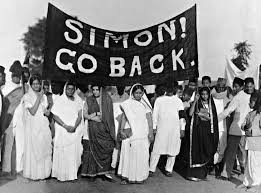
"Simon Go Back" was a protest slogan used in 1928 against the all-British Simon Commission sent to India to report on constitutional reforms. Indians, led by Congress and other leaders, boycotted the commission because it excluded Indian members, viewing it as an insult to their sovereignty.
The Simon Commission
"Simon Go Back" - Yusuf Meherally
The Simon Commission, appointed by the British government in November 1927 under the leadership of Sir John Simon, was tasked with evaluating the efficacy of the Government of India Act of 1919, commonly known as the Montagu-Chelmsford Reforms, and proposing subsequent constitutional advancements. Notably, the commission comprised exclusively British members, a composition that conspicuously omitted any Indian representation.
The formation of the Simon Commission can be attributed to several factors. The 1919 Act had stipulated a review of constitutional developments after a decade, which would have occurred in 1929. However, the British administration preemptively initiated this assessment in 1927, primarily to circumvent conducting it under a prospective government perceived as more amenable to Indian nationalist aspirations. Furthermore, the entirely British makeup of the commission disregarded Indian demands for inclusion in deliberations concerning their own governance.
The Indian response to the Simon Commission was marked by profound indignation, as the exclusion of Indian members was interpreted as a profound affront to national dignity and self-determination. This sentiment precipitated widespread agitation across the subcontinent, manifesting in protests, strikes, black-flag demonstrations, and hartals. The evocative slogan "Simon Go Back!" emerged as a unifying emblem of resistance. Key figures, such as Lala Lajpat Rai, spearheaded these demonstrations and endured severe police brutality; Rai succumbed to injuries inflicted during one such confrontation.
In terms of its broader implications for discourses on rights, the Simon Commission represented a pivotal juncture, emblematic of the British imperial reluctance to acknowledge Indian political autonomy. This backlash compelled Indian leaders to assert initiative independently, culminating in the formulation of the Nehru Report in 1928.
Karachi Resolution (1931)
In March 1931, merely six days following the execution of Bhagat Singh, Sukhdev, and Rajguru, the Indian National Congress convened and adopted the Karachi Resolution, which had been drafted by Jawaharlal Nehru. This resolution expanded the concept of "Swaraj" beyond mere political independence to encompass social and economic freedoms as well.
The Karachi Resolution incorporated two principal components. The first outlined fundamental rights, which included protections for freedom of speech, equality before the law, and the safeguarding of civil liberties. The second component presented a national economic program that emphasized social and economic justice, advocating measures such as the right to work, a minimum wage, protections for workers and peasants, and state ownership or control of key industries.
The significance of the Karachi Resolution lies in its role as the inaugural comprehensive framework for the rights and socio-economic policies of an independent India. Furthermore, it served as a foundational influence for the Directive Principles of State Policy enshrined in Part IV of the Indian Constitution.
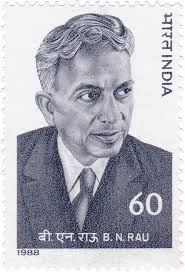
Sir Benegal Narsing Rau CIE was an Indian civil servant, jurist, diplomat and statesman known for his role as the constitutional advisor to the Constituent Assembly of India. He was also India's representative to the United Nations Security Council from 1950 to 1952.
Draft Constitution of India 1948
By October 1947, B. N. Rau had prepared the first draft of India’s Constitution. During two and a half years of intense debate and discussion in the Constituent Assembly, the Constitution of India was ultimately finalized on 26 November 1949. On 21 February 1948, the Drafting Committee submitted the Draft Constitution of India to the President of the Constituent Assembly. Four months earlier, the Committee had received a preliminary draft prepared by the Assembly’s Constitutional Adviser, Sir B.N. Rau. This document reflected the Assembly’s earlier decisions, based on reports from various subcommittees entrusted with framing specific constitutional provisions. Between October 1947 and February 1948, the Drafting Committee, under the chairmanship of Dr. B.R. Ambedkar, carefully examined, refined, and expanded upon Rau’s draft. The outcome of this process was the Draft Constitution of India, 1948.
The Draft comprised 315 Articles arranged across eighteen Parts and eight Schedules. It covered a broad spectrum of constitutional themes, including the structure of government, Centre–State relations, and the fundamental rights of citizens. In sections where the Drafting Committee made major revisions to Rau’s text or where ambiguities persisted, it inserted explanatory notes and footnotes to clarify its reasoning.
Notably, this Draft was the first comprehensive blueprint of the Indian Constitution to be made publicly available. It was circulated widely among Assembly members, provincial governments, central ministries, the Supreme Court and High Courts, as well as the general public, accompanied by an invitation for feedback and suggestions. After reviewing the comments received in March and October 1948, the Drafting Committee incorporated necessary amendments.
On 4 November 1948, Dr. B.R. Ambedkar formally introduced the revised Draft Constitution in the Constituent Assembly. Each member was provided with a copy of the document, along with the set of amendments recommended by the Committee. In his introductory address, Ambedkar summarized the contents of the Draft and responded to certain criticisms that had surfaced during the consultative process. Reactions within the Assembly were mixed, while some members lauded the Draft as a remarkable achievement, others expressed disappointment, particularly over its limited emphasis on the principles of Panchayati Raj in shaping India’s administrative and political framework.
On 15 November 1948, the Constituent Assembly commenced the clause-by-clause consideration of the Draft Constitution. Each provision was subjected to detailed debate, scrutiny, and amendment. Over the following eleven months, the Assembly discussed and decided upon numerous proposals and modifications introduced both by individual members and by the Drafting Committee itself. This extensive deliberative process continued until 17 October 1949. Subsequently, the Drafting Committee incorporated the Assembly’s decisions and prepared a revised version of the Draft Constitution, which was submitted for a second reading on 14 November 1949.
The discussions surrounding the Draft Constitution, along with its revised version, constituted the core of the Constituent Assembly Debates and represented the most substantial phase of India’s constitution-making process. Out of the Assembly’s total 165 sittings, an impressive 114 were devoted exclusively to debating this Draft. Finally, after nearly three years of exhaustive deliberation, the Constituent Assembly adopted the Draft Constitution on 26 November 1949, enacting it as the Constitution of India. Often, it is Dr. Ambedkar who is credited for adding the Fundamental Rights and Abolition of “Untouchability,” but we get to see these rights in the first draft of the Constitution, which was done by B.N. Rau, who was also a Brahmin by birth. The following are the Articles of the Draft Constitution of India 1948, which abolished Untouchability and added Fundamental Rights:
PART III
FUNDAMENTAL RIGHTS
Rights of Equality
DC.9
9. (1) The State shall not discriminate against any citizen on grounds only of religion, race, caste, sex or any of them. In particular, no citizen shall, on grounds only of religion, race, caste, sex or any of them, be subject to any disability, liability, restriction or condition with regard to-
(a) Access to shops, public restaurants, hotels and places of public entertainment, or
(b) The use of wells, tanks, roads, and places of public resort maintained wholly or partly out of the revenues of the State or dedicated to the use of the general public.(2) Nothing in this article shall prevent the State from making any special provision for women and children.DC.10
10. (1) There shall be equality of opportunity for all citizens in matters of employment under the State.
(2) No citizen shall, on grounds only of religion, race, caste, sex, descent, place of birth or any of them, be ineligible for any office under the State.
(3) Nothing in this article shall prevent the State from making any provision for the reservation of appointments or posts in favour of any backward class of citizens who, in the opinion of the State, are not adequately represented in the services under the State.
(4) Nothing in this article shall affect the operation of any law which provides that the incumbent of an office in connection with the affairs of any religious or denominational institution or any member of the governing body thereof shall be a person professing a particular religion or belonging to a particular denomination.DC.11
11. “Untouchability” is abolished and its practice in any form is forbidden. The enforcement of any disability arising out of “Untouchability” shall be an offence punishable in accordance with law.[3]
Dr. Ambedkar also gave credit to Sir B.N. Rau:
The credit that is given to me does not really belong to me. It belongs partly to Sir B.N. Rau, the Constitutional Adviser to the Constituent Assembly who prepared a rough draft of the Constitution for the consideration of the Drafting Committee. A part of the credit must go to the members of the Drafting Committee who, as I have said, have sat for 141 days and without whose ingenuity of devise new formulae and capacity to tolerate and to accommodate different points of view, the task of framing the Constitution could not have come to so successful a conclusion. Much greater, share of the credit must go to Mr. S.N. Mukherjee, the Chief Draftsman of the constitution. His ability to put the most intricate proposals in the simplest and clearest legal form can rarely be equalled, nor his capacity for hard work. “He has been as acquisition to the Assembly. Without his help, this Assembly would have taken many more years to finalise the Constitution. I must not omit to mention the members of the staff working under Mr. Mukherjee. For, I know how hard they have worked and how long they have toiled sometimes even beyond midnight. I want to thank them all for their effort and their cooperation. (Cheers.)[4]
Just as Dr. Ambedkar did, Mr. K.M. Munshi also gave credit to B.N. Rau, K.M. Munshi was an Indian freedom fighter, lawyer, writer, and educationist who played a crucial role in the independence movement and the formation of modern India. He was also member of the Constituent Assembly Debates, and he said this about Sir B.N. Rau:
The Members of the Committee, I may mention, have devoted careful attention to every aspect of the Rules and we have had the assistance of the able and distinguished jurist, our Constitutional Adviser, Sir B.N. Rau. The Committee had done its best to give it as perfect a shape as is possible. But I dare say there may be many defects still left, and the House may find some discrepancies. I am sure, points of view may have been omitted; I seek therefore the indulgence of the House. These are the Rules of the Assembly. They can be altered or added to when we next meet. We can always add new points of view if some one are omitted. But it is highly essential that we should adopt the Rules and appoint one or two committees which would keep the organisation of the Constituent Assembly going.[5]
Jaspat Roy Kapoor was a lawyer, a congressman, and a member of the Constituent Assembly Debates also gave credits to B.N. Rau, he said:
I must also express my gratitude to Shri B.N. Rau, Mr. Mukherjee and his loyal lieutenants for the very good and efficient work that they have all done. Shri B.N. Rau kept on flooding on us precedents after precedents of Constitutions as they are in the different parts of the world and they have been very helpful to us.[6]
Alladi Krishnaswami Ayyar was the chairman of the Credential Committee of the Constituent Assembly of India. He served as the Advocate General of Madras State from 1929 to 1944, he said:
I would also be failing in my duty if I do not give my tributes to the services of Sir B.N. Rau and to the untiring energy, patience, ability and industry of the Joint Secretary, Mr. Mukherjee and his lieutenants.[7]
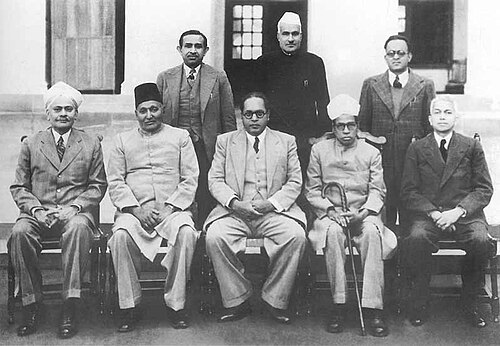
The World’s Longest Surviving Written Constitution
“However good a constitution may be, if those who are implementing it are not good, it will prove to be bad. However bad a constitution may be, if those implementing it are good, it will prove to be good.” - Dr. Ambedkar
The journey began with the Constituent Assembly, formed in 1946 under the Cabinet Mission Plan. Comprising 299 members (after the partition reduced it from 389), the Assembly held its first session on December 9, 1946. Over 2 years, 11 months, and 17 days, it conducted 11 sessions, debating every clause meticulously. Dr. Ambedkar played a pivotal role, guiding the debates and ensuring the document reflected principles of justice, liberty, equality, and fraternity.
The Indian Constitution is the longest written constitution in the world. At the time of its adoption in 1950, it contained 395 Articles, 22 Parts, and 8 Schedules. Over time, amendments have expanded it further, reflecting India’s evolving needs. Its detailed nature was intentional, aimed at addressing the complexities of a vast and diverse nation. Unlike most modern constitutions, the original Indian Constitution was entirely handwritten in both English and Hindi. It was calligraphed by Prem Behari Narain Raizada and artistically decorated by Nandalal Bose and his students from Shantiniketan. Each page is a blend of law and art, showcasing India’s rich heritage. The Indian Constitution is often described as a “bag of borrowings”, but this borrowing was deliberate and thoughtful. It adopted the best features from various constitutions across the world, Fundamental Rights from the USA, Parliamentary Government from the UK, Directive Principles from Ireland, and Federalism from Canada. This fusion created a uniquely Indian constitutional framework.
Delivering a lecture on India’s Constitution at the University of Madras in 1951, Sir Ivor Jennings described it as: ‘Too long, too rigid, too prolix’, and said that the dominance in the Constituent Assembly of lawyer-politicians had contributed to its complexity! In fact, he characterized India’s Constitution as ‘a truly oriental display of occidental constitutional devices.’[8] The same Ivor Jennings had been entrusted with the task of drafting the Constitution of Ceylon (now, Sri Lanka); and he took great care to see that it endured, but it lasted only fourteen years, which only goes to show that a finely-worded document is no guarantee of its success. It is only a spirit of constitutionalism (amongst the representatives of the people) that helps to keep it alive and functioning.[9]
ENDNOTES
[1] One can access the bare act here https://www.constitutionofindia.net/historical-constitution/the-constitution-of-india-bill-unknown-1895/
[2] B. Shiva Rao, Framing of India’s Constitution: Select Documents, Vol. I, pp.5-15.
[3] https://www.constitutionofindia.net/committee-report/draft-constitution-of-india-1948
[4] Dr. Ambedkar’s Last Speech in the Constituent Assembly on the Adoption of the Constitution. (November 25, 1949), p. 329.
[5] Constituent Assembly Debates (Proceedings) (9th December,1946 to 24th January,1950. pdf p. 226.
[6] Ibid., pdf p. 6509.
[7] Ibid., pdf p. 6576.
[8] Sir Ivor Jennings (1903-1965), British lawyer and academic who served as Vice-Chancellor of the University of Ceylon (1942-1955) and Vice-Chancellor of the University of Cambridge (1961-1963). Jennings was an authority on constitutional law, and author of a definitive book on the workings of the unwritten British Constitution. He had advised in the drafting of the Constitution of Ceylon to form the Dominion of Ceylon. Quoted from Fali S Nariman, You Must Know Your Constitution, p.16.
[9] Playwright George Bernard Shaw (1856-1950) visited Ceylon in 1948 – and he was ecstatic about its people. This is what he wrote to Jawaharlal Nehru: “I was convinced that Ceylon is the cradle of the human race because everybody there looks an original. All other nations are obviously mass produced.”! (Typically Shavian). Ibid.
