
Sanātana Dharma Gave Us Rama: A God Who Lived Through the Struggles of Man
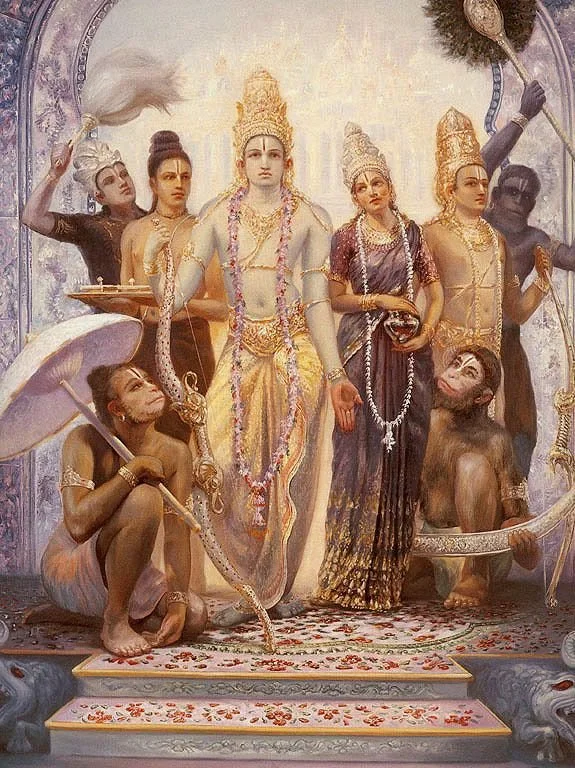
Written by Abhishek Iyengar · Edited by Pranav MDThere is something extraordinarily beautiful about Sanātana Dharma. It did not give humanity a god who simply sits on a throne in heaven, untouched by the pain of the world, issuing commandments to those who struggle below. It gave us Rama—a prince who lost his kingdom, a son who had to choose between personal happiness and filial duty, a husband separated from his wife, a brother who knew the pain of distance, a king burdened by responsibility, and a man who had to make difficult choices even when none of the available choices offered him complete happiness.
Perhaps the greatest beauty of Rama is that he was divine, yet his story understands the human condition better than most philosophies ever could.
Think about it. Rama was born a prince. He had everything that most people spend their lives trying to acquire: status, privilege, family, security and the promise of a glorious future. He was expected to inherit the throne of Ayodhya. His life appeared destined for comfort and power. And then, almost overnight, everything changed. The crown that awaited him was replaced by exile. The palace gave way to the forest. The future he had imagined disappeared, not because he had failed, but because life presented him with a circumstance he had not chosen.
Does that not sound familiar?
How many ordinary people have watched their carefully constructed lives collapse because of a family crisis, an unexpected loss, a financial setback or circumstances beyond their control? How many have been forced to abandon their dreams because duty demanded something else? Rama's exile is not merely an episode from an ancient epic. It is a reminder that life does not always honour our plans, and that our character is often revealed by how we respond when it does not.
Rama could have resisted. He could have used his strength, popularity or royal position to fight for the throne. Yet, in the Ramayana, his response is shaped by his commitment to his father's word and the values he has chosen to uphold. We may debate the moral complexities of that decision, and we should. But the enduring question remains: when keeping a promise costs us something, do we still believe that our word has value?
In an age when commitments are frequently abandoned at the first inconvenience, Rama's story asks us to look beyond immediate gratification. It reminds us that character is not what we claim when life is comfortable. Character is what we demonstrate when doing the right thing comes at a personal cost.
And then there is Sita.
Rama's journey is inseparable from the suffering, strength and agency of Sita, whose own story exposes the terrible price that circumstances, injustice and social expectations can impose on a woman. Their separation, the search for Sita, and the struggle against Ravana are not simply episodes in a battle between good and evil. They speak of love, loyalty, courage, loss and the determination to confront what appears impossible. Sita is not merely a character in Rama's story; she is one of the central moral forces of the Ramayana, and her trials demand that we examine the responsibilities of society towards women rather than romanticise their suffering.
That is the richness of our civilisation. It gives us stories that inspire devotion while also giving us questions that demand reflection.
Sanātana Dharma does not become beautiful because every episode is easy to explain. It becomes beautiful because its stories are large enough to hold devotion, duty, suffering, disagreement and moral inquiry together.
Consider Lakshmana, who accompanies Rama into exile. Consider Bharata, who refuses to treat his brother's misfortune as an opportunity to enjoy power. He does not simply occupy the throne and declare the matter settled. In the familiar telling of the Ramayana, he places Rama's sandals on the throne and governs as a custodian of his brother's rightful place. What a remarkable lesson in leadership! Power is not always a prize to be seized. Sometimes it is a responsibility to be exercised without claiming ownership.
Imagine how different our public life would look if every person entrusted with authority understood that distinction.
Our culture gave us a story in which the man who could have ruled chose restraint, and the man who could have occupied the throne chose service. We spend years studying leadership, ethics and governance, yet Bharata's gesture conveys a principle that needs no management textbook: authority is meaningful only when it is exercised in the service of something greater than personal ambition.
Then comes Hanuman, whose extraordinary strength is inseparable from humility and devotion. He does not need to be the central figure in every scene. His greatness lies in what he is willing to do for a purpose beyond himself. He crosses an ocean, searches for Sita, carries a message of hope and places his abilities at the service of a cause he believes in. In Hanuman, we see a different model of strength—one that does not require constant recognition, domination or applause.
And Ravana, for all his knowledge and power, becomes the warning on the other side. Intelligence without self-restraint, achievement without humility and power without respect for another person's dignity can destroy even the most accomplished individual. Our epics do not merely celebrate heroes; they warn us about the flaws that can turn greatness into ruin.
This is what makes the Ramayana so enduring. It is not simply a story in which one side wins a war. It is a civilisation reflecting on what makes a life worthy, what makes power legitimate, what makes a relationship meaningful and what happens when desire overwhelms judgement.
The idea of Maryada Purushottama—Rama as the ideal of conduct and restraint—has inspired generations. Yet Rama's story should not be reduced to the instruction that everyone must blindly imitate every decision made by every character. It invites us to examine dharma: the difficult responsibility of discerning what is right when duties collide, when private feelings conflict with public obligations, and when every choice carries consequences.
That is not a simplistic moral universe. It is a profoundly human one.
And perhaps this is where we misunderstand the beauty of Sanātana Dharma when we attempt to reduce it to a list of rules or a single book. It is a vast civilisation of philosophical inquiry, spiritual practice, diverse traditions, sacred narratives and living interpretations. Its epics have been retold across languages, regions, artistic traditions and generations. Rama belongs not only to a page in an ancient text, but also to theatre, music, poetry, sculpture, temple traditions, folk performance and the memories of families who have told his story for centuries.
The same Rama has been encountered through the poetry of Valmiki, the devotion of Tulsidas, the literary genius of Kamban and countless regional tellings. Each tradition has brought its own voice, texture and insight to the story. The diversity of these tellings is itself a testament to a culture that has continued to engage with its inherited wisdom rather than allowing one telling to exhaust every possible meaning.
What a beautiful inheritance it is—to receive not merely a commandment, but a story that every generation can enter, question, interpret and rediscover.
For a child, Rama may be the courageous prince. For a parent, he may represent the weight of responsibility. For a brother, he may evoke loyalty. For a leader, he may raise questions about duty and power. For someone facing adversity, his exile may offer companionship in suffering. For a devotee, he is Bhagavan, worthy of love and worship. These meanings need not cancel one another.
This is the extraordinary power of our traditions: the same story can be a source of faith, philosophy, literature, art and personal reflection.
We do not have to pretend that every episode is uncomplicated, or that every character is beyond moral examination, to appreciate the civilisation that preserved these stories. In fact, our inheritance becomes richer when we approach it with both reverence and intellectual honesty. Faith need not fear thought. Devotion need not eliminate questions.
The tragedy of modern life is that we often measure success by what we acquire, influence by how many people obey us, and strength by how effectively we defeat others. Rama's story invites us to consider different measures: the promises we keep, the responsibilities we accept, the temptations we resist, the people we protect and the values we refuse to abandon when abandoning them would be easier.
That is why Rama continues to matter.
Not because every human being can live his life without contradiction or suffering, but because his story gives us a language with which to confront both. Not because the world has become perfect, but because it continues to struggle with the very questions that the Ramayana explores.
Sanātana Dharma gave us Rama—not merely to worship from a distance, but to contemplate as we navigate the difficult business of being human.
A prince who lost a kingdom. A husband who endured separation. A son who faced an impossible choice. A brother whose story revealed the meaning of loyalty. A king whose responsibilities exposed the conflict between personal feeling and public duty.
And, for millions of devotees, the Supreme who chose to enter the human story.
Perhaps that is the greatest beauty of our culture. It does not ask us to look only towards heaven for wisdom. It invites us to find wisdom in the forest, in the family, in the kingdom, in the battlefield, in the promise, in the sacrifice and in the choices that define a life.
The Ramayana has survived for millennia because every generation discovers something of itself in its characters.
The world changes. Kingdoms rise and fall. Technology transforms the way we live. Yet we still struggle with ambition, jealousy, loyalty, love, grief, responsibility and the search for what is right.
And Rama still walks beside us through those questions.
That is the beauty of Sanātana Dharma: it gave us a divine ideal whose story never stops speaking to our humanity.
