
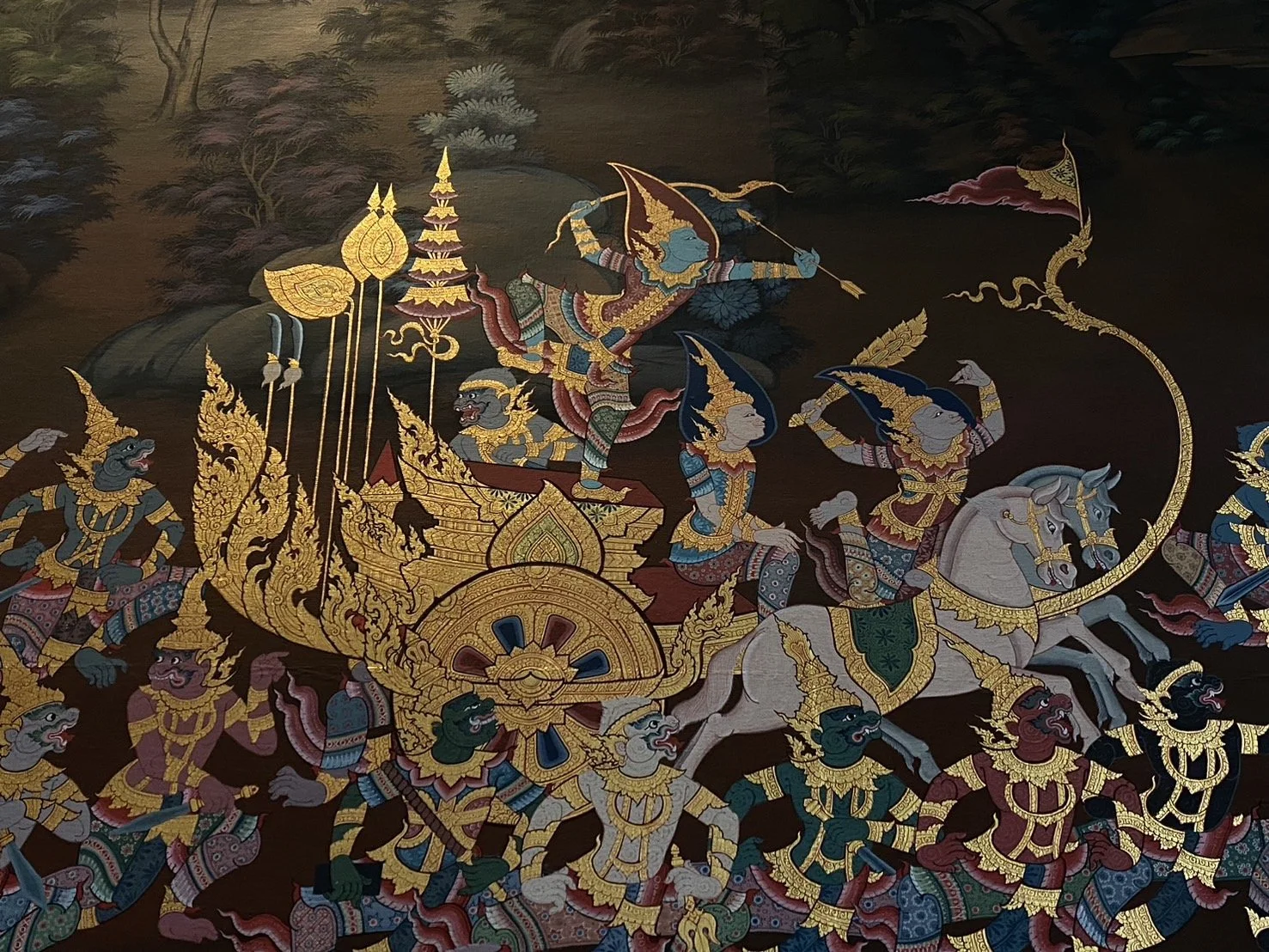
The migration of the Ramayana across Asia represents one of the most extensive cultural transmissions in world history. Between the middle of the first millennium BCE and the fourteenth century CE, the narrative traveled from its origins in the Gangetic plain of northern India across the Himalayas and over the Indian Ocean. It became foundational text to societies in Central Asia & Southeast Asia. Unlike the expansion of Hellenism under Alexander or the spread of Roman culture across the Mediterranean, this dispersal occurred without military conquest, imperial governance, or colonial settlement. It was a voluntary, multi-directional process where diverse societies adopted, translated, and modified the epic to serve their own political, religious, and literary requirements.
1. The Overland Route: Central Asia, the Silk Road, and Mongolia
The epic’s northern journey moved along the ancient trade highway known as the Uttarapatha.[1] Caravans of Indian merchants, accompanied by Buddhist monks and translators, carried the story through the mountain passes of the Karakoram into the oasis kingdoms of the Silk Road. One of the central hubs along this route was the kingdom of Khotan, in modern Xinjiang—a prominent Buddhist civilization where an Eastern Iranian language, Khotanese Saka, was spoken alongside Sanskrit.[2]
Much of what we know about this transmission comes from Cave 17 of the Mogao Grottoes at Dunhuang, an ancient library sealed around 1006 CE at the edge of the Gobi Desert.[3] Among the thousands of preserved scrolls were translations of the Ramayana in Khotanese Saka and ancient Tibetan, dating between the eighth and tenth centuries.[4] Because the dry desert air preserved organic paper and scrolls that decayed in the humid climate of the Indian subcontinent, these Central Asian manuscripts are physically older than nearly any surviving Ramayana text found in India itself.[5]
As the story traveled through Central Asia, local communities reframed it through a Buddhist lens:
In the Khotanese Saka version, the text opens with praise to the Buddha, and Rama is presented as a Bodhisattva, an enlightened being dedicated to universal compassion.[6]
The ending was rewritten to reflect the Buddhist ideal of non-violence (ahimsa). Instead of killing Ravana on the battlefield, Rama shoots him in his only vulnerable spot, his big toe. When Ravana falls, Rama spares his life and delivers a sermon on karma and compassion, prompting Ravana to repent and become a peaceful disciple.[7]
From the Silk Road, the narrative traveled into Tibet and across the northern plains into Mongolia. In the thirteenth century, the Tibetan scholar Sa-skya Pandita used Ramayana parables in his writings on royal ethics, which were later translated into classical Mongolian.[8] In Mongolian Buddhist lamaseries, Hanuman became widely revered as a protector deity who guarded traveling caravans and monasteries.[9] The story traveled as far west as European Russia, carried by the Buddhist Kalmyk Mongols who settled along the banks of the Volga River, where eighteenth-century manuscripts of the epic were eventually recovered.[10]
2. East Asia: Chinese Jatakas, Sun Wukong, and Medieval Japan
As the epic moved through Central Asian trading hubs, it was also translated into the literary traditions of China and Japan through the spread of Buddhism.
The Ramayana first entered China through Buddhist canonical scriptures. In 251 CE, a monk of Sogdian descent named Kang Senghui translated the Liudu ji jing (Collection of the Six Paramitas) into Chinese at Nanjing.[11] Story number 46 in this collection preserves the core narrative: an exiled prince honoring his father's vow, a loyal brother keeping the throne open by placing the prince's sandals on the seat, a queen abducted by an ogre, an alliance with a deposed monkey king, and a causeway built across the sea.[12] Later translations, such as the Za baozang jing in 472 CE, emphasized Rama’s devotion to his father.[13] Chinese translators highlighted this aspect of the story to align with Confucian filial piety (xiao), allowing an Indian epic to find acceptance among China's scholar-officials.[14]
The figure of Hanuman left a lasting mark on Chinese vernacular literature. In the sixteenth century, Ming Dynasty novelist Wu Cheng'en published Journey to the West, introducing China’s most beloved folk hero: Sun Wukong, the Monkey King.[15]
Scholars like Hu Shih and Ji Xianlin demonstrated that Sun Wukong was directly inspired by Hanuman.[16] Both heroes share striking characteristics:
Both have miraculous births linked to the wind.
Both can shape-shift into seventy-two forms and leap vast distances across the sky on clouds.
Both wield magical iron weapons that change size at will.
Both create chaos in celestial palaces before finding spiritual redemption by faithfully protecting a holy pilgrim.[17]
Archaeological evidence in southern China confirms this connection. On a stone pagoda at the Kaiyuan Buddhist Temple in Quanzhou, carved in 1237 CE, sits an ancient relief of a monkey warrior wielding a staff and wearing a rosary—a physical link between the Indian monkey warrior and the Chinese superhero.[18]
In Japan, the story was incorporated into medieval Buddhist didactic literature. The Sambo E-kotoba, written by Minamoto no Tamenori in 984 CE, records the story of King Dasaratha accidentally shooting the young hermit Shravana Kumara while hunting by sound alone.[19] Two centuries later, around 1179 CE, Taira no Yasuyori wrote the Hobutshushu (A Collection of Treasured Things).[20] Volume Two contains an adapted version of the Ramayana: a king’s wife is abducted by a supernatural Dragon King, the king allies with an army of monkeys to build an ocean causeway, and when the dragon's poison knocks the monkey army unconscious, a clever scout monkey flies to Mount Himavat (the Himalayas) to bring back miraculous healing herbs that revive the fallen warriors—a direct echo of the famous Sanjeevani episode.[21]
3. Southeast Asia: Ocean Winds, Stone Monuments, and Living Traditions
The southern journey of the Ramayana was driven by maritime trade across the Bay of Bengal. Predictable seasonal monsoon winds carried Indian merchant ships from Bengal, Odisha, and the Tamil coast to the Malay Peninsula and Indonesia in roughly forty days.[22] Because the winds did not reverse for several months, Indian traders, monks, and scribes lived in Southeast Asian port towns for four to six months at a time, establishing permanent cultural enclaves.[23]
Local Southeast Asian chieftains were not conquered by foreign armies; instead, they voluntarily adopted Indic culture to help build centralized kingdoms.[24] The Ramayana provided an ideal framework of sacral kingship, known as the Dharmaraja model.[25] By ruling in the image of Rama—a monarch who governed by moral righteousness and cosmic order—local rulers gained authority and prestige above competing tribal factions.[26]
This royal embrace created extraordinary monuments across the region:
Vietnam and Cambodia: In central Vietnam, King Prakashadharma of Champa built the world's earliest known dedicated temple and stone statue to Sage Valmiki in the seventh century.[27] In Cambodia, King Suryavarman II carved a continuous fifty-meter stone bas-relief of the Battle of Lanka along the walls of Angkor Wat in the twelfth century, while later Buddhist kings embraced the epic as the Reamker, viewing Rama as an aspiring Bodhisattva.[28]
Java: On the island of Java, the ninth-century temple complex of Prambanan features over one hundred continuous carved stone panels of the epic—a visual narrative more complete than any surviving ancient Ramayana stone carving in India itself.[29] Around the same time, Javanese court poets composed the Kakawin Ramayana, translating an intricate Sanskrit poem from Gujarat (Bhattikavya) into Old Javanese and introducing the Asta Brata, an eightfold code of royal conduct that guided Javanese kings for centuries.[30]
Thailand: In 1350 CE, Thai rulers named their royal capital Phra Nakhon Si Ayutthaya after Rama’s city.[31] When Bangkok was founded in 1782, the monarchs of the Chakri dynasty adopted the dynastic title "Rama," which continues to this day with King Rama X.[32] King Rama I authored the Thai national version, the Ramakien, which re-imagined Hanuman as a charming, roguish hero and treated the demon king Ravana (Thotsakan) with tragic sympathy as a ruler undone by an all-consuming love.[33]
When Islam spread across maritime Southeast Asia between the fourteenth and sixteenth centuries, the epic was not wiped out. On the island of Bali, the Hindu tradition survived intact, preserving ancient palm-leaf manuscripts and ritual performances like the Kecak chant dance.[34] On the Muslim mainland and in Java, communities preserved the story through cultural adaptation. In the Malay Hikayat Seri Rama, Rama was reimagined as a mortal sovereign guided by the decree of God.[35] In Java, Sufi teachers adapted the characters into the flat, stylized leather puppets of the Wayang Kulit, projecting them as undulating shadows against a screen to respect religious prohibitions against three-dimensional statues.[36] Through this artistic camouflage, the epic remained the living heart of village theater across centuries of religious change.
4. Conclusion: The Open-Source Epic
In his celebrated essay on the epic's diverse traditions, scholar A.K. Ramanujan recounted a traditional folktale that explains how the Ramayana was understood across Asia.[37]
Rama’s signet ring slips from his finger in Ayodhya, falls into a crack in the palace floor, and vanishes into the underworld. Hanuman shrinks his body, follows the ring down into the earth, and arrives at the realm of the spirits. When Hanuman asks for the return of his master’s ring, the king of the spirits sets down a large golden platter filled with thousands of identical rings.
Confused, Hanuman stares at the platter, unable to tell them apart. The spirit king explains: in every cosmic age, a Rama lives on the earth, and in every age, his ring falls down to the underworld. The platter holds the rings of all the Ramas who have ever lived, and all who are yet to come.[38]
This parable reveals why the Ramayana spread so successfully across an entire continent. It never functioned as a rigid, unchangeable text controlled by a single central authority. It was an open-source civilizational story.[39]
The epic offered a universal language of duty, exile, love, loss, and righteousness that any culture could adapt to its own worldview. For Buddhist monks in Central Asia and China, it became a story of filial piety and non-violence. For kings in Cambodia and Thailand, it was a manual of righteous governance and courtly poetry. For shadow-puppet masters in Java, it was a drama of moral balance that survived the rise and fall of empires.
The Ramayana conquered Asia without an army because it never forced anyone to surrender. It simply gave every culture a story they could call their own.
Endnotes
Upinder Singh, A History of Ancient and Early Medieval India: From the Stone Age to the 12th Century (New Delhi: Pearson Longman, 2008), pp. 840–845.
William Dalrymple, The Golden Road: How Ancient India Transformed the World (London: Bloomsbury, 2024), pp. 113, 151, 179.
Ibid., pp. 175–182.
Sir Harold Bailey's decipherment, cited from Dr. V. Raghavan (ed.), The Ramayana Tradition in Asia (New Delhi: Sahitya Akademi, 1980), pp. 509, 518, 625.
Ibid., p. 627.
Ibid., pp. 625, 628–630.
Ibid., p. 625.
T.S. Damdinsuren, "The Ramayana in Mongolia," cited from Dr. V. Raghavan (ed.), The Ramayana Tradition in Asia, pp. 628–633.
Ibid., p. 634.
Ibid., p. 627.
Upinder Singh, A History of Ancient and Early Medieval India, p. 841; see also Dr. V. Raghavan (ed.), The Ramayana Tradition in Asia, pp. 24, 123.
Dr. V. Raghavan (ed.), The Ramayana Tradition in Asia, p. 123.
Ibid., p. 123.
Ibid., pp. 123–124.
William Dalrymple, The Golden Road, pp. 151, 179; see also Dr. V. Raghavan (ed.), The Ramayana Tradition in Asia, pp. 648–652.
Hu Shih and Ji Xianlin, cited from Dr. V. Raghavan (ed.), The Ramayana Tradition in Asia, pp. 648–652; see also Paula Richman (ed.), Many Rāmāyaṇas: The Diversity of a Narrative Tradition in South Asia (Berkeley: University of California Press, 1991), pp. 22–32.
Dr. V. Raghavan (ed.), The Ramayana Tradition in Asia, pp. 648–652.
Cited from Paula Richman (ed.), Many Rāmāyaṇas, p. 32; see also Dr. V. Raghavan (ed.), The Ramayana Tradition in Asia, p. 650.
Prof. Minoru Hara, "The Rama Story in Japan," cited from Dr. V. Raghavan (ed.), The Ramayana Tradition in Asia, pp. 315–316.
Ibid., pp. 309–316.
Ibid., pp. 310–314.
Sanjeev Sanyal, Land of the Seven Rivers: A Brief History of India's Geography (New Delhi: Penguin Books India, 2012), pp. 9–14; see also William Dalrymple, The Golden Road, pp. 13–15.
Upinder Singh, A History of Ancient and Early Medieval India, pp. 841–843; see also William Dalrymple, The Golden Road, pp. 14–16.
William Dalrymple, The Golden Road, pp. 24–27; see also Upinder Singh, A History of Ancient and Early Medieval India, pp. 840–844.
William Dalrymple, The Golden Road, pp. 11–13, 26–27.
Ibid., pp. 11–13, 442; see also Paula Richman (ed.), Many Rāmāyaṇas, pp. 22–30.
Inscription of Tra Kieu, cited from R.C. Majumdar (ed.), The History and Culture of the Indian People: The Age of Imperial Kanauj (Bombay: Bharatiya Vidya Bhavan, 1955), p. 412; see also Dr. V. Raghavan (ed.), The Ramayana Tradition in Asia, pp. 36, 262.
William Dalrymple, The Golden Road, pp. 19–20, 26; see also R.C. Majumdar (ed.), The History and Culture of the Indian People: The Struggle for Empire (Bombay: Bharatiya Vidya Bhavan, 1957), p. 772; and Dr. V. Raghavan (ed.), The Ramayana Tradition in Asia, pp. 648–652.
William Dalrymple, The Golden Road, pp. 242–244.
Willem Stutterheim and Manomohan Ghosh, cited from Dr. V. Raghavan (ed.), The Ramayana Tradition in Asia, pp. 20–39, 103–115; see also William Dalrymple, The Golden Road, p. 442.
William Dalrymple, The Golden Road, p. 27; see also Dr. V. Raghavan (ed.), The Ramayana Tradition in Asia, pp. 245–255.
Dr. V. Raghavan (ed.), The Ramayana Tradition in Asia, pp. 245–255.
A.K. Ramanujan, "Three Hundred Rāmāyaṇas," cited from Paula Richman (ed.), Many Rāmāyaṇas, pp. 38–39; see also Frank E. Reynolds, "Ramayana, Rama Jataka, and Ramakien," cited from Paula Richman (ed.), Many Rāmāyaṇas, pp. 54–56; and Dr. V. Raghavan (ed.), The Ramayana Tradition in Asia, pp. 670–675.
Sanjeev Sanyal, Land of the Seven Rivers, p. 120; see also Dr. V. Raghavan (ed.), The Ramayana Tradition in Asia, pp. 20–39.
Dr. V. Raghavan (ed.), The Ramayana Tradition in Asia, pp. 122–128, 626.
Ibid., pp. 138–141, 626–627.
A.K. Ramanujan, "Three Hundred Rāmāyaṇas: Five Examples and Three Thoughts on Translation," cited from Paula Richman (ed.), Many Rāmāyaṇas, pp. 45–46.
Ibid., p. 46.
Ibid., pp. 44–48; see also Dr. V. Raghavan (ed.), The Ramayana Tradition in Asia, Introduction, pp. 1–19.
