
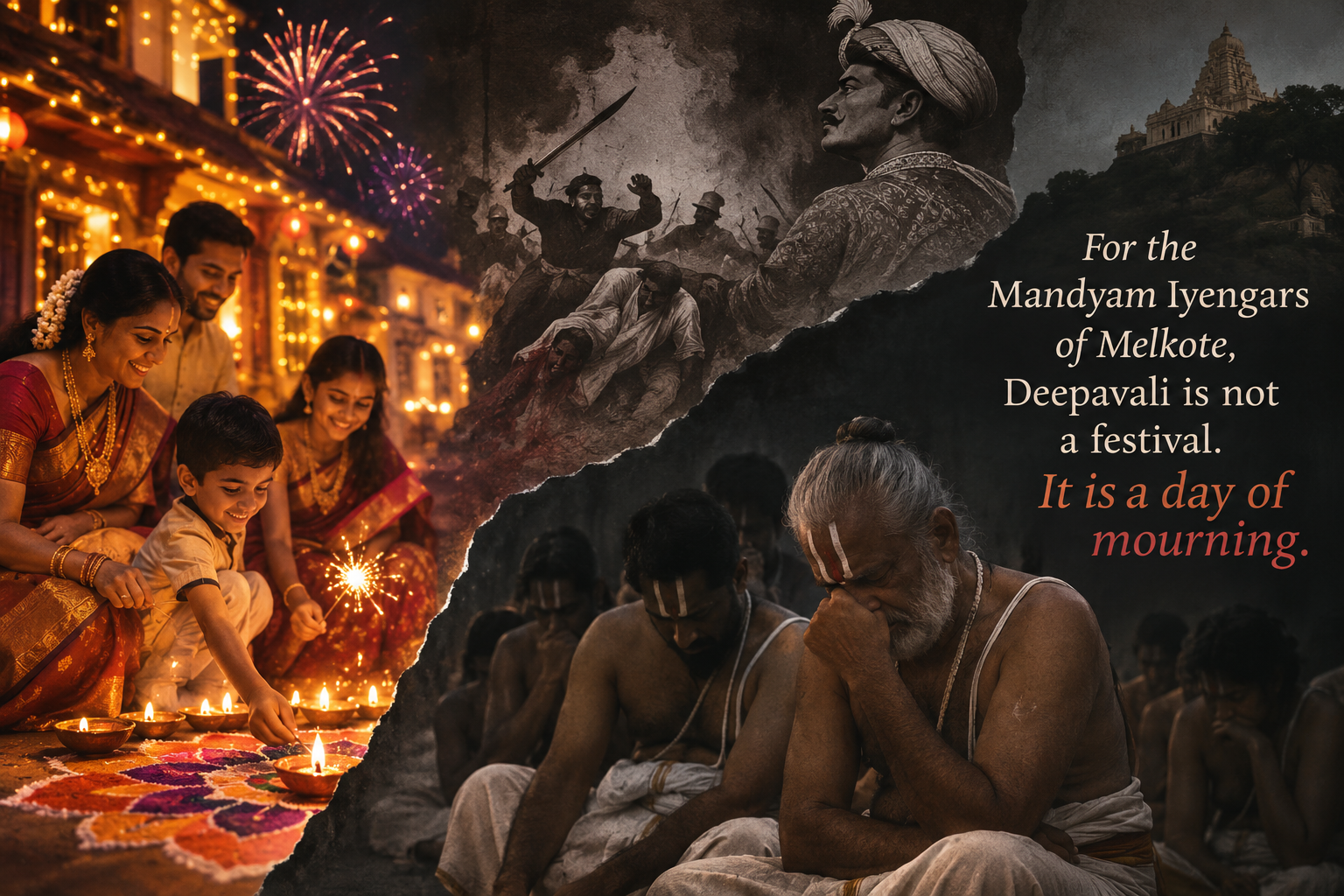
Every Deepavali, India celebrates the victory of good over evil. Millions of homes are illuminated, fireworks light up the skies, sweets are exchanged and families come together to celebrate Naraka Chaturdashi. Yet, in Melkote, Karnataka, there are families for whom this celebration carries an entirely different meaning. For a section of the Mandyam Iyengar community, particularly those belonging to the Bharadwaja Gotra, Naraka Chaturdashi is not a festival. It is a day of mourning.
While the rest of the country lights lamps, these families remember ancestors who, according to their community's historical accounts, were massacred under Tipu Sultan's rule. While others celebrate the destruction of Narakasura, they remember the destruction of their own community. Their refusal to celebrate Deepavali is not a fashionable protest, a political statement or a rejection of tradition. It is a memory carried across generations, a wound that has survived for more than two centuries.
According to accounts preserved by the Mandyam community, the tragedy unfolded at Srirangapatna during the reign of Tipu Sultan. The community's historical account places the massacre in 1783, on Naraka Chaturdashi. Other accounts and reports have cited different dates, including 1790. The reported victims were members of the Mandyam Iyengar families who were allegedly suspected of supporting the Mysore royal family and conspiring against Tipu. Community narratives describe the killing of hundreds of families, including women and children. The precise number of victims and the circumstances remain matters of historical debate, but the community's inherited memory of the tragedy is undeniable.
Think about the magnitude of this memory. A community has preserved its grief for generations to the extent that an entire festival has become associated with mourning for some of its families. This is not merely a historical anecdote. It is a living memory that influences how people observe one of India's most important festivals even today.
And yet, how many Indians know this story?
How many schoolchildren have heard about the Mandyam Iyengars? How many history lessons discuss the reported massacre at Srirangapatna? How many textbooks explain why a section of a Vaishnava community in Melkote does not celebrate Naraka Chaturdashi?
We seem to have room in our history books for the achievements of rulers, but remarkably little room for the suffering of the communities who lived under them.
This is where the problem of selective historical memory becomes impossible to ignore. Tipu Sultan continues to occupy a prominent and contested place in Karnataka's historical and political conversations. His military campaigns, resistance to the British, administrative decisions and patronage of certain temples are frequently discussed. But the suffering attributed to his reign must also be examined with the same seriousness. A ruler cannot be remembered only through the achievements that make his legacy attractive while the painful experiences of communities affected by his policies are pushed aside.
Historical accountability cannot be selective.If we can discuss a ruler's courage against colonial forces, we must also be willing to examine allegations of persecution and violence during his reign. If we can celebrate his administrative achievements, we must also listen to communities that preserve memories of suffering under his authority.
The Mandyam Iyengar story deserves serious historical investigation, documentation and inclusion in public discourse. The community's own historical records, including the work compiled by its members, preserve accounts of the tragedy. Newspaper reports have also documented the continuing practice of mourning among some families. A research paper by scholars from the community has been cited in discussions of the episode. These materials deserve scholarly examination rather than dismissal or unquestioning acceptance.
Why should its grief be treated as an inconvenience to a preferred historical narrative?
This is not an argument against any community living today. It is not an invitation to inherit hatred. It is a demand that historical suffering be acknowledged without fear, prejudice or political calculation. The descendants of those who suffered deserve the dignity of being heard.
Our history textbooks should not be instruments for glorifying rulers. They should be instruments for understanding history in all its complexity. A history that records the throne but forgets the people who suffered under it is an incomplete history.
For the Mandyam Iyengars who mourn on Naraka Chaturdashi, the absence of celebration is itself a historical testimony. It tells us that history does not always survive in monuments, inscriptions and official documents. Sometimes it survives in the customs of a family, in the silence of a household and in a lamp that is deliberately not lit.
A nation that celebrates the victory of light over darkness must have the courage to acknowledge the darkness in its own history.
We cannot change what happened more than two centuries ago. But we can decide whether the memory of those who suffered will continue to be ignored. We can decide whether historical education will remain selective or become more honest.
Deepavali may be a festival of light for millions. But for some Mandyam Iyengar families, Naraka Chaturdashi remains a night of remembrance. Their history deserves to be heard, not hidden.
