
A New Name for an Old Chain: The Indian Indenture System
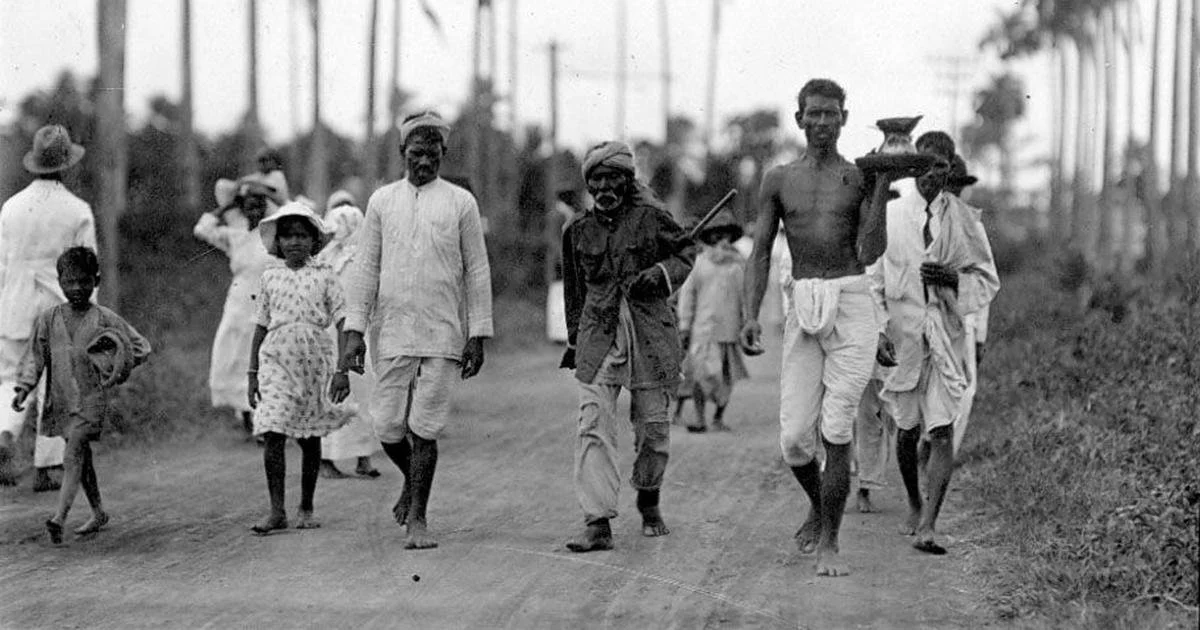
When slavery was abolished across the British Empire in the 1830s, the plantation economies of the Caribbean, Mauritius, Fiji, and South Africa faced a crisis. Their fields still needed hands. The solution the empire reached for was elegant in its bureaucratic simplicity and brutal in its human consequences: indentured labour, workers bound by contract to serve on plantations in distant colonies for a fixed term, usually five years, in exchange for passage, wages, and the theoretical right of return. The historians who study this period call it "a new form of slavery." The colonial administrators who ran it called it a labour scheme. The people inside it had their own word: narak. Hell.
The Word They Were Given
The word used for the workers was coolie, derived, ironically, from the Tamil word kuli, meaning wages or hire. First used by Portuguese merchants along the Coromandel Coast in the late sixteenth century, the term spread across the colonial world as Europeans competed for control of trade with the subcontinent. They used it for the men who carried loads at the docks. Gradually it broadened to mean anyone paid to do menial work.
When the British began enlisting indentured labourers after emancipation, "coolie" was the label they imposed on an enormously diverse group, workers from many castes, many occupational backgrounds, many regions of India. Most would never have used the word for themselves. They registered their protest in folk songs that were passed down for generations.
"Why should we be called coolies / We who were born in the clans and families of seers and saints."
— Folk song composed by indentured labourers in British Guiana
The word was inescapable and, critically, it was permanent. Even if an Indian worker in the West Indies became a milk-seller, a shopkeeper, a rice farmer, or, generations later, a teacher or a lawyer, they were still called a coolie. By the time of the 1893 ode to the "cooly girl", someone born in British Guiana, someone who had never been indentured at all, the word had evolved a new layer of meaning: not a job, but an essence. Someone exotic. Someone fundamentally foreign. And as tensions between African and Indian communities deepened over the indenture era and beyond, "coolie" became an ethnic slur, a challenge to Indians' claim to belong.
It was not until 1956 that Trinidad's future prime minister, Eric Williams publicly called on his countrymen to banish it from their vocabulary, alongside the n-word, as part of the anti-colonial struggle. Both words, he understood, were instruments of colonialism: tools designed to make the colonised hate each other and hate themselves.
The roots of displacement
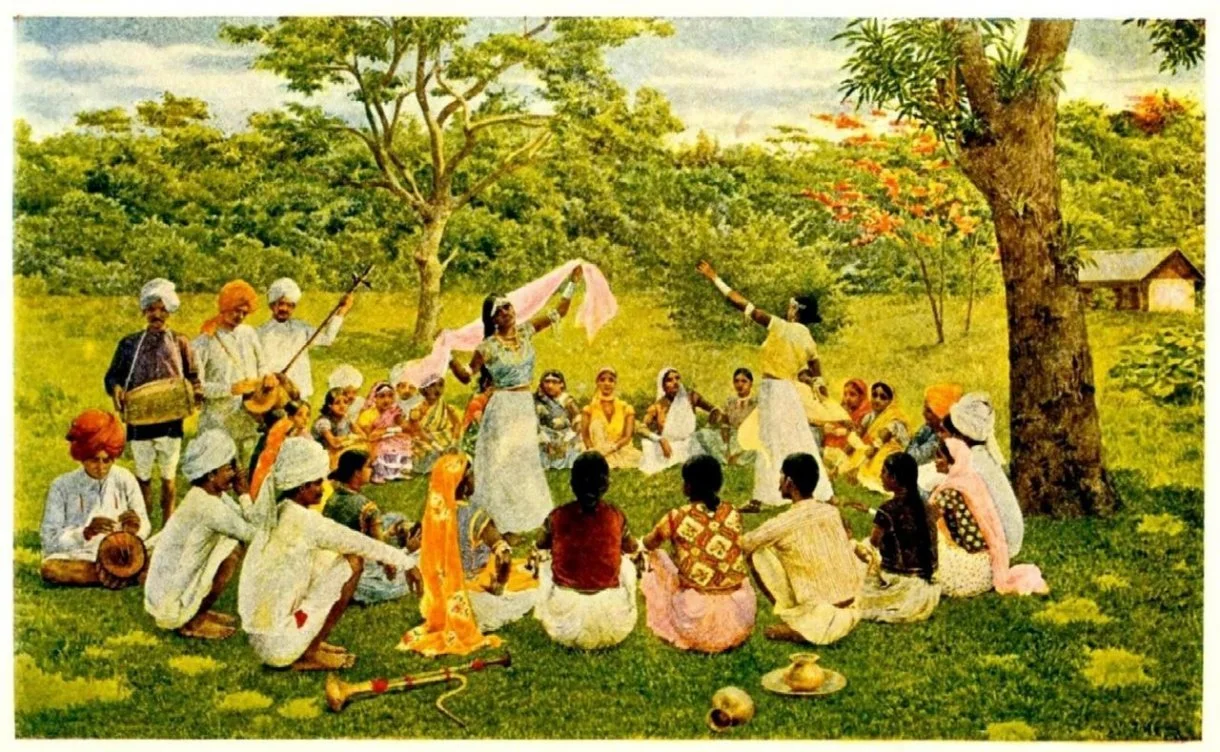
To understand who ended up on the indenture ships, one must first understand what had happened to the Indian countryside. British colonial policy had devastated the rural economy. Farmers were driven off their land to make way for opium cultivation. The Company's monopolies destroyed traditional industries. Thousands were reduced to destitution, and when the recruiter arrived in the village with promises of wages and prosperity, the desperation he found was not accidental; it was manufactured.
Some of those who boarded the ships were also former sepoys, soldiers fleeing the brutal British reprisals that followed the uprising of 1857. For the empire, the distinctions mattered little. Mutineers, criminals, the destitute, and the displaced were all processed through the same machinery.
The Indian novelist Amitav Ghosh described the migration of peasants from the Gangetic plains as "fate thrusting its fist through the living flesh of the land in order to tear away a piece of its stricken heart." It was the wrenching of people from everything they had known, not as an incidental consequence of policy, but as its very purpose.
The lie that started it all: recruitment
Recruitment for indenture was built on deception. Professional recruiters, despised figures in indentured folk memory, were paid per head and had every incentive to lie. They gave recruits the false impression they could return home from their jobs for the weekend. They promised work as easy as sifting sugar. They exaggerated wages and conjured images of lands flowing with milk, honey, and gold.
In the folk songs that survived them, recruiters are cursed and vilified: "Oh recruiter, your heart is deceitful. Your speech is full of lies! Tender may be your voice, articulate and seemingly logical, but it is used to defame and destroy the good names of people."
The targets were chosen with cold precision. Recruiters knew the customs of the Indian countryside and looked for women who had no one, no one to provide for them, no one to prevent them from going. Widows. Women who had left marriages. Women who had been cast out. A pamphlet published in Guiana in 1930 described female recruiters eavesdropping on conversations at wells and women's gathering places, collecting the secrets and gossip that could be used to trap vulnerable women into signing.
The regulations required that at least forty women travel for every hundred men on each indenture ship. This ratio was not about welfare, it was about ensuring that labourers would be more likely to remain in the colonies after their contracts expired. Women were considered essential to keeping men from demanding repatriation. They were, in the cold calculus of the system, an anchor.
The crossing
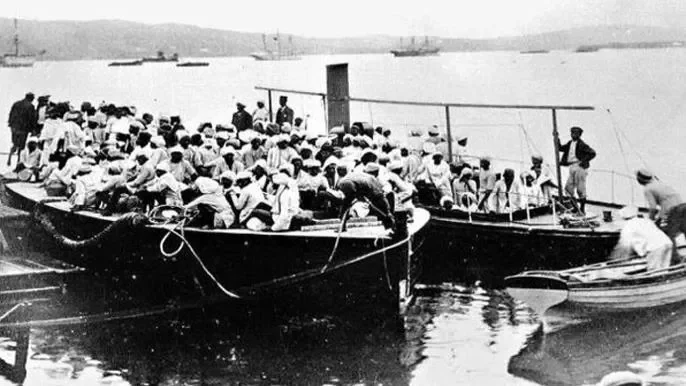
The ships crossing from Kolkata to Trinidad, from Madras to Mauritius, from ports across India to distant colonies were, in the words of historian Gaiutra Bahadur, "crossing in the wake of slavers." The mortality figures bear this out with horrifying precision. In just one year, 1856 to 1857, on the Kolkata-to-Trinidad route, the death toll was catastrophic.
Male deaths at sea was 12.3%
Female deaths at sea was 18.5%
Infant deaths at sea was 55%
Boys who died was 28%
Girls who dies was 36%
To contextualise those numbers: the mortality rate of enslaved Africans on the Middle Passage, long considered one of history's most horrifying atrocities, was estimated at around 12.5%. To be an indentured Indian labourer transported to the Caribbean on British ships was, as Shashi Tharoor has written, "to enter a life-and-death lottery in which your chances of survival were significantly worse than those of a shackled African slave."
Between 1519 and 1939, an estimated 5.3 million people were carried on British ships as what scholars call "unfree migrants." Approximately 58% were enslaved Africans, 36% were indentured workers, predominantly from India, and 6% were transported convicts. The empire moved bodies across the ocean on an industrial scale, and it did so with methodical bureaucratic organisation.
Life on the plantation
Those who survived the crossing found themselves housed in estate quarters, known as logies, with no latrines, no privacy, and no reliable source of clean drinking water. In the songs they improvised together on verandahs at night, the indentured compared their lodgings to stables. In some colonies, they used the words narak (hell) and kasbi ghar (brothel). The Reverend C. F. Andrews, who visited British Guiana a decade after the indenture system ended, described the logies he found there as "death-traps" and "filthy slum property" that should be condemned as unfit for human habitation.
The legal system that governed indentured workers was designed to keep them in place. A repressive framework regularly convicted more than a fifth of all labourers as criminals, often on the word of the overseers who exploited them. The offences were labour violations: arriving late, working too slowly, leaving the estate without permission. The punishment was imprisonment. Workers who attempted to assert themselves, refuse orders, or draw attention to abusive conditions risked being criminalised simply for existing.
The hierarchy on the sugar estate was racial, layered, and enforced from every direction. Indians occupied the bottom, below the English, Scottish, and Irish plantation managers, below the African-descended workers sometimes appointed as "drivers" or foremen over work gangs. From all of these directions, from overseers, magistrates, missionaries, the word "coolie" descended. It was the ambient language of debasement.
The women who crossed
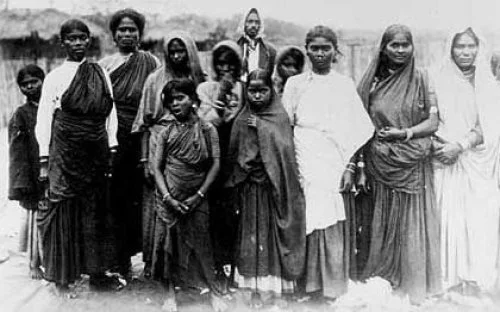
The experience of women in the indenture system deserves particular attention. The regulation requiring forty women per hundred men ensured that women were present in significant numbers, but the conditions they faced were shaped by both the violence of the plantation system and the social dislocation of having left India. Many of the women who emigrated were, by the standards of caste and village society, already outcasts: widows, women who had left abusive marriages, or those too poor to have any protection at all.
On the indenture ships, vessels crossing in the wake of slavers, with their documented history of exploitation, women faced particular vulnerability. The cramped quarters, the absence of privacy, the length of the voyage, and the power structures on board all created conditions for abuse. On the estates, the absence of latrines and private space meant that even the most basic dignities were denied.
Yet it is also the women of the indenture era who are among the most powerful figures in the historical record, not because the system treated them well, but because they endured, adapted, and in many cases led the cultural and familial continuity that allowed Indian identity to survive transplantation. The folk songs, the most intimate documents the indentured left behind, were often theirs.
The illusion of return
The right of return, passage home to India after five years of bonded labour, was written into the indenture contracts. In practice, it was almost entirely theoretical. The regulations were carefully engineered to make repatriation impossible for most workers. The right lapsed if not claimed within six months of the contract's expiry. The fare charged for the return voyage was set deliberately high, beyond what most labourers could afford. Clever bureaucratic tweaks ensured that the theoretical right could rarely be exercised.
The few documented cases of successful return are so rare as to function as exceptions that prove the rule. One of the most poignant is a handful of survivors who returned to India from a shipload transported to the Caribbean island of St. Croix in 1868, a voyage on which the majority of passengers had perished.
For almost everyone who boarded those ships, the journey was permanent. They were cut off from their families, their villages, their gods, and the land that had defined them for generations. They arrived in places that did not want them as people, only as labour, and were expected to disappear into the cane fields and stay there.
"It is stated everywhere that it is a hard thing to leave one's motherland. This is everywhere admitted, and several persons told me that they would have emigrated long ago but for the fear they had of breaking the tie which had bound their families to the same spot for generations."
— Gaiutra Bahadur, Coolie Woman
Between 1825 and 1917, a span of over eight decades, the British indenture system forcibly moved an estimated 1.9 to 3.5 million workers across the globe, shipping them to more than twelve colonies, including Trinidad, Fiji, Mauritius, South Africa, Guyana, and Jamaica. The system was not merely exploitative in transit; once on the plantations, it criminalised the workers it had transported. More than 20% of indentured labourers were convicted as "criminals" every year, most often for nothing more than labour violations, on the word of the very overseers who exploited them.
Beyond Mauritius, Indian workers were deployed across the entire British colonial world: building railways in Uganda, clearing jungle in Malaya, making Burma the rice bowl of Southeast Asia, developing the commercial infrastructure of colonies in China and Africa. They were, as Tharoor writes, "cogs in the wheels of the imperial machinery", essential to the profitability of the empire, invisible in its official story.
After indenture: discrimination continued
When the indenture system finally ended in 1917, and the last contracts were cancelled in 1920, the workers and their descendants did not find discrimination ending with it. In Trinidad, perhaps the most documented case, the post-indenture era brought a new set of exclusions.
Hindu religious marriages were illegal until 1945. Because Hindu priests were not recognised as civil marriage officers, couples who married under religious rites had to complete a separate legal registration, and most did not. As a result, the great majority of Hindu children born before 1945 were technically illegitimate under colonial law, with real consequences when parents died without formal wills. Property slipped away through legal mechanisms that the state had deliberately left in place.
No state funds were allocated to Hindu schools until the late 1940s. Christian missionaries had long attacked Hinduism and Islam, using what the historical record describes as "unfair means" to secure conversions, pressuring children in denominational schools, deriding their accents, their poverty, their "Indian" lunches. Hindu and Muslim cultural events received far less government support than those connected to the Afro-Trinidadian community.
In the post-independence era, under the People's National Movement (PNM) governments that dominated from 1956 to 1986, not a single Hindu Trinidadian held Cabinet office. Appointments and promotions in the public service were blocked. Scholarships went predominantly to PNM supporters. The pattern of exclusion was so systematic that some historians have described it as approaching apartheid in its effects, if not its formal structure.
Building something from the wreckage
Shut out of government, the public service, and formal institutional power, Indo-Trinidadian families turned to education and commerce. Under B. S. Maraj and the Maha Sabha, the organisation that would become a major voice of the Hindu community, scores of Hindu primary schools were built in the 1950s, many of them humble structures in rural villages. Eric Williams, then campaigning for independence, publicly derided these schools as "cow sheds." The phrase became, over time, an ironic emblem: the cow sheds produced lawyers, doctors, and professionals who transformed their communities from within.
By the 1980s, Indo-Trinidadians were well represented in commerce and industry, and probably overrepresented in law and medicine, precisely the professions that required no government favour to enter, only qualifications. The long road from the cane field to the courtroom was travelled through deliberate, sustained investment in the next generation.
The political shift came gradually. In 1986, Basdeo Panday became the first Indo-Trinidadian to serve in Cabinet, in a ceremony that had to be halted because no copy of the Bhagavad Gita could be found at President's House. In 1995, he became Prime Minister. In 2010, Kamla Persad-Bissessar became the first and second woman. The communities that had arrived as human cargo, been worked to death, and been denied legal marriage and state schooling had finally arrived at the table where decisions were made.
What the experience created
The Indian diaspora that exists today across the Caribbean, Mauritius, Fiji, South Africa, and East Africa is largely the legacy of indenture. These are communities formed not by choice but by coercion, and yet they created something. Languages changed. New musical forms emerged, blending Indian classical and devotional traditions with Caribbean and African rhythms. New cuisines were invented out of what was available. New identities were forged that were neither Indian nor colonial, but something distinct, something that had not existed before.
What the crossing created, beyond suffering, was what Shashi Tharoor calls the "Brotherhood of the Boat", a shared sorrow between those transported as enslaved people and those transported as indentured labourers, expressed in poetry, shared folklore, and above all music that persists to this day. The system that tried to erase identities ended up forging new ones.
"That we have survived is only because of the strength of our religion, our culture and the dedication of our people."
— Sat Maharaj, Maha Sabha, 2010
The India that the indentured labourers left behind has since built one of the world's most celebrated diasporas, courted, cultivated, celebrated as a source of national pride and soft power. The first Indians to go abroad in any significant numbers were the coolies. They were denigrated, transported, worked, criminalised, and denied the right to name themselves. That the communities they built have survived, and in many places flourished, is not the empire's legacy. It is theirs.
The history of indenture is not a footnote. It is the foundation on which much of the modern Indian diaspora stands, and it demands to be remembered with the same seriousness as the history of slavery, of colonial extraction, and of all the other mechanisms by which the British Empire turned human beings into instruments of profit.
Sources
Coolie Woman: The Odyssey of Indenture by Gaiutra Bahadur
An Era of Darkness: The British Empire in India by Shashi Tharoor
Inglorious Empire: What the British Did to India by Shashi Tharoor
Ethnic Histories: The Indocentric Narrative of Trinidad's Past
