Team Itiha Team Itiha

The "Infidels" Who Defended a Golconda Sultanate: The Forgotten Story of Akkanna and Madanna

The untold story of Akkanna and Madanna, the brothers who reformed the Golconda Sultanate, allied with Shivaji Maharaj, and fought to the death against the Mughal Empire.

In 1677, two Brahmin ministers did the unthinkable: they convinced a Muslim Sultan to fund the revival of Hindu temples across the Carnatic. But their plan went deeper than religious patronage. They were using the Sultan’s own gold to systematically dismantle foreign control and empower local Deccani of Golconda Sultanate.

When Chhatrapati Shivaji Maharaj arrived in Hyderabad to seal this alliance, the implications terrified the Mughal Emperor, Aurangzeb. From his throne in Delhi, he branded the brothers "infidels" and  eventually declared a brutal holy war to crush them.

They weren't kings or generals. They were accountants who stole a kingdom back from its colonizers. This is the story of Akkanna and Madanna.

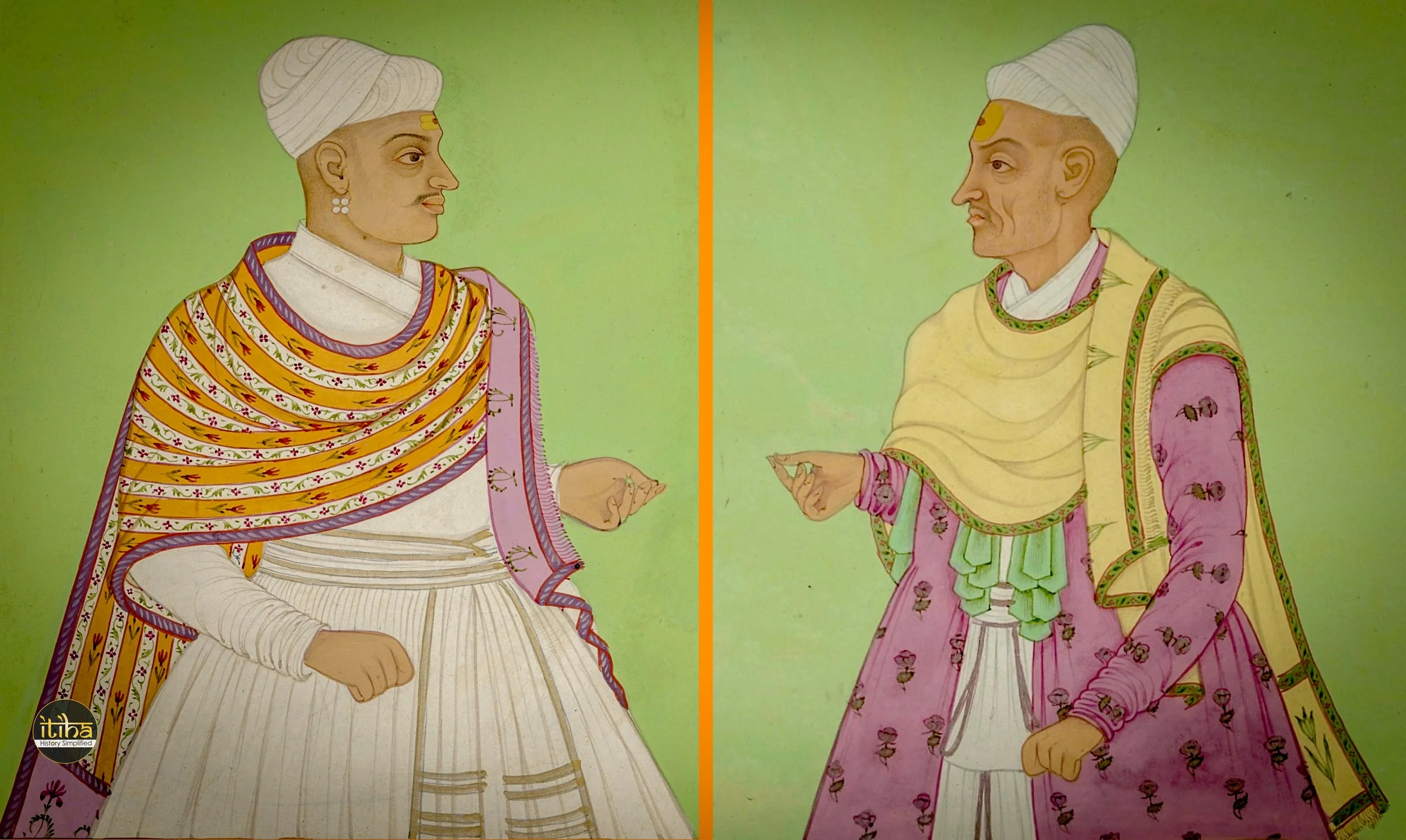
Portrait of Madanna and Akkanna from The Witsen Album

Madanna and Akkanna were two Brahmin brothers who rose to prominence in the Golkonda sultanate. Ultra Patriots of the land hate by Mughal Emperor Aurangzeb, His chroniclers used harsh words against these brothers.

The Persian Colony

To understand why these brothers were so dangerous to the status quo, you have to meet them at their lowest. Born Akkarasu and Madhava Bhanu ji Panthulu in Hanumakonda, they grew up in absolute poverty. They were Niyogi Brahmins—a sub-caste that traditionally took up the sword and the pen rather than the priesthood. But above all, they were Mulki—true sons of the soil.

While they scrapped for a living in the dusty markets of the Deccan, the elite looked toward Iran.


Before Aurangzeb conquered the Deccan, Mir Jumla conquered its wealth from declining Vijayanagara Empire

For 160 years, the Golconda Sultanate had been a Persian colony in spirit. The Qutub Shahi rulers viewed themselves as junior partners to the Safavid Empire of Iran. The Shah’s name was read in Friday sermons. The high offices—Revenue, Treasury, Military, Judiciary were a closed club for the Afaqi (Westerners). Persians, Arabs, and Turkomans held a monopoly on power.

Ships plied annually between the Qutub Shahi ports and Bandar ‘Abbas on the Persian Gulf. Traders and mercenaries arrived from Iran, were given warm welcomes, extracted massive wealth, and left.

The archetype of this era was Mir Jumla. The son of a poor oil-seller from Iran, he used the Golconda state machinery to become the richest man in the Sultanate. He owned the diamond mines, controlled the global trade, and even licensed the export of native Hindus as slaves to European colonies. When he was finished plundering, he defected to the Mughals, taking the legendary Kohinoor diamond with him.

To men like Mir Jumla, the Deccan was just a resource to be harvested.

Akkanna saw this clearly. In a rare, candid moment with a Dutch merchant, he drew a sharp line in the sand:

...you yourself can imagine which government serves the king best, ours or that of the Moors [Muslims]; ours being fullheartedly devoted to the welfare of the country, while we are not people who have or seek other countries, but that of the Moors is only to the end of becoming rich and then to leave for those places which they consider to be either their fatherland or holy. - Akkanna (1683)
— Xenophobia in seventeenth-century India, Kruijtzer, G.C. (2008)

Portrait of Akkanna

Akkanna’s comment with Dutch trader was a remarkably progressive statement, It was a proto-nationalist sentiment in a feudal age. Akkanna and Madanna wanted to stop the bleeding.

The Coup of the Clerks

Madanna saw the rot from the inside while working as a secretary for the Finance Minister, Syed Muzaffar. He was a "man of the pen," mastering the complex bookkeeping of the state and learning Persian better than the foreigners who ruled him.

He eventually caught the eye of the Sultan, Abu’l Hasan, who felt his authority waning under his overbearing Finance Minister, Syyed Muzaffar. In 1674, Sultan took Madanna under his confidence and made his move. In a bloodless political maneuver, Madanna helped the Sultan regain control of his own government, ousting his former boss. 

The Sultan appointed Madanna as Peshwa (Prime Minister), granting him the title Surya Prakasa Rao. After nearly two centuries, a native Hindu had broken the glass ceiling. The Persian nobility was stunned. The sons of the soil were finally in control.

Fixing the Broken Engine: Ijaradari System (Tax Farming)

When Madanna took the reins, the economy was a nightmare. The state relied on the Izara system tax farming. Villages and ports were auctioned to the highest bidder. These Ijaradars paid the state upfront and then squeezed the peasantry for profit.

Madanna rode in a palanquin, escorted by armed guards

Akkanna with his armed guard.

If a district was auctioned for one lakh, the revenue farmer extracted ten lakhs. They didn't care about famines or harvests.Taxes were extracted irrespective of produce.  The wealth of the countryside was siphoned into Hyderabad to be enjoyed by Persian nobility(Afaqi), while the natives starved.

The human cost was staggering. In 1659 alone, 22,000 parents were so desperate they sold their children into slavery or allowed them to be emasculated as eunuchs near Golconda Fort just to survive.

Madanna’s solution was radical. He abolished the Izara system. He replaced short-term auctioneers with salaried government officials, local Hindus and Deccani Muslims who had a stake in the land’s future were prioritized in Government employment. . In deserted villages, he offered a nine-year zero-tax policy to entice farmers back from the forests.

He then turned to the diamond mines, where 60,000 people worked in near-slavery. Madanna centralized the mines under the state, providing workers with thatched-roof homes and real salaries.

Taming the European Menace

While rebuilding the heart of the Deccan, the brothers turned their gaze to the coast. The Dutch, French, and English had long treated the Coromandel Coast like a playground, bribing their way out of taxes.

Madanna changed the rules.

When the English Governor, Baron Langharn, tried to evade taxes through the usual bribes, Madanna placed his nephew, Linganna, in charge of the strategic Poonamallee district. Akkanna personally audited the English East India Company’s records. When the English defied them, Madanna ordered a total blockade of Madras.

Suddenly, the "arrogant" English was cut off. Realizing bribery was dead, they submitted and paid their fines. Madanna repeated these blockades in 1678 and 1680. He treated native and foreign traders as equals, shattering the European notion of racial superiority. It is no wonder European records from this time are full of complaints about "Brahmin dominance."

The Grand Strategy: The Chhatrapati Shivaji Alliance

While the Persian nobility wanted to fight the Marathas, Madanna saw the bigger picture. He viewed Chhatrapati Shivaji Maharaj not as a rival, but as the protector of their civilization.

Madanna convinced the Sultan to fund Shivaji’s mission to restore Hindu power in the South.

to put a part of Karnataka under Hindu domination and to make himself a powerful protector of Shivaji
— Francois Martin, the French governor of Pondicherry

In March 1677, Shivaji Maharaj arrived in Hyderabad. The brothers received him at the city gates. They subsidized his entire Southern Campaign: The Dakshin Digvijaya, using the Sultanate’s treasury and artillery. Because of this alliance, Shivaji was able to repair and revive countless temples across South India that still stand today.

To protect this vision, Madanna decentralized the power of the unreliable Jagirdars and built a professional "Shahi Army" of 40,000 cavalry, paid directly by the treasury. He doubled the salaries of local soldiers and appointed his brother Akkanna as Commander-in-Chief.

The Emperor Aurangzeb Rage

To Aurangzeb, this was intolerable. A Shia Sultan allied with a "Maratha infidel," guided by Brahmin ministers who were building temples? It was a declaration of war against his beliefs.

In 1681, Prince Akbar, the Emperor’s own son, sought refuge with Chhatrapati Sambhaji. This spark brought the full fury of Aurangzeb to the Deccan. Aurangzeb arrived in the Deccan with a vast army, expecting a quick victory. But the Deccan stood together. Madanna guided Sultan Abu’l Hasan to propose a triple alliance: The Marathas would reinforce Bijapur, while 40,000 Qutub Shahi horsemen would meet the Mughals in the field.

In August 1685, the Mughal army marched on Golconda. Madanna dispatched a force under the command of Muhammad Ibrahim, Shaikh Minhaj, and his own nephew, Rustam Rao. For four grueling months, the Golconda army held the Mughals to a bloody stalemate at Malkhed.

Aurangzeb realized that valor alone would not win this war only gold would.

The Emperor targeted the greed of the Commander-in-Chief, Muhammad Ibrahim. He bought the general’s loyalty with a massive bribe and promises of Mughal titles. Ibrahim defected, leaving the Qutub Shahi forces leaderless and betrayed.

The Last Stand

The Mughals entered Hyderabad on October 8, 1685. They looted the city unopposed.

The Sultan, confused by the betrayal, fled to Golconda Fort. Inside the walls, corrupt officials and extremists saw their opening. They blamed the "Brahmin Ministers" for the ruin. A loyal slave overheard a queen urging the Sultan to execute the brothers to appease the enemy—a sentiment supported by the very elites Madanna had displaced.

The end was brutal. Akkanna and Madanna were murdered while returning to their home. Their bodies were tied to horses and dragged through the streets. Madanna’s head was sent to Aurangzeb as a trophy; Akkanna’s head was crushed under the foot of an elephant.

Murder of Akkanna & Madanna paintings bhy Rijksmuseum, Amsterdam

Akkanna & Madanna Dead bodies dragged through the streets of Hyderabad by a mob, Dutch Paintings, Source Rijksmuseum

A massive genocide followed. Brahmin homes were burned, and countless Hindus were slaughtered in the chaos. Aurangzeb lived up to his expectation as the “archenemy of Brahmins”

Aurangzeb called them bigots. History books largely ignored them. But Akkanna and Madanna were never anti-Muslim; they were ultra-patriots who believed the wealth of the Deccan belonged to the people of the Deccan . They were the last shield of the kingdom.

When they fell, Golconda fell. Within a year, the Sultanate was erased from the map, absorbed into the Mughal Empire

Read More