From Religion to Caste, From Geography to Generation – The New Politics of Dividing India
Written by Abhisek Iyengaar
Edited by pranav md
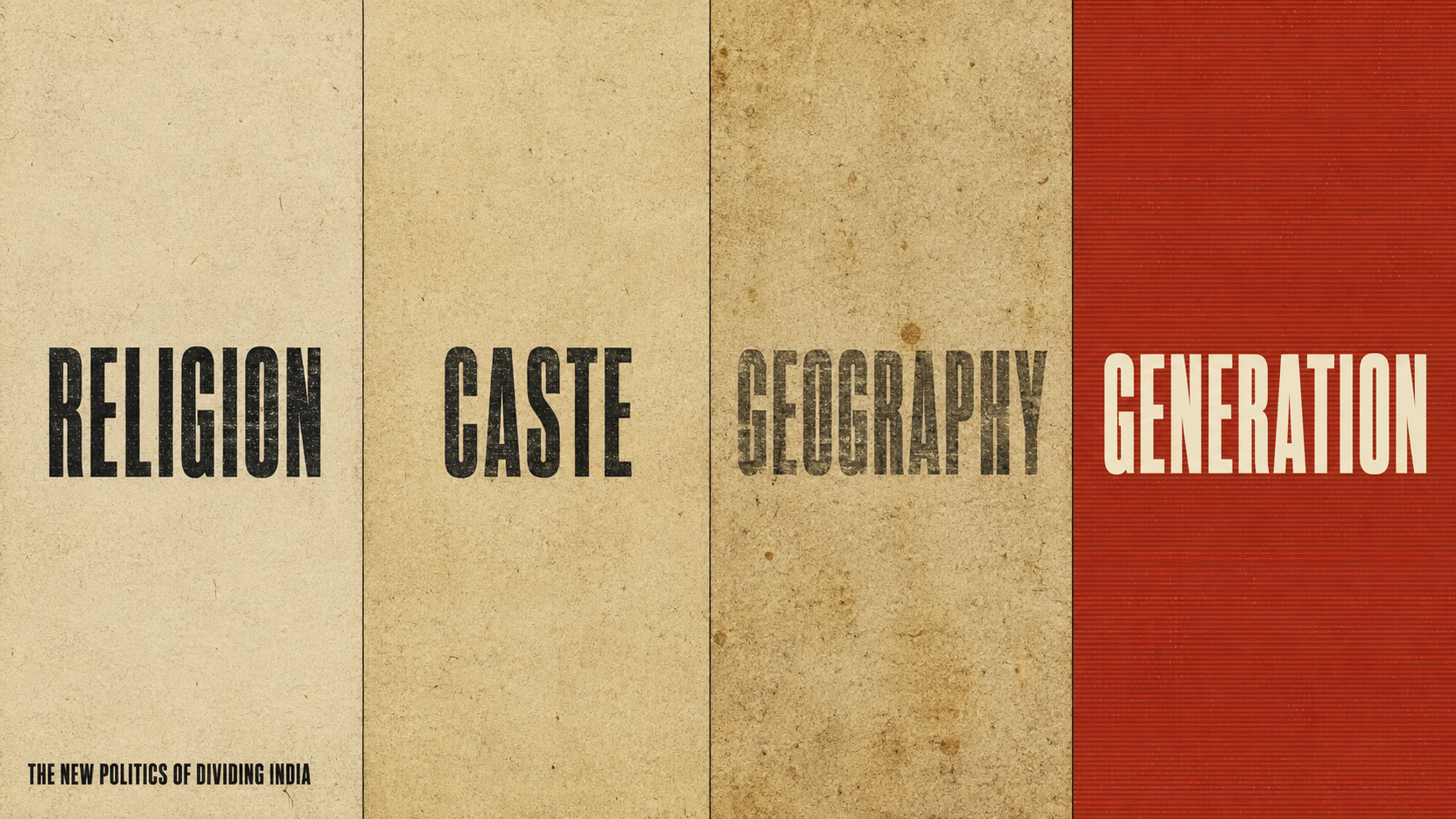
Attempts to divide India are not new. The country’s enormous social diversity has repeatedly been used as a political tool—sometimes in the name of religion, sometimes caste, and at other times through geographical identities such as North versus South or East versus West. But today, another dimension is quietly entering the politics of division: generation.
The language of “Boomers versus Millennials,” “Millennials versus Gen Z,” and “the younger generation versus the old generation” may appear harmless when used casually on social media. But when generational identities are deliberately transformed into political identities, the consequences can be far more serious.
India’s greatest strength has always been its continuity between generations. The experience of grandparents, the struggles of parents and the energy of young people are not opposing forces. They are different parts of the same social fabric. Yet social media discourse increasingly tries to turn this relationship into a simplistic “us versus them” narrative.
It is easy to tell young Indians that their problems are the fault of previous generations. It is equally easy to tell older generations that today’s youth are inexperienced, irresponsible or incapable of understanding reality. Both arguments may generate engagement online, but neither captures the complexity of Indian society.
Every generation has grown up under different circumstances. Millennials experienced liberalisation, globalisation, the arrival of the internet and India’s rapid economic transformation. Gen Z has grown up almost entirely within a digital environment. The older generations experienced a very different India, shaped by scarcity, institutional limitations and a vastly different economic and technological landscape.
Different experiences do not automatically make different generations enemies.
But turning those differences into political fault lines is one of the oldest tricks in politics.
And now that strategy has acquired a powerful new instrument: social media.
Recent developments in India have demonstrated just how quickly generational identity can become part of political discourse. The recent youth-led protests associated with the so-called Cockroach Janta Party have been widely described as a Gen Z political phenomenon. At the same time, commentators have questioned whether it is really accurate to reduce a broader social movement to one generation. Recent reporting has also highlighted the growing political visibility of Gen Z while pointing out that its representation in Parliament and state legislatures remains extremely limited.
That distinction matters.
The young people of today did not create the digital world from nothing. The smartphones, social-media platforms, digital businesses, online education systems and technological infrastructure they use were built over decades, with Millennials and earlier generations playing a major role. At the same time, dismissing the concerns of young people would be equally foolish. Their questions about employment, education, examinations, technology and the future are legitimate.
One generation does not have to destroy another for society to move forward.
The danger is that social media itself rewards division. A sharp statement against another generation is more likely to generate attention than a nuanced discussion about shared problems. Algorithms can repeatedly expose people to opinions similar to their own, creating ideological bubbles and making social divisions appear much larger and more permanent than they actually are.
This is where the danger becomes political.
Yesterday, Indians were divided in the name of religion.
Then came caste.
Then region and geography.
And now we risk being asked another question:
“Which generation are you?”
If this becomes a political identity, there will be no end to the divisions.
Tomorrow, we may hear that Millennials are responsible for everything wrong with India, that Gen Z is incapable of understanding the country, or that Boomers are responsible for holding society back. Such labels may be entertaining on Instagram, but they are dangerously inadequate as political arguments.
A 60-year-old can be technologically progressive. A 20-year-old can hold deeply conservative views. A Millennial can be more radical than a Gen Z citizen, while a Gen Z citizen can be more traditional than someone twice their age.
Age is not an ideology.
A birth year does not determine political wisdom.
This distinction is particularly important as Gen Z becomes an increasingly significant political constituency. Current reporting suggests that Gen Z accounts for roughly a quarter of India’s population, while its representation in Parliament and state legislatures remains very small. That is a legitimate democratic issue: young people need greater political participation. But increasing representation should not mean creating a political war between generations.
India does not need a generational war. It needs a generational conversation.
Young Indians should have opportunities, but they do not need to reject experience. Older generations deserve respect, but they cannot demand that every new idea be judged by the standards of the past. Millennials should not forget the struggles of their time, and Gen Z should not dismiss the struggles that came before them.
For political forces, however, generational division can be extremely convenient.
A population arguing with itself is a population asking fewer questions of those in power.
If young people are busy blaming Millennials, Millennials are busy blaming Boomers, and Boomers are busy blaming Gen Z, then questions about jobs, education, healthcare, governance, corruption, economic inequality and institutional accountability can quietly move into the background.
That is precisely why we must be cautious.
Dividing India through religion is dangerous.
Dividing India through caste is dangerous.
Dividing India through geography is dangerous.
And turning generations into opposing political camps is equally dangerous.
Parents should not teach their children to despise an older generation. Older citizens should not dismiss young people simply because they communicate differently. Gen Z is not the enemy of Millennials, and Millennials are not a threat to Gen Z. They are citizens of the same country who happened to grow up in different periods of its history.
India does not need one generation to defeat another.
It needs every generation to contribute something.
The young have energy and new questions. The middle generations have experience of a rapidly changing India. The older generations carry memories, institutional knowledge and lessons from a different era. A mature democracy should combine all three rather than turn them against each other.
India does not always need physical borders to be divided. Sometimes all it takes is an invisible line in people’s minds—the line between “us” and “them.”
So the next time someone says, “This generation is the problem,” perhaps we should ask a more important question:
Is the problem really the generation—or is it the politics that wants us to see another generation as the enemy?
India needs a new generation. It also needs the wisdom of previous generations. Above all, it needs the understanding that both belong to the same nation.
The face of divisive politics may keep changing—from religion to caste, from geography to generation—but the objective remains the same: keep people fighting each other while the real questions remain unanswered.
The real challenge before India is therefore not to decide which generation should win.
It is to ensure that India itself does not lose.
About author
Abhishek Iyengar is a theatre practitioner, writer, filmmaker and cultural professional based in Bengaluru. With over two decades of experience in theatre and the arts, he has written, directed and performed across various platforms. His interests extend beyond the performing arts to society, politics, culture and contemporary issues. Through his writing, Abhishek seeks to question conventional narratives, challenge assumptions and spark meaningful conversations.

 Instagram